
The Illusion of Control in Maintenance Budget Planning
Every year, maintenance managers across industries sit in front of empty Excel spreadsheets labeled “Annual Budget,” and ask themselves how to make numbers work that were never based in operational reality.
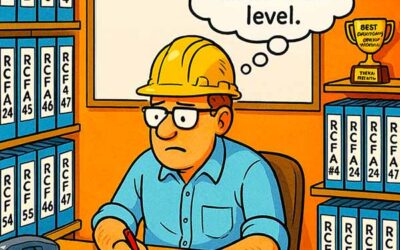
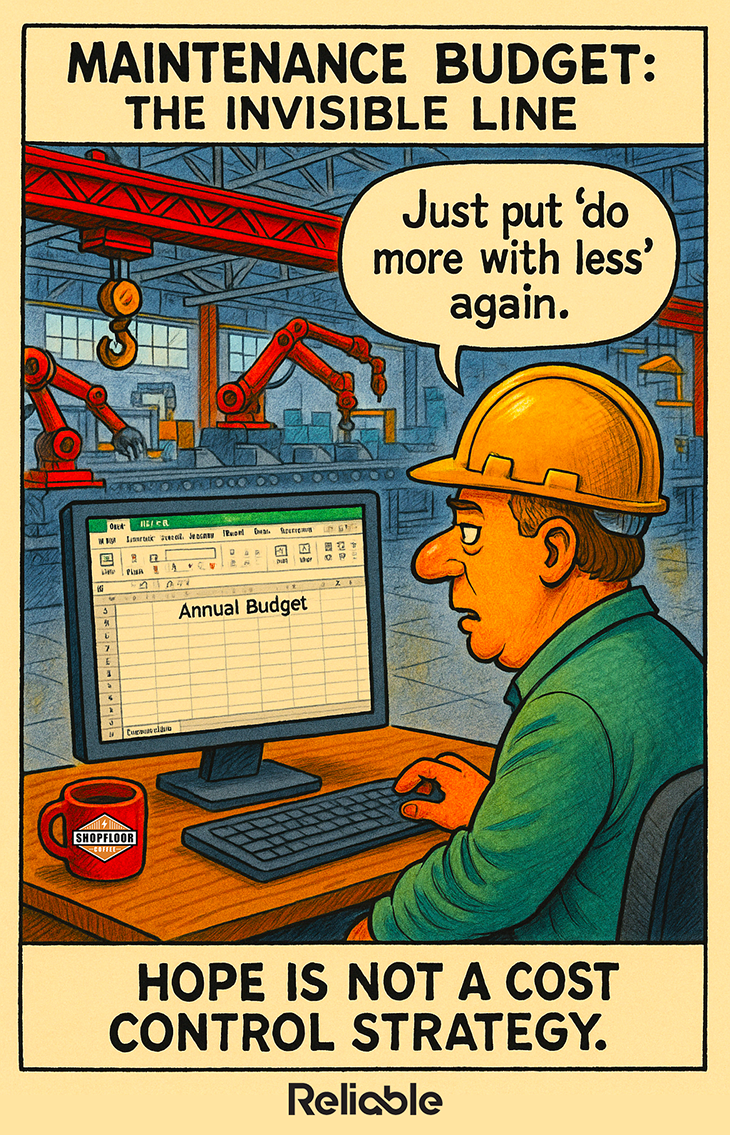
The cartoon shows a familiar scene: a worker told to “just put ‘do more with less’ again.” It’s not satire—it’s an unspoken policy. Unrealistic maintenance budgets don’t just strain teams—they quietly erode the foundation of reliability, safety, and cost control.
Executives often draw a hard line on spending without acknowledging the fixed and variable costs required to maintain equipment health. When frontline teams are pressured to accept that line without input or feedback, it sets the stage for reactive maintenance, increased unplanned downtime, and chronic inefficiency. Hope becomes the strategy. And as the cartoon reminds us: hope is not a cost control strategy.
Why Unrealistic Maintenance Budgets Fail Over Time
When maintenance budgets are dictated top-down without alignment to actual asset needs or risk profiles, they create what Drew Troyer would call “cost illusions.” These illusions may look good in short-term financials but lead to long-term performance failures.
Key failure mechanisms:
- Deferred Maintenance Backlog: Skipping inspections or deferring small fixes often escalates into expensive failures.
- Loss of Predictive Capability: Budget cuts often eliminate condition monitoring, reducing the ability to forecast failures.
- Workforce Attrition: Chronic underfunding leads to overworked teams and higher turnover, which in turn causes loss of tribal knowledge and increased errors.
By ignoring the true requirements for asset reliability, unrealistic maintenance budgets fail to deliver sustainable performance. In most cases, these budgets look efficient on paper, but in practice, they undermine the very metrics they aim to protect: uptime, safety, and cost-per-output.
The Hidden Costs of “Do More with Less”
“Do more with less” isn’t a strategy. It’s an abdication of leadership.
When budget targets are set arbitrarily or in isolation from asset performance data, it forces maintenance teams into a lose-lose proposition. They’re expected to deliver uptime without the tools, time, or talent necessary to do it well. The cartoon’s phrase—“The Invisible Line”—is apt: everyone feels the budget constraint, but no one can find where it was justified.
Hidden costs include:
- Reduced Mean Time Between Failures (MTBF): Starving PMs and PdM tasks directly shrinks MTBF.
- Increased Emergency Work: Emergency repairs often cost 3–5x more than planned ones.
- Unquantified Risk Exposure: Safety, environmental, and production risks increase when assets run beyond their known limits.
These hidden costs accumulate invisibly—until they don’t. And when something breaks catastrophically, the post-mortem rarely blames the budget. But make no mistake: the budget was the root cause.
Building Defensible Maintenance Budgets That Align With Reality
The antidote to unrealistic maintenance budgets is a process that blends financial discipline with asset-centric thinking. Start by reframing the budget as a performance plan, not just a cost control tool.
Best practices:
- Risk-Based Budgeting: Use criticality rankings to justify budget needs. Assets with higher risk get more attention and resources.
- Zero-Based Justification: Instead of rolling last year’s budget forward, build from zero based on actual task needs and risk exposure.
- Maintenance Maturity Assessments: Evaluate your current practices against best-practice benchmarks. This gives credibility to your funding requests.
- Cross-Functional Collaboration: Involve operations, finance, and reliability engineering in budget planning. You’ll gain buy-in and eliminate blind spots.
Framing budget discussions around asset risk and lifecycle cost—not just spend ceilings—leads to smarter decisions. Financial gatekeepers care about ROI. Show them how your maintenance investments protect revenue, reduce downtime, and lower TCO.
When Budgeting Becomes a Culture Problem
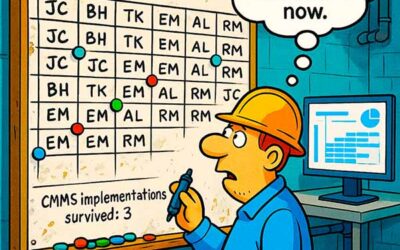
The cartoon captures a subtle but pervasive culture problem: when leadership consistently underfunds maintenance and expects miracles, it creates a cycle of disempowerment and cynicism. The result? Technicians stop reporting issues. Planners fudge schedules. Engineers abandon improvement projects. Everyone becomes a short-term firefighter.
Budgeting is not just an accounting function—it’s a cultural signal. It tells your team whether asset care is valued or ignored. And over time, that message reshapes behavior far more than any strategy deck or safety slogan ever will.
If your organization is stuck in the “do more with less” loop, you’re not just running lean—you’re running blind. Break the cycle by making your next budget cycle a chance to recalibrate expectations with reality. Then measure what matters: not just cost savings, but reliability outcomes.