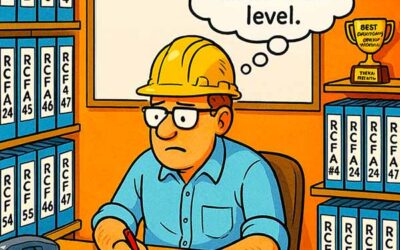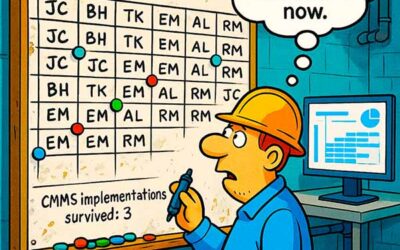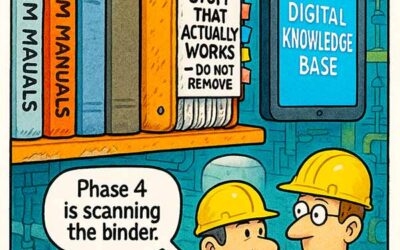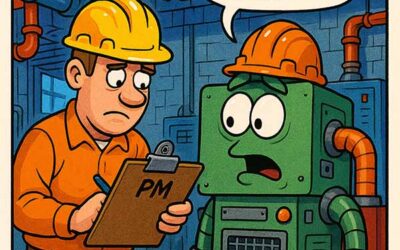

You fix the machine before it breaks. You catch the developing fault in time. The equipment runs clean, temperatures stay nominal, and nothing fails on your watch. Then someone in accounting asks why the maintenance budget keeps going up.
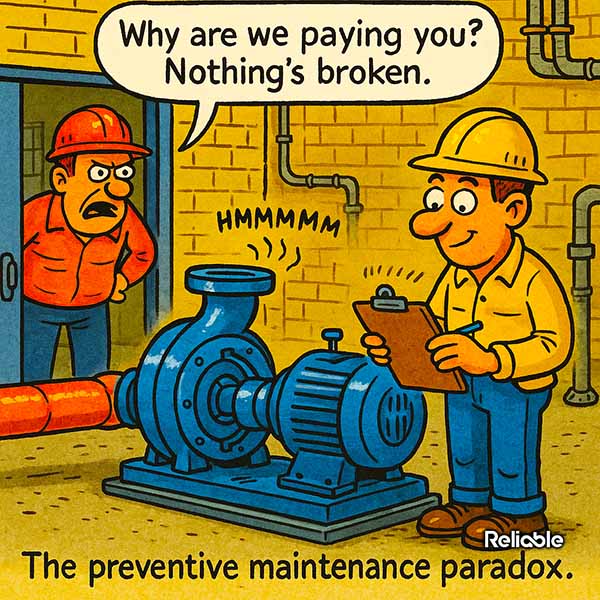
Welcome to the preventive maintenance paradox. The better you perform, the less visible your results become. Successful prevention looks, from the outside, like nothing happening. And in organizations that only measure what goes wrong, ‘nothing happening’ is hard to defend.
Most people frame this as a morale problem, but the root cause is measurement. Until organizations track cost avoidance with the same rigor they apply to repair costs, maintenance teams will keep fighting for credibility they’ve already earned.
The Invisible Win
Every time a technician spots a developing fault before it becomes a failure, that’s real money saved. We’re talking avoided emergency labor rates, avoided production downtime, avoided expedited freight on critical parts, and avoided secondary damage that turns a bearing swap into a full shaft replacement.
None of that shows up on the budget spreadsheet. Finance sees maintenance labor: $X. They don’t see the 14-hour unplanned shutdown that was never scheduled, or the impeller that didn’t get destroyed, or the gearbox that didn’t seize because someone caught a lubrication issue in week three.
Reactive maintenance is easy to justify precisely because failures are visible events with costs attached. A failed pump equals a production stop equals lost revenue. You can point at that, do the math, and make the case. Prevention looks different. It gives you Tuesday afternoon where everything just ran.
Signs your PM program is working (that nobody’s measuring):
- Mean time between failures is trending upward on your critical assets
- The ratio of planned work orders to emergency work orders keeps improving
- You’re predicting parts usage instead of reacting to it
The problem is that most reliability teams don’t track these things consistently, and even when they do, the data doesn’t make it into the conversations that matter. A maintenance planner knows the failure history cold. The VP of Operations is looking at a cost variance report.
The better you prevent failures, the harder it becomes to justify the program that’s doing the preventing.
Closing that gap is the core challenge of modern reliability management. It requires translating technical outcomes into financial language, and doing it before budget season, not during.
The organizations that do this well have one thing in common: they’ve made cost avoidance a first-class metric, tracked with the same rigor as repair costs. That’s a cultural shift, and it starts with the maintenance team making the case clearly and consistently.
A monthly reliability report delivered to plant leadership, summarizing cost avoidance alongside repair costs, does more work than any single budget conversation. It keeps the value of prevention visible between crises, when attention is easier to hold and decisions are less reactive.
Building the Financial Case
The math isn’t complicated, but it requires discipline. Start with the true cost of a failure on each critical asset: production loss per hour, average repair cost, average time to restore. That number, multiplied by the historical failure frequency without PM, gives you a baseline.
From there, subtract the annual cost of your PM program for that asset. What’s left is the value the program generates. On most critical equipment, the ratio is somewhere between 3:1 and 10:1 in favor of prevention. You won’t know your number until you build the model.
Components of true failure cost:
- Lost production revenue during downtime (hourly rate multiplied by mean time to repair)
- Emergency labor premiums and overtime costs
- Expedited parts and overnight freight on critical components
- Secondary damage to connected equipment or systems
- Quality losses from off-spec product produced during degraded operation
The organizations that make this case most effectively document failures in enough detail to pull real numbers. ‘The pump failed at 2 AM on a Monday. Production was down 7.5 hours. We paid $4,200 in overtime, expedited a seal kit for $380, and lost approximately $42,000 in production.’ That’s a number you can work with.
Most PM programs are underfunded because the value hasn’t been quantified in terms the organization recognizes. The failure cost data is there. It just needs to be assembled.
That level of documentation takes effort, but it pays off in every future budget conversation. You’re pointing at specific events with specific costs, not arguing about the abstract value of maintenance.
This approach also changes the framing. Instead of asking ‘why should we spend more on maintenance,’ the question becomes ‘what does it cost us when we don’t?’
Making Failure Visible
One underused tactic is the near-miss log. Every time a PM route catches something that would have become a failure, document it. Note what was found, what the likely outcome was if left unaddressed, and what it would have cost to address after the fact.
Over a year, that log becomes a compelling document. A hundred near-misses, with estimated cost avoidance attached to each, tells a story no budget spreadsheet can tell on its own. It puts a face on prevention.
Some organizations take this further, maintaining a reliability dashboard that tracks key metrics in real time: overall equipment effectiveness, planned-to-unplanned ratio, PM completion rate, and cost avoidance year-to-date. When those numbers are visible to leadership, the conversation about maintenance value becomes easier to have.
Metrics worth tracking to demonstrate PM program effectiveness:
- PM completion rate (target: above 95%)
- Planned versus unplanned maintenance ratio
- Mean time between failures by asset class
- Cost avoidance documented through the near-miss log
Getting these metrics in front of the right people consistently is half the battle. The other half is framing them correctly. A PM completion rate of 97% sounds like an operational stat. ‘We completed 97% of scheduled PMs last quarter, avoiding an estimated $380,000 in failures’ sounds like a return on investment.
A near-miss log turns invisible prevention into documented value. It’s one of the most powerful tools a reliability team can put in front of management, and most shops don’t keep one.
The language shift matters. Reliability professionals who learn to translate their work into financial outcomes end up with better-funded programs and less pressure to justify the basics.
The preventive maintenance paradox won’t resolve on its own. The physics of failure don’t care about budget cycles. Equipment degrades, faults develop, and without intervention, things break. The question is whether your organization recognizes that intervention for what it is: an investment with measurable returns.
Quantify the value. Make it visible. And the next time someone asks why nothing is broken, you’ll have an answer worth giving.