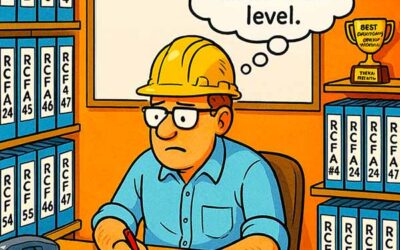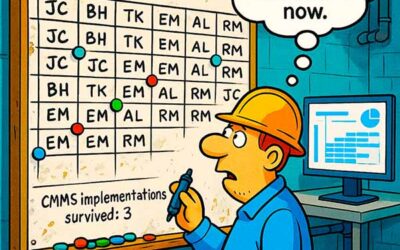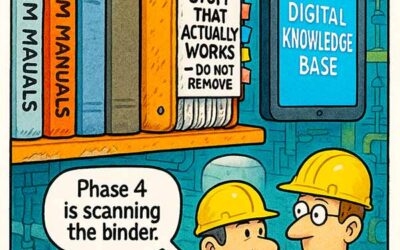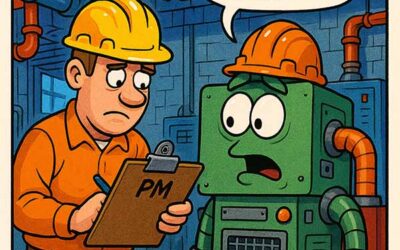
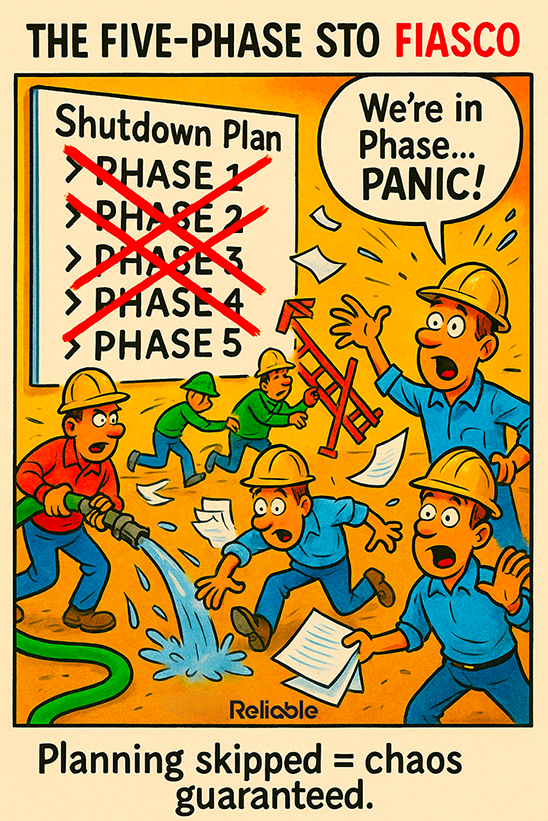

Every maintenance professional recognizes the scene: alarms blaring, papers flying, schedules unraveling, and everyone suddenly “discovering” they’re in Phase Panic. The cartoon nails this moment, the point where months of deferred planning implode into frantic improvisation.
In reliability terms, that’s not just bad luck, it’s a planning failure.
Shutdowns, turnarounds, and outages (STOs) are among the most complex operations in any industrial setting. They involve hundreds of interdependent tasks, safety risks, and tight schedules. Yet many organizations treat shutdown turnaround outage planning as an afterthought until it’s too late.
The result? Crews chasing parts that aren’t there, contractors working without supervision, safety permits delayed, and leadership questioning how things spiraled so quickly. The truth is simple: if you skip planning, you’re not saving time, you’re borrowing chaos from the future.
How Shutdown Turnaround Outage Planning Prevents Chaos
A successful STO is not defined by how fast it starts, but how predictably it ends.
Shutdown turnaround outage planning provides the structure that keeps large, multi-departmental events aligned, turning what could be chaos into a coordinated effort.
Without it, these failure patterns emerge:
- Unclear Work Scope: Teams discover overlapping jobs or missing details on Day 1.
- Resource Bottlenecks: Skilled craftspeople or contractors are double-booked.
- Procurement Gaps: Critical components still sitting in supplier warehouses.
- Communication Breakdowns: Safety, operations, and maintenance each use different plans.
- Schedule Creep: Every unexpected task steals time from recovery.
A disciplined planning process ensures every department operates from the same reality, one that accounts for asset readiness, manpower, permits, logistics, and testing. The benefit isn’t just fewer surprises; it’s confidence under pressure.
When shutdown turnaround outage planning is done right, chaos becomes optional.
Building a Reliable STO Planning Framework
Plants that consistently execute successful outages share a familiar pattern: they never rely on hope. They rely on process. The backbone of effective shutdown turnaround outage planning includes five repeatable steps.
1. Define the Scope with Precision
Freeze the scope early, ideally 90 to 120 days before execution. Scope creep kills schedules faster than any other factor. Every new “small add-on” adds exponential complexity.
2. Validate the Plan Through Reviews
Conduct readiness reviews at multiple intervals: 90-day, 60-day, and 30-day checkpoints. Each review should confirm that materials, manpower, and safety planning are on track.
3. Resource and Schedule Realistically
Avoid the temptation to overcommit resources or compress durations. Every shortcut taken before the outage creates delays during it. Build slack time for the unexpected, because it will happen.
4. Stage Materials Early
Establish a kitting and staging area. This eliminates lost time from missing tools or parts. Every maintenance planner knows: one missing gasket can delay a restart by hours.
5. Integrate Communication Channels
Unify everyone – operations, maintenance, procurement, safety- under a single master schedule and platform. The best STOs function like air traffic control: transparent, centralized, and accountable.
Plants that embed these principles into daily culture report shorter downtimes, fewer safety incidents, and measurable improvements in reliability KPIs.
Common Pitfalls That Turn STO Plans Into Fiascos
Even with good intentions, STO planning can derail quickly. These are the traps that turn a schedule into a firefight:
Last-Minute Scope Additions
Leaders often say, “Since we’re already down, let’s fix this too.” It sounds reasonable, but it destroys alignment. The scope freeze exists to protect predictability. Violating it guarantees slippage.
Undefined Ownership
No one can steer a ship with five captains. Every successful shutdown turnaround outage planning process assigns a single accountable owner, often a turnaround manager, who makes data-driven calls.
Reactive Procurement and Logistics
When parts are ordered after the equipment stops, you’ve already lost. Every delay ripples through the entire outage. Proactive staging and procurement discipline are nonnegotiable.
Overly Optimistic Timelines
Optimism is not a strategy. Underestimating task durations or assuming “best case” timelines sets teams up for failure. Leading organizations use historical performance data to forecast durations realistically.
Poor Communication Discipline
If field teams, contractors, and supervisors are updating progress in separate tools or spreadsheets, you’ve lost visibility. One version of the truth, shared daily, is essential.
These pitfalls aren’t random; they’re predictable. And because they’re predictable, they’re preventable.
Making STO Planning a Strategic Capability
Leading organizations view shutdown turnaround outage planning not as a maintenance activity, but as a strategic reliability capability.
They operationalize it through technology, metrics, and continuous improvement:
- STO Management Platforms: Software that integrates planning, scheduling, cost tracking, and safety KPIs in real time.
- CMMS Integration: Work orders and permits automatically sync with STO progress updates.
- Post-Outage Debriefs: Teams document lessons learned and feed them into the next cycle’s plan.
- Predictive Maintenance Alignment: Condition monitoring data (vibration, oil analysis, thermography) identifies the right jobs to include in the next shutdown.
- Cross-Functional Review Boards: Finance, maintenance, and operations jointly review performance and variances.
When an STO plan is treated like an investment, not an expense, it transforms reliability outcomes.
Predictable shutdowns build credibility with leadership and free capital for proactive maintenance initiatives. Most importantly, they eliminate the “panic phase” altogether.
The Bottom Line: Plan Early, Execute Smoothly
The difference between a fiasco and a flawless STO isn’t luck; it’s discipline.
Shutdown turnaround outage planning is where reliability leadership proves itself: the more structured the preparation, the less reactive the execution.
The next time someone says, “We’ll figure it out when we get there,” remember this cartoon.
Because in the real world, there’s one final phase after panic, postmortem, and it’s always too late to fix what planning could have prevented.