
Planned maintenance shutdowns are the Super Bowls of reliability. They demand enormous planning, complex coordination, and flawless execution. Plants budget millions, shut down production, and line up contractors in hopes of restoring equipment health and unlocking new capacity.
Yet too often, shutdowns run over budget, past schedule, and into frustration. Everyone expects the restart to bring stability, but instead, it brings chaos, missed KPIs, and angry production managers. What went wrong?
The culprit is rarely poor intent or bad planning. The silent killer is scope creep in maintenance shutdowns – those incremental additions that seem harmless in the moment but ultimately devastate outcomes.
This article examines why scope creep in maintenance shutdowns is so destructive, the patterns that fuel it, and the strategies that reliability leaders can use to turn shutdown discipline into a competitive advantage.
Why Scope Creep in Maintenance Shutdowns Is More Dangerous Than You Think
Scope creep sounds harmless. A few extra tasks, added in good faith, don’t seem like a big deal. But in a shutdown environment, time is compressed and risk is multiplied. Every added job acts like a stone tossed into a pond, the ripple effects are far-reaching:
- Schedules detonate. A shutdown’s critical path is finely tuned. Add a task, and suddenly craft resources are spread thin, inspections back up, and sequencing falters. A three-hour “quick fix” can cascade into three lost days.
- Costs spiral. Contractors bill extra hours. Spare parts must be expedited. Crews earn overtime. The financial hit compounds. Industry studies show uncontrolled scope creep in maintenance shutdowns can inflate budgets by 15–25%.
- Reliability declines. Ironically, more work often means worse reliability. Rushed crews take shortcuts. Documentation is skipped. Systems are restarted with half-finished work. Failures spike in the weeks following the shutdown.
Unlike unplanned downtime, scope creep in maintenance shutdowns is deceptive. Leaders walk the floor and see people working hard, boxes checked, machines opened. It feels productive. But the schedule silently slips. The actual damage reveals itself when production misses delivery targets or safety incidents spike.
Root Causes of Scope Creep in Maintenance Shutdowns
Scope creep doesn’t arrive like a lightning strike. It builds slowly from common, predictable behaviors. Understanding these root causes is the first step toward prevention.
1. The “While You’re in There” Effect
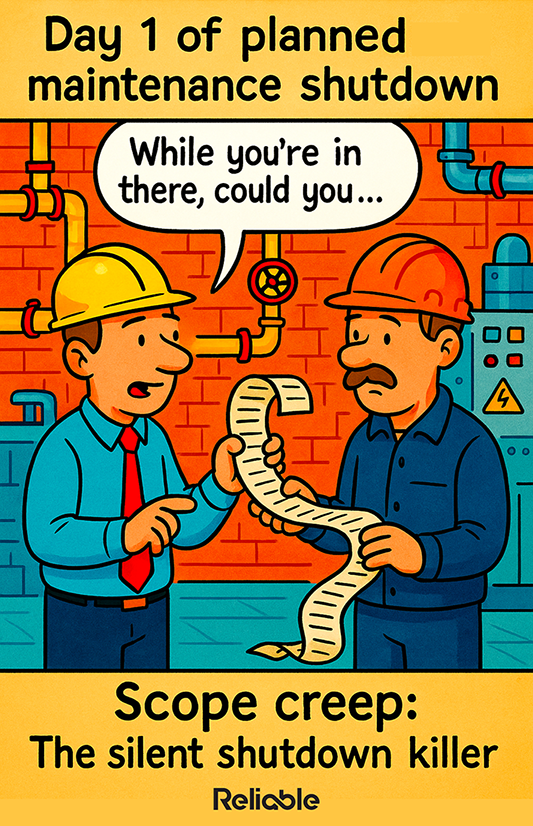
It starts innocently: “Since the pump is already open, could you also replace that valve?” These add-ons are logical, even well-intentioned. But stacked together, they overwhelm the plan.
2. Weak Front-End Planning
Inadequate work scoping and insufficient equipment history analysis create fuzziness. Crews arrive with vague job cards, opening the door for additions on the fly.
3. Political and Organizational Pressure
Shutdowns attract attention from every department. Capital projects want to piggyback their upgrades. Environmental teams want inspections done. Executives push pet initiatives. The shutdown becomes a corporate dumping ground.
4. The Fear Factor
No one wants to wait another 18 months for the next shutdown window. So teams jam in every conceivable task “just in case.” The result: dilution of focus and guarantee of delay.
Reliability collapses when organizations trade discipline for improvisation. Scope creep is a perfect case study: decisions that seem pragmatic in the moment can ultimately destroy performance over the long term.
Strategies to Prevent Scope Creep in Maintenance Shutdowns
Eliminating scope creep requires more than a stern lecture from the shutdown manager. It takes system-level strategies that reinforce discipline at every stage.
1. Freeze the Scope Early
A formal “scope freeze” 60–90 days before shutdown is essential. After freeze, every proposed addition should go through a risk-based approval board. Ask:
- Does this work mitigate a clear, documented risk?
- What is the cost of deferral until the next window?
- Does it impact the critical path?
If the answer is weak or speculative, the work waits.
2. Segregate Maintenance from Capital Projects
Capital projects love to hijack shutdowns. The logic seems sound – “machines are down, so why not install the upgrade now?” But mixing reliability-focused maintenance with capital expansion creates schedule collisions. Best practice is to run separate governance tracks. Maintenance protects uptime; projects pursue growth.
3. Train Leaders on the Hidden Costs
Executives often drive scope creep unknowingly. Teach them that every “while you’re in there” task carries schedule risk, safety risk, and cost multipliers. Leaders who understand this dynamic are less likely to undermine their own teams.
4. Enforce Work Prioritization Tools
Frameworks such as risk-priority numbers (RPN) or asset criticality rankings should guide task selection. If a job ranks low, it shouldn’t muscle into a shutdown just because someone shouts loudest.
5. Monitor and Report Scope Creep Metrics
What gets measured gets managed. Track:
- Number of tasks added after freeze
- Hours consumed by added tasks
- Percentage of budget tied to post-freeze work
Transparency curbs bad behavior. When everyone sees the data, no one wants to be the person who inflated the shutdown by 12%.
Turning Shutdown Discipline Into a Reliability Advantage
Reliability leaders don’t just battle machine failures, they battle organizational behaviors that erode performance. Scope creep in maintenance shutdowns is one of the most insidious forms of this behavior.
Plants that master scope control gain clear advantages:
- Shorter downtimes. Production restarts on schedule, protecting revenue.
- Higher reliability. Crews focus on high-value tasks, executed with full attention.
- Lower lifecycle costs. Work stays within budget, freeing funds for predictive and proactive programs.
- Cultural strength. Discipline in shutdowns sets a tone of professionalism across the entire maintenance organization.
The real lesson? Reliability isn’t just about grease guns and vibration monitors. It’s about leadership discipline in the face of pressure. A plant that can say “no” to extras during a shutdown is a plant that can sustain reliability long term.
Leading Against Scope Creep
Every maintenance leader faces the exact moment: someone hands over a new task list mid-shutdown and says, “While you’re in there, could you…?”
The great ones pause, look at the risk, and say, “Not this time.”
Because they know scope creep in maintenance shutdowns is the silent shutdown killer. Preventing it is not about rigidity; it’s about protecting reliability, cost, and safety. And when reliability leaders hold that line, they don’t just save days—they set the foundation for world-class performance.