Run-to-Failure Maintenance Strategy: The Hidden Costs of Reactive Thinking
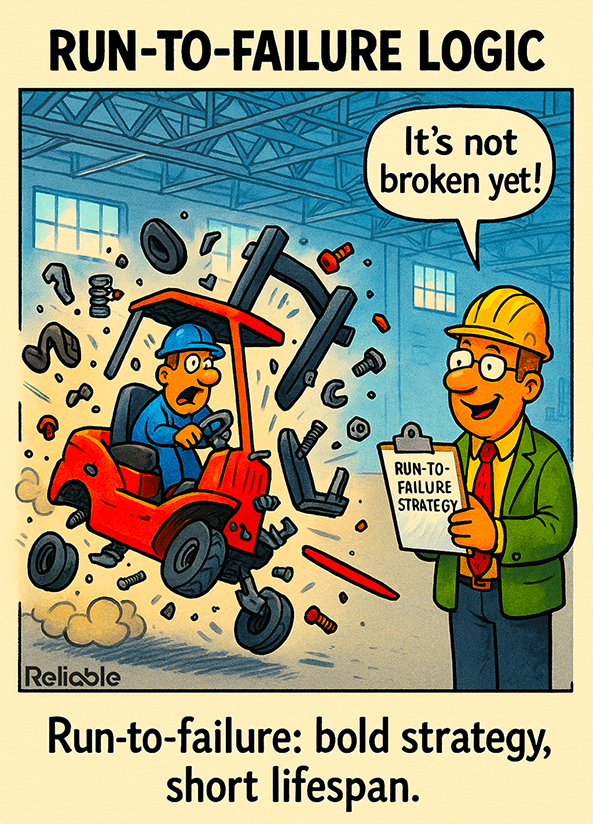
The cartoon’s humor lands because it’s true. Every maintenance professional has heard it: “It’s not broken yet.” The phrase captures the essence of a run-to-failure maintenance strategy—a reactive approach that masquerades as cost savings but quietly drains resources, time, and morale.
At first glance, run-to-failure sounds pragmatic. After all, why spend money maintaining something that still works? Yet beneath the surface, this logic ignores the hidden costs, emergency downtime, production delays, and safety incidents that emerge when failure becomes the trigger for action.
Every dollar you save by skipping maintenance eventually returns as ten in downtime, disruption, and damage.
True reliability requires foresight, not faith in luck. The organizations that escape the “run it until it breaks” trap aren’t just better at fixing things; they’re better at preventing chaos, stabilizing output, and protecting profit margins.
The Psychology Behind the Run-to-Failure Maintenance Strategy
The run-to-failure maintenance strategy often thrives not because of ignorance, but because of pressure. Budget constraints, production targets, and short-term thinking make it tempting. Maintenance managers are usually rewarded for keeping immediate costs low, not for preventing long-term losses.
This short-term bias creates a dangerous illusion: as long as machines are running, the system seems efficient. But hidden failure mechanisms, bearing fatigue, lubricant contamination, misalignment—accumulate silently. By the time symptoms appear, damage is irreversible, and downtime is imminent.
Even worse, reactive cultures can erode technical excellence. Teams become skilled at firefighting rather than diagnosing root causes. Every emergency fix is celebrated, reinforcing bad habits. Heroic recoveries replace preventive planning as the hallmark of success.
In essence: Run-to-failure isn’t a maintenance plan—it’s a lack of one.
The True Cost of the Run-to-Failure Maintenance Strategy
Every time a component fails, the cost extends beyond the repair invoice. When viewed through a full lifecycle lens, the run-to-failure maintenance strategy is among the most expensive choices a plant can make.
1. Unplanned Downtime Multiplies Losses
A single equipment failure can cascade across production lines, idling operators, and halting throughput. Lost production often dwarfs the repair cost itself. Downtime at $10,000 per hour adds up fast when failures strike unannounced.
2. Emergency Repairs Are Inefficient by Design
Reactive maintenance demands overtime labor, rush-shipped parts, and unscheduled interventions. Emergency procurement often circumvents vendor agreements, inflating costs and breaking budgets.
3. Collateral Damage Is the Hidden Killer
When a bearing seizes or a pump impeller fails catastrophically, it rarely happens in isolation. Nearby components, shafts, and seals absorb the shock. What could have been a $500 repair becomes a $15,000 rebuild.
4. Safety and Environmental Risk
A “run it till it breaks” culture increases the likelihood of incidents. Hydraulic bursts, leaks, or mechanical failures can injure personnel or create compliance issues. Reliability isn’t just about uptime; it’s about control.
Ultimately, a run-to-failure maintenance strategy trades predictability for volatility. It’s a budgetary mirage, one that hides risk until it erupts in the worst possible way.
When Run-to-Failure Maintenance Makes Sense (Rarely)
Not every machine warrants predictive analytics or vibration sensors. For non-critical assets like lighting, simple conveyors, or redundant pumps, run-to-failure can be economically justifiable. The key is intentional application based on asset criticality, not default neglect.
A disciplined reliability program classifies assets by their consequence of failure:
A-level (Critical): Safety, environmental, or production-critical. Requires predictive or preventive maintenance.
B-level (Important): Impacts cost or quality; condition-based maintenance recommended.
C-level (Non-critical): Minimal consequence of failure; suitable for run-to-failure.
The problem? Most organizations never perform this analysis. Instead, run-to-failure becomes the default setting. Without a clear boundary, it infects the entire maintenance culture. That’s when “strategic neglect” becomes “operational chaos.”
Alternatives to the Run-to-Failure Maintenance Strategy
Breaking the cycle begins with adopting methods that prioritize foresight over reaction. Each alternative builds on data, discipline, and a deeper understanding of asset health.
Preventive Maintenance (PM)
PM uses time-based or usage-based schedules to perform tasks before failures occur. It’s the first step away from chaos, reducing surprises by addressing wear before breakdowns.
Condition-Based Maintenance (CBM)
CBM leverages real-time monitoring - vibration, thermography, oil analysis - to detect anomalies early. This is where maintenance starts to align with actual machine condition, not calendar dates.
Predictive Maintenance (PdM)
The evolution of CBM, predictive maintenance uses analytics and machine learning to forecast failures before symptoms appear. AI-driven models process years of data to predict when a bearing, gearbox, or motor will fail with remarkable accuracy.
Reliability-Centered Maintenance (RCM)
RCM provides the structured logic to select the right strategy for each asset type. It balances cost, risk, and performance, ensuring that maintenance effort matches business consequence.
Transitioning from a run-to-failure maintenance strategy to a hybrid reliability model doesn’t happen overnight. It starts with small wins: collecting data, analyzing failure modes, and shifting conversations from “fixing” to “preventing.”
Building a Reliability Culture That Rejects Failure
Even the best tools fail in a weak culture. Reliability excellence depends on mindset as much as technology. Organizations that sustain improvement do five things consistently:
Define Asset Criticality Clearly
Identify which assets truly justify a run-to-failure approach, and which do not.Institutionalize Root Cause Analysis
Every failure event should generate actionable lessons. These insights must be integrated into CMMS records and training programs.Engage Operators in Daily Care
Operators are the first line of defense. Empower them to inspect, detect, and communicate early warning signs.Align KPIs With Long-Term Goals
Move away from tracking “maintenance cost reduction” toward “uptime increase” and “planned work ratio.” Incentives should reward prevention, not emergency heroics.Lead With Vision, Not Fear
Leadership must communicate reliability as a business advantage—not just a maintenance metric. When uptime becomes a shared mission, accountability follows naturally.
Culture change begins when plants stop rewarding firefighting and start celebrating foresight.
Conclusion: Moving Beyond the Run-to-Failure Trap
The run-to-failure maintenance strategy is seductive in its simplicity but destructive in practice. It thrives in environments that mistake activity for progress and savings for strategy. But every breakdown, every emergency purchase order, and every late-night repair tells a different story, one of lost control and predictable chaos.
Reliability isn’t an accident. It’s a system built on discipline, foresight, and continuous learning. The organizations that win aren’t the ones that fix the fastest; they’re the ones that prevent the most failures.
In the end, the most dangerous phrase in maintenance isn’t “It’s broken.”
It’s “It’s not broken yet.”