How Remote Condition Monitoring Systems Changed Maintenance Forever
The Wake-Up Call of Remote Monitoring
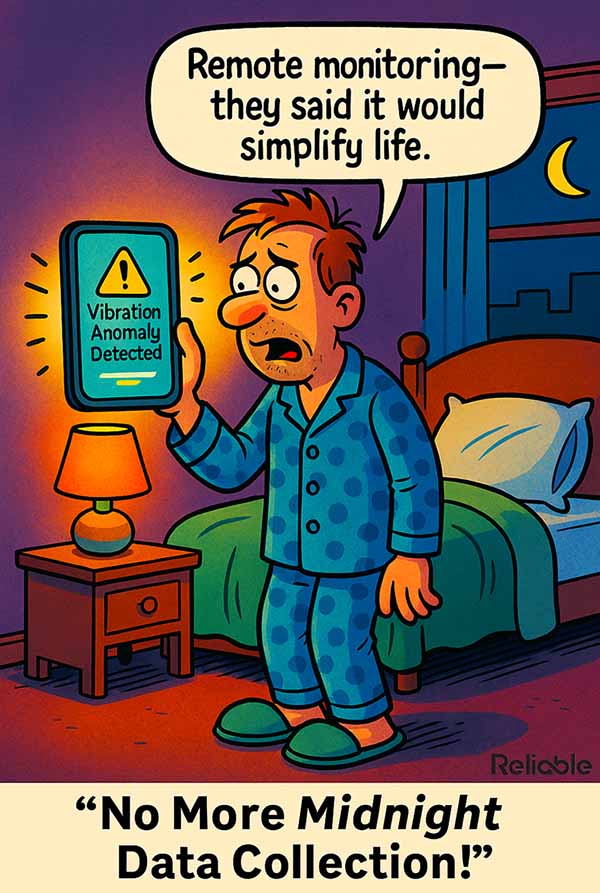
It’s 12:03 a.m., and the plant’s vibration sensor just pinged your phone. “Vibration anomaly detected.” You stare at the alert through bleary eyes and wonder: Wasn’t this technology supposed to simplify life?
Remote monitoring promised convenience and control, machines that talk to us, maintenance that predicts itself. Yet, the real experience often lands somewhere between empowerment and exhaustion. Maintenance professionals are now living in a hyperconnected world, where remote condition monitoring systems deliver a constant stream of data, insights, and, occasionally, midnight surprises.
The promise of automation isn’t fewer problems - it’s better awareness of the ones you already have.
The paradox is that technology designed to reduce human workload sometimes shifts it instead, transforming how we interact with reliability. But when used intelligently, these systems deliver extraordinary benefits: fewer breakdowns, greater safety, and the ability to make decisions based on evidence rather than assumptions.
Why Remote Condition Monitoring Systems Matter
In today’s competitive industrial environment, downtime is the enemy. That’s where remote condition monitoring systems prove their worth. They continuously capture key data—vibration, temperature, pressure, current, oil quality, and more without human intervention. Instead of collecting data once a month, plants receive real-time insights 24/7.
This change eliminates one of maintenance’s oldest inefficiencies: walking routes. Traditional condition monitoring required technicians to visit every asset, collect readings, and manually upload them. Now, sensors send information directly to a centralized dashboard, enabling faster, data-driven action.
Yet the magic isn’t in the sensors. It’s in what happens after the data arrives. Without structured alarm thresholds, contextual analytics, and skilled interpretation, the system becomes a noisy distraction. A “smart” plant isn’t one flooded with alerts; it’s one where every alert means something.
To capture real value from remote monitoring, teams should:
Define meaningful limits - Alarms should relate to asset criticality, not just raw values.
Fuse multi-sensor data - Combine vibration, oil, and temperature to verify failure progression.
Use analytics engines - Automate baseline comparisons and identify deviation trends early.
Design escalation paths - Route anomalies by severity and role; not everyone needs to wake up.
Train analysts regularly - A system’s intelligence is only as sharp as its interpreters.
When configured with discipline, remote monitoring becomes an early warning network that improves uptime, extends asset life, and boosts confidence across operations.
From Data Fatigue to Diagnostic Clarity
For many facilities, remote condition monitoring systems created a new challenge: too much visibility. With sensors on nearly every bearing, gearbox, and pump, teams now face data overload. Alerts fire at all hours, overwhelming analysts and triggering alarm fatigue.
To solve this, progressive organizations are developing what could be called a diagnostic maturity curve:
Stage 1: Data Collection - Information is gathered but rarely analyzed; decisions remain reactive.
Stage 2: Alert-Centric - Thresholds trigger constant alarms, many of them false positives.
Stage 3: Correlation-Aware - Teams integrate multiple data types for cross-validation.
Stage 4: Insight-Driven - Predictive insights feed planning and scheduling systems.
Stage 5: Autonomous Optimization - AI dynamically adjusts thresholds and predicts degradation paths.
At the higher stages, data works for you, not against you. The system filters noise, interprets context, and delivers insights directly tied to asset criticality. Instead of waking engineers with vibration spikes, it sends morning summaries that highlight actionable trends.
That’s when technology finally delivers on its promise, simplifying life by making maintenance predictive rather than reactive.
Integrating Remote Systems Into a Reliability Strategy
Implementing remote condition monitoring systems successfully isn’t about buying sensors; it’s about changing how maintenance is managed. The technology should align with reliability goals and organizational processes.
Here are the pillars of a robust integration strategy:
Centralized Intelligence - Bring all monitoring streams (vibration, oil, thermal, ultrasonic) into a unified analytics platform. Fragmented data leads to misinterpretation.
Contextual Thresholds - Customize alarm levels by equipment type, operating environment, and process load. A pump in a cleanroom behaves differently from one in a quarry.
Closed-Loop Workflows - Automatically generate work orders in the CMMS when anomalies meet critical criteria.
Human Oversight - Even with automation, expert judgment remains essential. Skilled analysts provide the reasoning AI lacks.
Continuous Feedback - Post-event analysis should refine both the monitoring strategy and preventive maintenance plans.
The most advanced plants are using monitoring data to justify design changes, improve OEM specifications, and even renegotiate supplier contracts based on evidence of premature failures. The result: reliability becomes a board-level conversation, not just a maintenance task.
When Remote Monitoring Meets Predictive Maintenance
Remote systems are now merging with predictive technologies, machine learning, digital twins, and advanced diagnostics. Remote condition monitoring systems act as the sensory layer, feeding data into AI-driven models that forecast component wear, lubricant degradation, and imbalance trends before they cause downtime.
Predictive algorithms thrive on data volume and variety. The more complete your monitoring picture, the more accurate your predictions. Plants that once relied solely on vibration data now integrate thermography, ultrasound, and oil analysis to triangulate machine health.
When data streams converge, machines stop surprising you and start teaching you.
This synergy marks a shift from reactive monitoring to predictive optimization. Maintenance schedules are no longer fixed; they’re dynamically adjusted based on real-time risk profiles. The days of calendar-driven maintenance are fading fast.
However, predictive success still depends on one thing: trust in the data. A single misconfigured sensor can erode confidence in the entire system. That’s why calibration, validation, and disciplined data governance remain non-negotiable.
Expanding Reliability with Smart Asset Monitoring Technologies
As manufacturing and heavy industry evolve, the next leap forward is combining smart asset monitoring, industrial IoT platforms, and predictive maintenance software into cohesive ecosystems. These solutions go beyond simple remote condition monitoring systems. They represent a total transformation in how organizations detect, interpret, and respond to machine behavior.
Industrial IoT condition monitoring enables equipment to communicate performance deviations instantly, allowing machine health monitoring solutions to detect imbalance, misalignment, and bearing degradation far earlier than manual inspection. When tied to cloud-based predictive maintenance platforms, this data becomes the foundation for data-driven decision-making that minimizes unscheduled downtime.
Modern plants now rely on:
Wireless vibration monitoring systems that provide continuous asset visibility.
AI-powered maintenance analytics tools that rank assets by failure risk.
Edge computing for industrial monitoring, reducing latency and processing anomalies in real time.
Smart sensors for rotating equipment, enhancing reliability across pumps, compressors, and turbines.
Predictive maintenance dashboards that integrate KPIs, asset hierarchy, and criticality analysis.
The future of digital maintenance transformation depends on connecting these technologies into a single intelligent architecture, linking predictive analytics, condition-based maintenance software, and industrial data historians. Together, they allow maintenance and reliability teams to move from reactive firefighting to proactive performance optimization.
For advanced facilities, this isn’t just technology adoption; it’s a competitive necessity. Plants that fully embrace remote equipment monitoring, AI condition analysis, and automated fault diagnostics consistently outperform peers in uptime, cost per operating hour, and energy efficiency.
Smarter Systems, Better Sleep
Remote monitoring isn’t the villain; it’s a mirror reflecting our processes. If it’s waking you at midnight, the problem isn’t the alert; it’s the setup. The purpose of remote condition monitoring systems is to free humans from constant vigilance, not tether them to their devices.
As the technology matures, maintenance teams must evolve from data collectors to data strategists. When insights are contextualized, alarms are meaningful, and responses are deliberate, plants achieve the holy grail of reliability: stability without constant supervision.
Technology can’t simplify life on its own, but disciplined application can. The next step is clear: teach your systems when to whisper and when to shout. Then, you can finally get a good night’s sleep without missing a beat from your machines.