
Reliability program governance exists to steer improvement, yet in many plants it can become a reason improvement stalls. A committee forms, a meeting schedule begins, and months later the same decisions circle the same table while the equipment waits. Structure meant to create momentum quietly absorbs it. The people involved are usually capable and well-intentioned, which makes the paralysis all the more frustrating to watch.
The problem is often less about effort or intelligence in the room than about how authority, decisions, and accountability are arranged. Governance that drives action looks different from governance that only deliberates, and the gap between them is worth understanding closely. A few structural changes often separate a body that moves from one that merely convenes.
Why Reliability Program Governance Becomes a Bottleneck
Bottlenecks often start with unclear decision rights. When no one in the room can commit without checking upward, the meeting can only recommend, and recommendations pile up waiting for an authority that never quite arrives in time. Everyone leaves the meeting believing progress was made, when in truth the ball was only passed.
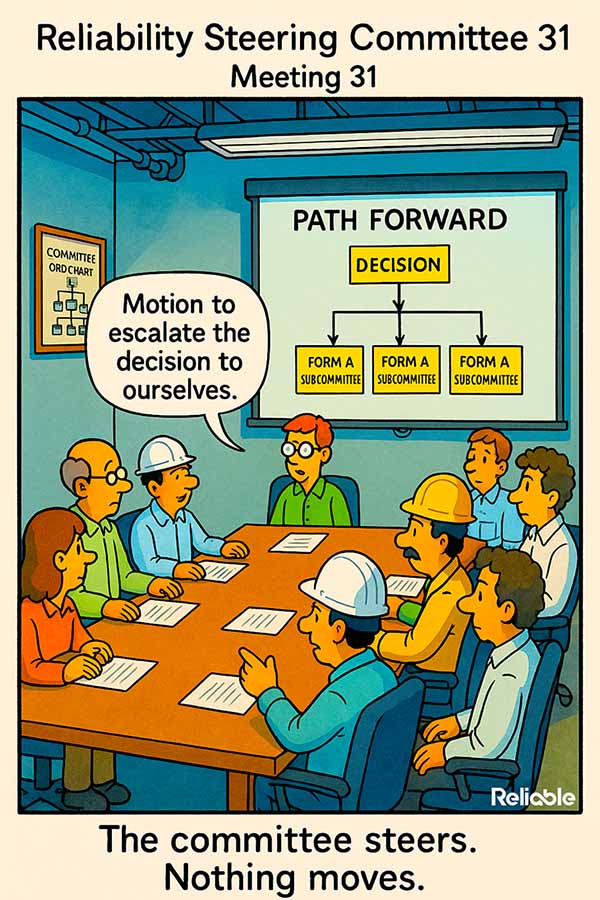
Risk aversion makes it worse. Forming a subcommittee or gathering yet more data feels safer than deciding, so the group chooses study over action again and again, mistaking motion for genuine progress. Each deferral feels prudent in isolation, yet the sum is a program that studies problems it could be solving.
A governance body that can discuss anything and decide nothing will reliably produce meetings and little else.
Scope creep also clogs the works. When every question, large or small, routes through the same committee, the important decisions wait behind trivial ones, and the agenda swells until nothing gets real attention. Sound governance protects business reliability by keeping the big calls moving. A quick agenda triage that routes small items elsewhere frees the group for the decisions that matter.
The pattern feeds itself over time. As decisions slow, frustrated members disengage, attendance drifts, and the few who remain grow cautious, which slows decisions further still. Breaking the cycle takes a deliberate redesign rather than more willpower.
The Difference Between Steering and Deciding
Steering and deciding are different jobs, and confusing them is where much governance goes wrong. Steering sets direction, priorities, and boundaries. Many operational decisions commit resources to specific actions and belong closer to the work, within clearly delegated authority. Blurring the line can pull a strategy group into operational details it was never meant to manage.
A healthy structure separates the two on purpose. A governance group sets the reliability strategy and the guardrails, then delegates day-to-day decisions to people equipped and authorized to make them. Strategic, capital, safety, and enterprise-risk decisions still escalate to the level defined by the organization. Clear delegation is what lets a program scale beyond a single overloaded committee.
- Agendas full of operational choices that a manager or engineer could own directly.
- Decisions revisited across several meetings without new information to justify the delay.
- Subcommittees formed to avoid a call the group already has the authority to make.
- Members waiting for consensus on matters that simply need one clear owner.
The fix is to hand routine decisions to clear owners and reserve the group’s limited time for the choices that genuinely need collective judgment. Good asset management decision making depends on matching each decision to the right level of the organization.
Giving Governance the Power to Act
Governance drives action when it holds real authority and actually uses it. That means naming, in advance, which decisions the group can make on its own and what resources it controls, so a choice made in the room actually sticks afterward. Authority granted on paper but withdrawn in practice trains a group to stop trying.
Time-boxing decisions can help. Setting a date by which a call will be made, with a sensible default or escalation path if the group cannot agree, turns open-ended deliberation into a defined decision process.
Authority without a deadline drifts, and a deadline without authority is only a wish; a working program needs both.
For many steering decisions, a compact, empowered group with clear ownership can move faster than a crowded committee where responsibility is diffuse. The right size depends on the decision, the expertise required, and who holds the authority to commit resources.
Action also depends on follow-through between meetings. Assigning each decision a single owner and a due date, then reviewing progress briefly at the next session, keeps commitments from evaporating the moment the room clears out. A short standing review of open items often does more for momentum than adding fresh discussion.
Making Governance Accountable
Accountability is what keeps a redesigned governance body from sliding back into a talking shop. The group should measure itself the way it measures the plant, against outcomes rather than against activity. A calendar full of meetings is easy to mistake for progress until the results are laid next to it.
Useful measures here are straightforward. How many decisions the group made, how long they took, whether assigned actions were completed, and whether the program metrics moved in the intended direction all help reveal whether governance is working or merely meeting. Those measures show association and follow-through; they do not prove that the committee alone caused a reliability result.
- Decision throughput and the average time from an issue raised to an action taken.
- The share of reliability initiatives that reach completion rather than stalling out.
- Movement in the reliability metrics the program was chartered to improve.
- Open commitments past their due date, reviewed briefly at every meeting.
These measures give the governance group an early signal when decisions slow or actions stall. The group can then adjust its decision rights, agenda, ownership, or escalation process before delay becomes the normal way of working.