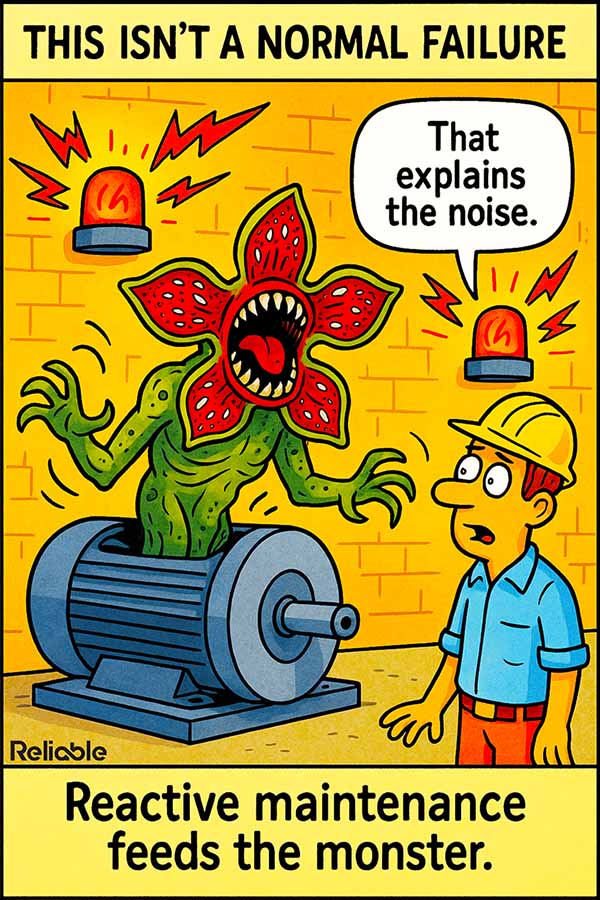

Something growls inside the motor housing at 2 a.m. on a Tuesday. The night shift operator writes it up. The day shift supervisor reads the note, shrugs, and says the motor sounds fine now. Two weeks later, that motor seizes, takes a gearbox with it, and shuts down a production line for 14 hours. Anyone who’s worked in industrial maintenance has watched this exact sequence play out. And it explains why reactive maintenance increases downtime at every plant that relies on it.
Reactive maintenance, sometimes called run-to-failure or breakdown maintenance, means waiting for equipment to stop working before doing anything about it. In limited, deliberate applications (disposable items, non-critical redundant systems), it makes sense. As a default strategy for an entire facility, it’s a compounding disaster.
Why Reactive Maintenance Increases Downtime: The Compounding Effect
The math behind reactive failure is counterintuitive. Most people assume that if a pump fails once a year and the repair takes four hours, you’ll lose about four hours annually. That estimate misses almost everything that actually happens.
When that pump fails without warning, the maintenance team is probably already working on something else. The right parts may or may not be in the storeroom. The technician with the most experience on that particular pump might be on vacation. Every one of those variables adds time.
A study from the U.S. Department of Energy found that reactive maintenance costs two to five times more than planned maintenance on the same equipment. The cost difference comes almost entirely from three factors:
- Extended repair duration: emergency repairs take 1.5 to 3 times longer than the same repair performed during a planned shutdown, because technicians troubleshoot under pressure without pre-staged parts or procedures.
- Collateral damage: a bearing that fails catastrophically scores shafts, damages seals, and sometimes takes out adjacent components that were perfectly healthy an hour earlier. One failure becomes three or four repairs.
- Production penalties: unplanned stops hit during active production, when the financial impact per hour is at its peak. Planned shutdowns can be scheduled around low-demand windows.
These three factors multiply each other. A repair that should cost $500 and take two hours during a planned shutdown balloons into a $5,000, 12-hour emergency that ripples through production schedules for the rest of the week.
A repair that should cost $500 during a planned shutdown balloons into a $5,000, 12-hour emergency when equipment fails without warning, and the ripple effects last far longer than the repair itself.
The compounding gets worse over time. As emergency work orders pile up, technicians spend more hours on reactive fixes and fewer on preventive tasks. The preventive tasks they skip lead to more failures, which generate more emergency work orders. This spiral is why plants stuck in reactive mode see their downtime increase year over year even when headcount stays the same.
The Hidden Costs Most Plants Overlook
Downtime hours and repair invoices are the visible costs. The hidden ones are often larger.
Technician Burnout and Turnover
Maintenance technicians in reactive environments work more overtime, handle more stressful repairs, and have less control over their schedules. It’s the industrial equivalent of a hospital emergency room running 24/7 with no patient appointments: exhausting, unpredictable, and demoralizing.
Turnover in reactive maintenance environments runs 15 to 25% higher than in plants with structured PM programs, according to workforce studies from the Society for Maintenance and Reliability Professionals. Replacing a skilled maintenance technician costs $40,000 to $60,000 when you factor in recruiting, onboarding, and the productivity gap while the new hire gets up to speed.
Inventory Chaos
Planned maintenance lets you stock exactly the parts you need, when you need them. Reactive maintenance turns the storeroom into a guessing game. Plants end up carrying excess inventory on parts they might need urgently (tying up capital) while still running out of the specific part they actually need when a failure hits.
The typical reactive plant carries 20 to 30% more spare parts inventory than a comparable plant with a mature PM program, yet still experiences more stockout events. That’s money sitting on shelves collecting dust alongside empty bins for the parts that matter.
Quality and Safety Impacts
Equipment operating in a degraded state (vibrating more than it should, running hotter, leaking slightly) produces lower-quality output. The defects may be subtle: dimensional variance that’s technically within spec but trending in the wrong direction, surface finish issues that increase customer complaints, contamination risks that pass inspection 95% of the time.
Safety is the sharper concern. Equipment that fails unexpectedly creates uncontrolled energy releases, unexpected motion, and hazardous conditions that a planned repair never would. OSHA incident data consistently shows higher injury rates at facilities with predominantly reactive maintenance programs.
Breaking the Reactive Cycle: Where to Start
Shifting from reactive to planned maintenance takes sustained effort, and it requires leadership commitment more than a seven-figure technology investment. The most successful transitions start small and build credibility through results.
Step 1: Identify Your Top 10 Failure Sources
Pull 12 months of work order data and sort by total cost per asset, including labor, parts, and estimated production losses. The top 10 assets on that list are your starting point. These are the machines where reactive maintenance increases downtime the most, and where a basic PM program will show the fastest return.
- Document the failure modes for each asset: what actually breaks, how often, and what the early warning signs are.
- Establish PM tasks based on manufacturer recommendations and the failure history you’ve documented. Keep the initial task list short and executable.
- Schedule the PM tasks during planned downtime windows and assign specific technicians who know the equipment.
Step 2: Track the Ratio
The single most revealing metric in maintenance is the planned-to-unplanned work ratio. World-class facilities run at 85% or higher planned work. Most reactive plants sit below 30%.
Start tracking this number weekly. Post it visibly. The goal in year one is to move from wherever you are toward 60%. That shift alone typically reduces total maintenance costs by 12 to 18% and cuts unplanned downtime by a third.
Step 3: Protect PM Schedule Compliance
The biggest threat to a new PM program is the very reactive mindset it’s trying to replace. When an emergency hits (and it will, especially early on), the temptation is to pull technicians off PM tasks to fight fires. Every time that happens, the cycle resets.
Protect PM schedule compliance the way production protects its run schedule. Set a target of 90% compliance and treat missed PMs with the same urgency as missed production targets. This single discipline, more than any technology or staffing decision, determines whether the transition sticks.
Protect PM schedule compliance the way production protects its run schedule. This single discipline determines whether the transition from reactive maintenance actually sticks.
Some plants designate specific technicians as “PM-only” during certain shifts, making them unavailable for emergency calls unless safety is at stake. It feels wasteful at first. Within three months, the reduction in emergency calls usually validates the decision.
Step 4: Build a Feedback Loop
Every reactive failure that still occurs after the transition starts is a learning opportunity. Conduct a brief root cause analysis on each unplanned breakdown: was there a PM task that should have caught this? Was the task on the schedule but missed? Was the task performed but the inspection criteria too vague to catch the developing problem?
These questions close the loop between reactive events and the PM program. Over time, the answers sharpen your PM task lists, adjust inspection frequencies, and eliminate the gaps that reactive failures exploit. Plants that skip this feedback step end up with a static PM program that slowly drifts out of alignment with the equipment’s actual failure patterns.
Tracking why reactive maintenance increases downtime in your specific facility, with your specific equipment and operating conditions, is far more valuable than any industry benchmark. The benchmark tells you what’s possible. Your own failure data tells you what to fix next.
The Long-Term Payoff
Plants that commit to moving away from reactive maintenance typically see the full financial impact within 18 to 24 months. Unplanned downtime drops by 30 to 50%. Maintenance cost per unit of production falls. Asset life extends. Spare parts inventory stabilizes and often shrinks.
The less tangible benefits matter just as much. Technicians who spend their days on planned, purposeful work stay longer and perform better. Operations teams that can trust their equipment to run as scheduled make better production commitments. The whole facility operates with less friction.
Understanding why reactive maintenance increases downtime is the easy part. The data is overwhelming and the case is clear. The hard part is building the discipline to change a plant’s default response from “fix it when it breaks” to “keep it from breaking.” That shift requires leadership commitment, consistent follow-through, and patience measured in quarters rather than weeks. But every plant that makes it wonders why they started so late.