Conferences Are Investments, Not Field Trips

I believe companies should send people to conferences. Good conferences expose teams to new ideas, new technologies, peer experiences, case studies and practical lessons that are difficult to gain inside the four walls of the company. In asset-intensive businesses, where technology, work execution, reliability, safety, environmental performance and financial outcomes are tightly connected, the right conference can be a very high-return investment.
But only if it is engineered that way.
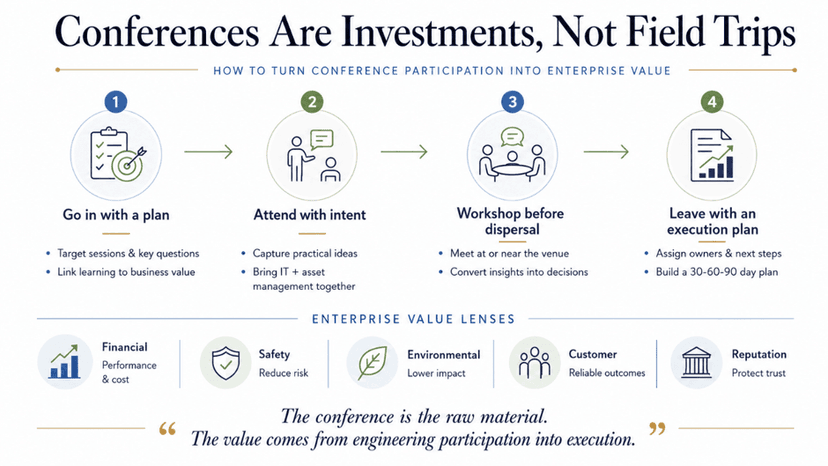
The model is simple. First, each delegate should go into the conference with a plan. He or she should know which sessions to attend, which questions to ask, which people to meet and, most importantly, how the learning could create value for the company.
Second, the company should organize a post-conference workshop to convert the learning into execution plans. If delegates are coming from multiple plants, business units, regions or functions, that workshop should ideally be held at or near the conference venue before everyone scatters back to their daily work. The purpose is not to compare notes casually. The purpose is to turn insight into action.
That is the engineering part.
I will be serving as both pre-conference workshop leader and emcee for the SAP for Asset and Service Management Conference Europe 2026, scheduled for 27–29 October in Seville, Spain. My workshop, “Asset Management in Dollars & $ense: Turning EAM and ERP into Enterprise Value,” is built around a question that should be central to every conference attendee and every executive sponsor: how do we turn asset management, EAM and ERP capability into measurable enterprise value?
That question should not be asked after the conference. It should shape how the company participates in the conference.
Go With a Value Hypothesis
In my prior executive asset management roles, I sponsored teams to attend conferences around the world. I wanted my people there. I wanted them listening, questioning, comparing, and learning. However, I did not simply approve travel and hope that value would somehow emerge.
Each delegate was required to identify, before the conference, which sessions he or she intended to attend and why. More importantly, each delegate had to explain how those sessions related to creating value for the company.
Not personal interest. Not “this looks relevant.” Not “I want to see what others are doing.” Value.
Could the session help us reduce risk? Improve safety? Increase availability? Improve throughput? Strengthen asset integrity? Reduce environmental exposure? Improve work execution quality? Improve master data? Strengthen planning and scheduling? Improve inventory decisions? Accelerate adoption of a new technology? Support a capital decision? Improve the business case for transformation?
That pre-work changed the posture of the delegates. They did not wander from room to room collecting ideas. They arrived with a purpose.
They did not wander from room to room collecting ideas. They arrived with a purpose.
The difference matters. A delegate attending a conference casually hears interesting presentations. A delegate attending with a value hypothesis listens differently. He asks better questions. She compares the speaker’s experience to the company’s current condition. He looks for evidence. She looks for patterns. They both come home better prepared to influence change.
Conferences Are Expensive. Wasted Learning Is More Expensive.
Registration fees, flights, hotels, meals, time away from the business, and the opportunity cost of pulling good people out of daily execution all add up quickly. For a company sending a meaningful delegation, the fully burdened cost can easily reach tens of thousands of dollars.
That is not necessarily a problem. The problem occurs when conference participation is treated as professional tourism instead of a value-creation investment.
I have always believed that conferences can be among the highest-return development and transformation investments an organization makes. They create space for people to step away from the tyranny of the urgent and think about what must change. They allow teams to see how peers are solving similar problems. They provide access to experts, vendors, practitioners, and technology partners in a concentrated setting.
But the return is not automatic. It must be designed.
The problem starts when conference participation is treated as professional tourism instead of a value-creation investment.
A conference delegate should not return with a bag of brochures and a notebook full of disconnected ideas. A delegate should return with a point of view. What should we stop doing? What should we start doing? What should we simplify? What should we standardize? What should we pilot? What should be incorporated into the transformation roadmap?
Those questions are too important to leave to chance.
Convert Learning Before It Evaporates
Anyone who has attended a good conference knows the pattern. During the event, ideas are flowing. The team is energized. People see possibilities. They have hallway conversations. They hear how other companies solved similar problems. They begin to imagine a better way.
Then they return home.
The inbox is full. The plant has issues. The program has deadlines. The urgent immediately attacks the important. Within a week, the conference has become a handful of notes, a few brochures and a vague recollection that “we should do something with that.”
That is waste.
The post-conference workshop protects the investment. It forces the team to compare notes, identify common themes, challenge assumptions, and decide what will actually be done. The output should not be a trip report. It should be a 30-, 60-, and 90-day execution plan.
The output should not be a trip report. It should be a 30-, 60- and 90-day execution plan.
This is especially important when delegates come from different functions or geographies. If people are flying in from multiple sites, regions, or business units, take advantage of the fact that they are already together. Book the room. Hold the workshop. Convert the learning while the experience is fresh and the right people are still present.
The questions are straightforward.
What did we learn that confirms our current direction? What did we learn that challenges it? What decisions need to be made? What should be escalated? What actions should begin immediately? Who owns them? What value are we trying to create?
This is where conference participation becomes enterprise value.
Where IT and Asset Management Need to Meet
The SAP for Asset and Service Management Conference Europe is precisely the kind of event that deserves this level of discipline because it sits at the intersection of technology, asset management, and business performance.
One of the greatest opportunities is to bring IT, IM, and IS&T professionals together with asset management practitioners. These groups often view EAM technology through different lenses.
IT, IM, and IS&T professionals naturally focus on architecture, configuration, integrations, data structures, cybersecurity, workflows, migration rules, user roles, and system performance. Those lenses are essential. Without them, the technology will not work.
Asset management, maintenance, reliability, operations, engineering, and field service practitioners often focus on different questions. Can the planner find the right task list? Does the technician have the right job plan? Is the equipment hierarchy useful? Are failure codes meaningful? Are maintenance plans tied to risk and failure modes? Are bills of material accurate? Can condition data trigger the right work? Does the system help frontline workers execute safely, precisely, and efficiently?
Those lenses are also essential. Without them, the business will not improve.
The problem is not that either group is wrong. The problem is that they are often looking at the same technology from opposite sides of the table.
Without the IT lens, the technology will not work. Without the practitioner lens, the business will not improve.
A conference like this creates an opportunity to put them on the same side of the table.
Five Lenses for Enterprise Value
In my view, EAM and ERP investments should be evaluated through five value lenses: financial performance, safety, environmental stewardship, customer satisfaction, and reputational protection.
Financial value may come from improved availability, improved rate performance, reduced reactive work, optimized inventory, better labor productivity, and better capital decisions. Safety value comes from reducing emergency work, improving job planning, strengthening asset integrity, and enabling frontline workers to execute work safely. Environmental value comes from reducing spills, emissions events, waste, energy intensity, and process instability. Customer satisfaction improves when operations are more reliable and service interruptions decline. Reputational protection comes from preventing the kinds of events that destroy trust, invite regulatory scrutiny, and damage enterprise value.
This is the level at which EAM should be discussed.
A company should not send one group to learn about technology and another group to learn about maintenance. It should send a cross-functional team to answer a much bigger question: how do we better leverage EAM to create enterprise value?
S/4HANA Is a Business Reset, Not a Technical Migration
This discipline is particularly important for organizations facing an S/4HANA conversion or restart.
These programs can easily become consumed by deadlines, migration rules, budgets, configuration decisions, and cutover plans. All of those things matter. But if the program loses sight of value, the company may spend a great deal of money recreating yesterday’s weaknesses on tomorrow’s platform.
Use the S/4HANA conversion to rebuild asset management around value instead of migrating what already exists.
The better question is not “How do we move what we have into S/4HANA?”
The better question is, “How do we use this moment to create the asset management system our business actually needs?”
That means better master data. Better functional location and equipment structures. Better asset criticality. Better work management. Better task lists. Better maintenance plans. Better bills of material. Better failure coding. Better connection between condition signals and work execution. Better integration between reliability strategy and frontline execution. Better visibility of risk. Better linkage between EAM activity and business performance.
In other words, better value.
The Real Test Is What Changes Afterward
The SAP for Asset and Service Management Conference Europe will provide the setting. The sessions, workshops, roundtables, sponsors, SAP experts, and peer conversations will provide the raw material. But the conference itself will not create value for a company.
The company creates value by showing up prepared.
That means selecting delegates intentionally. It means assigning session coverage based on business priorities. It means bringing IT and asset management practitioners together. It means asking every delegate to connect learning to value. It means holding a post-conference workshop while the team is still together. It means converting insight into a plan. It means assigning owners and following through.
Conferences should inspire us. They should expose us to new ideas. They should help us build relationships. But in asset management, inspiration is not enough.
The real test is what changes when we get back to work.