
Shallow Questions, Shallow Results
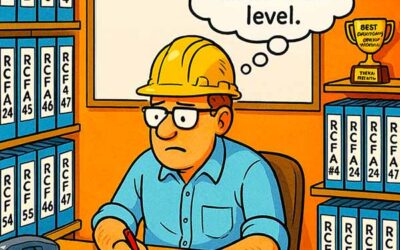
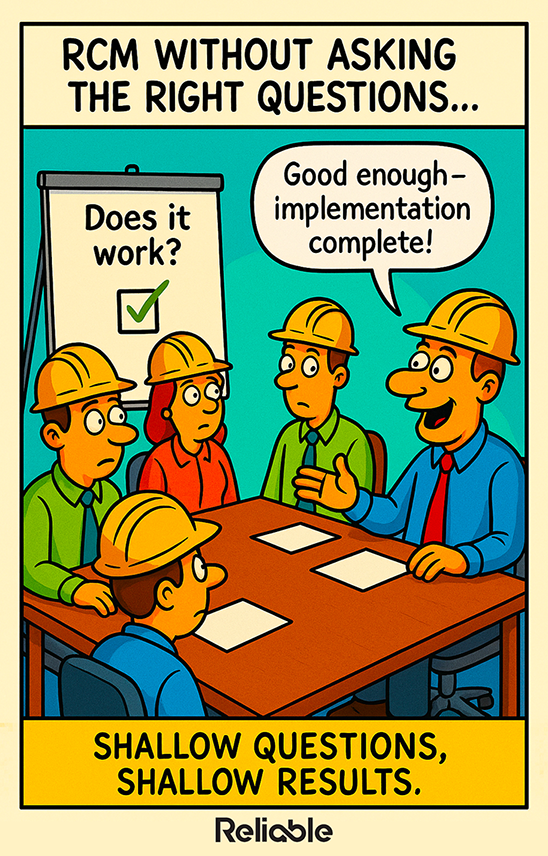
In too many plants, Reliability-Centered Maintenance (RCM) becomes a paperwork exercise rather than a performance improvement strategy. Teams hold a few meetings, fill out forms, and ask surface-level questions like “Does it work?” before declaring success. But “working” is not the same as being reliable. Functionality without sustainability is simply luck in motion.
When reliability engineers and maintenance leaders treat RCM as a compliance box to tick, the outcome is predictable: temporary improvement followed by long-term regression. Assets that “seemed fine” eventually fail, often at the worst possible time. The root cause? Shallow inquiry.
Reliability doesn’t come from answers – it comes from asking better questions.
True reliability stems from depth—depth of understanding, depth of questioning, and depth of analysis. The most successful organizations follow RCM implementation best practices that emphasize rigor, cross-functional insight, and failure anticipation. They recognize that the quality of questions determines the quality of answers.
Why RCM Implementation Fails Without Depth
Many RCM programs fail because they never truly begin. The team’s focus is on documentation, not discovery. The objective shifts from understanding failure behavior to completing forms or meeting audit expectations. This “shallow RCM” delivers minimal insight and often leads to task duplication or wasted maintenance effort.
Typical failure points in RCM include:
- Narrow participation: Only maintenance staff are involved, leaving out critical perspectives from operations, engineering, and safety.
- Incomplete failure analysis: Failure modes are guessed or generalized, not derived from historical and operational data.
- Reactive bias: Teams design maintenance tasks around what’s already failed, ignoring latent failure risks.
- Short-term thinking: The focus is on achieving quick wins instead of developing sustainable reliability systems.
- Cultural complacency: Leaders celebrate “completion” instead of measurable reliability outcomes.
Each of these pitfalls reflects a breakdown in curiosity. A robust RCM process forces organizations to think critically about how and why things fail, not just how to fix them afterward. That intellectual rigor separates maintenance activity from maintenance excellence.
Asking the Right Questions in RCM Implementation
The foundation of RCM implementation best practices is inquiry, asking structured, meaningful, and often uncomfortable questions. Every RCM facilitator should guide teams beyond the superficial “Does it work?” to explore the conditions, causes, and consequences of failure.
Here are the six essential categories of questions that drive practical RCM analysis:
- Functional Intent:
What exactly should this system do, and what defines acceptable performance? Clarifying intended function prevents ambiguity and ensures maintenance supports operational goals rather than assumptions. - Functional Failures:
Under what circumstances could this asset fail to perform as intended? A clear definition of functional failure bridges the gap between design expectations and real-world behavior. - Failure Modes:
What specific events, errors, or conditions could lead to each functional failure? Teams must identify not just component wear, but human error, process variability, and external factors that drive unreliability. - Failure Effects:
What happens when a failure occurs? Does it create a safety hazard, environmental risk, production loss, or hidden degradation? This question shifts focus from symptoms to consequences, ensuring the proper prioritization of risks. - Failure Consequences:
What is the business impact of this failure mode? Evaluating cost, safety exposure, and downtime consequences ensures RCM efforts align with enterprise priorities. - Proactive and Corrective Tasks:
What actions can prevent, predict, or mitigate this failure? And are those actions technically feasible and economically justified?
The goal of RCM is not to find the perfect maintenance plan; it’s to find the most defensible plan based on logic, risk, and cost. Teams that skip these structured questions build unreliable systems built on assumptions instead of evidence.
Embedding RCM Implementation Best Practices
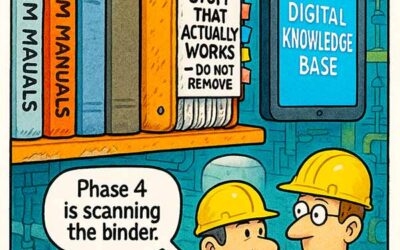
Asking the right questions is only the start. To sustain gains, organizations must embed RCM implementation best practices within the operational fabric of the plant. RCM must live inside the culture, not in a binder on a shelf.
The essential components of a sustainable RCM framework include:
- Governance and Leadership Alignment:
Establish an RCM steering team with executive sponsorship. Leadership must communicate that RCM is not optional; it’s strategic. - Training and Facilitation Quality:
Skilled facilitators are non-negotiable. They must understand the logic tree of decision analysis and be able to challenge assumptions without alienating participants. - Cross-Functional Participation:
Effective RCM demands collaboration between maintenance, operations, safety, and reliability engineering. Each brings a unique lens to asset function and consequence. - Integration with CMMS and EAM Systems:
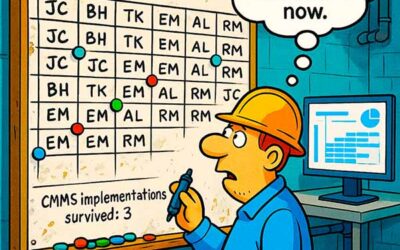
RCM results must drive actual maintenance actions—task lists, intervals, and work instructions. If it doesn’t change work execution, it hasn’t been implemented. - Feedback and Continuous Improvement:
Every failure is a data point. Root cause analysis (RCA) should continuously feed back into the RCM logic, updating tasks and assumptions. - Performance Metrics:
Measure RCM success through leading indicators:- Percentage of proactive vs. reactive work
- Mean time between failures (MTBF)
- Condition-based task compliance
- Maintenance cost per unit of output
When these practices become institutionalized, RCM transforms from a project into a living reliability framework, a mindset that drives consistent performance gains year after year.
From Compliance to Competence: The Reliability Mindset
The end goal of RCM isn’t compliance, it’s competence. A “complete” RCM analysis that fails to influence behavior or outcomes is a hollow achievement. In contrast, an organization committed to RCM implementation best practices builds a shared understanding of how assets fail and how to prevent those failures economically.
Plants that succeed in RCM share a few key traits:
- They treat every assumption as a hypothesis to be tested.
- They focus relentlessly on function and consequence.
- They learn from every failure, no matter how small.
- They integrate reliability into operations, not just maintenance.
Reliability is not a department; it’s a discipline. When teams ask deep, systematic questions and embed those lessons into everyday work, reliability stops being a slogan; it becomes a measurable reality.