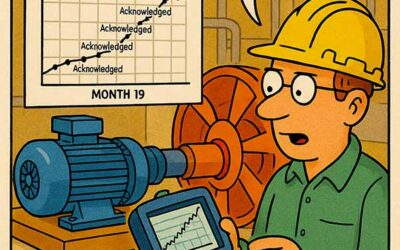
The cartoon captures the all-too-common rush on the plant floor: a technician swinging a sledgehammer at a bearing while yelling, “Precision? Nah. I’ve got momentum.” The message below cuts deep: Speed isn’t skill. Install bearings the right way.
That impact can initiate damage invisible to the eye, yet devastating over time. Industry surveys and field reports commonly estimate that improper mounting – including impact damage, misalignment, contamination during installation, and incorrect fit selection – contributes to roughly 10–20% of premature rolling-element bearing failures, often overlapping with lubrication and contamination issues.
The Hidden Cost of Impact-Based Mounting
Hammering drives force through the rolling elements, creating instantaneous contact stresses that can exceed 4 GPa (4,000 MPa)—far above typical design levels of 1.5–3 GPa and high enough to cause local plastic deformation in through-hardened bearing steel.
These overloads produce true brinelling: permanent indentations that initiate fatigue once the bearing rotates. Cocking, cracked rings, or forced-in contaminants compound the problem, compromising the bearing before startup.
True Brinelling vs. False Brinelling: Critical Distinction
- True brinelling: Plastic deformation from impact or overload during mounting; indentations show material displacement at rolling-element pitch.
- False brinelling: Fretting wear from micro-oscillations while stationary (common in storage/transport); polished marks without displaced material.
Proper bearing installation techniques eliminate mounting-induced true brinelling.
Core Principles of Proper Bearing Installation Techniques
These practices align with manufacturer mounting guidelines and damage modes in ISO 15243 (bearing damage and failure modes) and life assumptions in ISO 281:
- Apply force only to the ring with the interference fit.
- Ensure absolute cleanliness and geometric accuracy.
- Use controlled uniform pressure or thermal expansion, never impact.
Step-by-Step Proper Bearing Installation Techniques for Solid Shafts
Preparation Phase
- Measure shaft and housing to 0.001 mm accuracy; confirm OEM fits.
- Remove burrs/high spots; seats must be square and smooth.
- Clean thoroughly; keep bearings sealed until mounting.
- Never spin a dry bearing to “clean” it – unlubricated rotation causes metal-to-metal contact that can smear raceways and create early surface damage, especially with particles present.
Thermal Mounting – Preferred for Interference Fits
Induction heating remains the benchmark:
- Target 80–110 °C for most bearings. Many manufacturers allow up to about 120 °C; some heat-stabilized large bearings may permit slightly higher temperatures, per specific instructions.
- Heat until the inner ring expands sufficiently (typically 0.075–0.15 mm).
- Slide straight onto shaft; hold against shoulder until grip forms.
- After thermal mounting, allow cooling to near ambient before adding lubricant if using grease (prevents thermal degradation). Factory-sealed bearings typically need no additional lubrication.
For angular-contact or tapered roller bearings that require specific preload, follow the manufacturer’s procedures for measuring and adjusting preload after installation.
Cold Mechanical Mounting – When Required
- Use full-face sleeves contacting only the pressed ring.
- Apply steady axial force via press or hydraulic nut.
- Monitor displacement; stop immediately at shoulder contact.
Four Proven Proper Bearing Installation Techniques and Tools
1. Induction Heating
- 60–180 second cycles
- Precise control + automatic demagnetization
- Zero contamination risk
2. Hydraulic Press with Full-Face Sleeves
- Force/displacement monitoring
- Essential for bearings >200 mm OD
3. Oil Injection Method
- Creates thin high-pressure oil film that can reduce effective mounting force by roughly an order of magnitude versus dry fits
- Ideal for very large bearings
4. Controlled Oven/Hot Plate
- Acceptable backup when carefully monitored
Adapter and Withdrawal Sleeves – Torque Only
Tighten locknuts (typically 50–500 Nm by size) using a hook spanner and a torque wrench per manufacturer tables. Hammering transmits force through rollers and rapidly cracks inner rings.
Hydraulic nuts deliver repeatable clamping without shock.
Misalignment Guidelines by Bearing Type
Cocking during mounting accelerates fatigue:
- Deep-groove ball bearings: typically 2–3 arc minutes (~0.0005–0.001 radians). Bearings with higher internal clearance (C3, C4) and larger sizes may tolerate slightly more.
- Cylindrical roller bearings: ≤2 arc minutes (~0.0006 radians) due to high line-contact sensitivity; precision applications often require ≤1 arc minute.
- Spherical roller bearings: self-aligning design accommodates 1.5–3 degrees during operation, depending on series and load. During initial mounting, aim for <0.5 degrees misalignment for optimal load distribution, even though operational tolerance is much higher.
These are typical guidelines; always consult the specific bearing catalog, as permissible angles vary with size, clearance, load, and series.
Contamination During Mounting – Often Overlooked
Particles forced into raceways under pressure become indenters once rotation starts. Proper bearing installation techniques require surgical cleanliness: clean gloves, tools, and surfaces.
Special Consideration: Hybrid and Full-Ceramic Bearings
Different thermal expansion rates demand strict adherence to manufacturer procedures, overheating can create destructive preload.
Real-World Gains from Proper Bearing Installation Techniques
Facilities that ban hammers and standardize controlled mounting consistently report strong results:
- Gearbox rebuild shops have reported up to 70–80% reductions in premature failures after adopting induction heating and sleeve methods.
- Heavy-industry plants (paper, mining, steel) frequently document 2× or greater bearing life when proper bearing installation techniques replace legacy impact practices.
- A facility facing 100 bearing failures annually with average total cost (parts + labor + downtime) of $2,000–$4,000 per event can save $100,000–$300,000 yearly by cutting failure rates 50–75% through disciplined proper bearing installation techniques.
Actual improvements depend on baseline practices, loads, contamination control, and lubrication quality.
Common Objections – And Answers
- “We’ve always hammered them with no issues.” Survivorship bias ignores the silent failures.
- “Induction heaters cost too much.” Most pay back in months at typical bearing consumption.
- “Heating takes forever.” Modern units reach target temperature in 1–3 minutes, far less than one seized-bearing repair.
Institutionalizing Proper Bearing Installation Techniques
Five Fast Actions
- Equip benches with induction heaters and full-face sleeves.
- Post clear “NO IMPACT MOUNTING” signage.
- Require mounting method verification on every work order.
- Section failed bearings for root-cause reviews, show true brinelling evidence.
- Track and celebrate the longest mean time between replacements.
The hammer-wielding technician isn’t careless; he’s rushed and under-equipped. Provide the right tools, clear procedures, and leadership support, and that same person becomes the reliability expert who delivers years of extra service life.
Momentum without control destroys value. Precision, delivered consistently through proper bearing installation techniques, multiplies it.