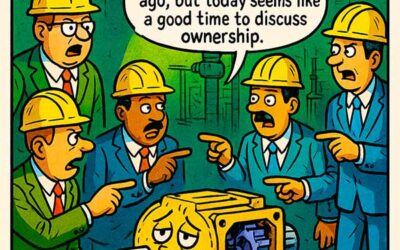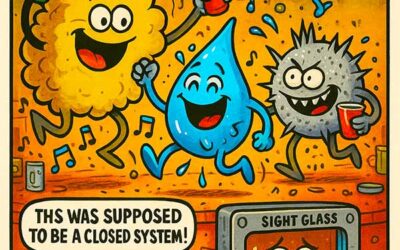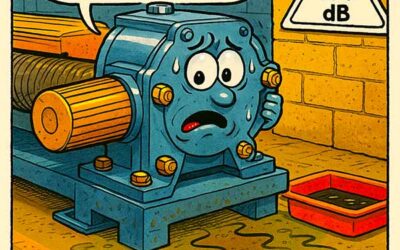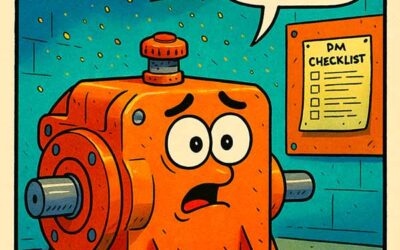
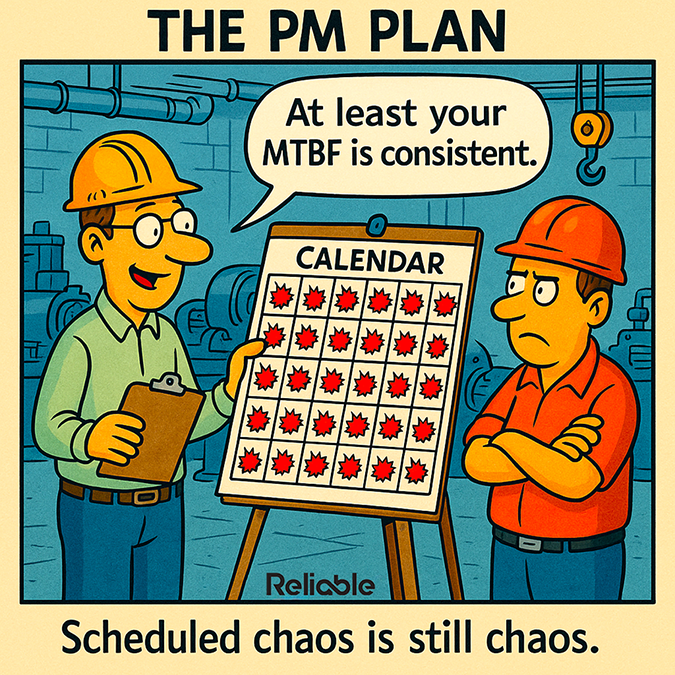

A calendar packed with preventive maintenance (PM) tasks looks impressive until you realize it’s just organized chaos. Many plants believe a full PM schedule equates to control. But when every day is booked solid and failures still occur, that’s not structure, it’s dysfunction with a clipboard.
Preventive maintenance scheduling optimization separates activity from effectiveness. It’s not about how many PMs you complete; it’s about whether those PMs actually extend mean time between failures (MTBF), reduce reactive work, and stabilize production. Proper optimization transforms maintenance from a scheduling exercise into a performance strategy.
Why Preventive Maintenance Scheduling Optimization Matters
Without optimization, preventive maintenance becomes a ritual, a cycle of repetitive tasks that provide comfort, not results. The root problem is that many PM programs were built decades ago and have never evolved. They’re filled with outdated OEM intervals, redundant checks, and vague inspection notes that add little value.
Preventive maintenance scheduling optimization forces a reexamination of every task’s purpose. Each PM should prevent a specific failure mode, deliver actionable data, or eliminate a known risk. Anything else is waste disguised as work.
The benefits are measurable:
- Reduced reactive labor. Less firefighting means more stability.
- Increased wrench time. Technicians spend more hours doing meaningful work, not rescheduling.
- Improved reliability metrics. MTBF rises, downtime drops, and cost per repair declines.
Optimization transforms the PM schedule into a reliability roadmap: leaner, smarter, and perfectly aligned with operational priorities.
Breaking the Cycle of Predictable Failures
When MTBF remains constant, it’s not a sign of consistency; it’s proof that nothing is improving. Many plants experience failures like clockwork, right on schedule, because their PMs never attack the underlying causes.
Preventive maintenance scheduling optimization introduces a feedback mechanism that ties every PM to real-world outcomes. After each event, data from work orders, inspections, and root cause analyses feed back into the schedule. Over time, this creates a dynamic, self-correcting plan that evolves as the equipment and operation change.
To end the cycle of “scheduled breakdowns”:
- Map failure modes and link each to its corresponding PM task.
- Quantify PM effectiveness. Did the task reduce risk or just consume time?
- Adjust intervals based on asset behavior—not arbitrary calendar cycles.
- Incorporate PdM data. Condition-based inputs refine PM frequency and scope.
The result is a schedule that predicts, prevents, and continuously improves, rather than simply repeating the same mistakes every month.
Building a Consequence-Based PM Schedule
Traditional PM calendars treat every asset equally. Optimization challenges that assumption. A failed air handler in the breakroom doesn’t deserve the same attention as a critical turbine bearing. Preventive maintenance scheduling optimization ranks assets by consequence, not convenience.
This is where criticality analysis becomes essential. By combining failure consequence, probability, and repair cost, planners can assign risk-weighted priorities to every PM task. From there, resources are distributed intelligently:
- High-consequence assets get precision inspections and PdM coverage.
- Medium-risk assets follow streamlined PMs optimized for effort vs. benefit.
- Low-consequence equipment is managed through run-to-failure or minimal monitoring.
A consequence-based schedule delivers more value per maintenance hour. And when integrated with production planning, it also reduces conflict—aligning downtime windows, labor availability, and parts readiness.
For maximum stability, freeze 80% of your weekly schedule and limit last-minute changes to actual emergencies. Discipline in planning is the foundation of reliability.
Integrating Technology for Smarter Scheduling
Modern reliability programs don’t rely on paper calendars or gut feel—they use data-driven orchestration. Preventive maintenance scheduling optimization thrives when technology connects the dots between planning, execution, and performance.
- CMMS Integration: Automatically generate work orders based on condition triggers, not arbitrary dates.
- Analytics Dashboards: Visualize workload balance, overdue PMs, and variance from plan.
- AI & Machine Learning: Predict optimal maintenance timing by correlating performance, load, and environmental data.
- Digital Twins: Simulate PM intervals virtually before implementing them in production.
Technology doesn’t replace human insight; it amplifies it. The combination of planner discipline and digital intelligence turns scheduling from reactive firefighting into predictive foresight.
Closing the Feedback Loop with Continuous Optimization
A PM plan is never “finished.” It’s a living document that must evolve as assets, environments, and personnel change. The most reliable organizations audit their PM plans quarterly and perform full optimization reviews annually.
Effective preventive maintenance scheduling optimization requires a closed feedback loop that includes:
- Post-PM analysis to measure real failure prevention.
- Failure data integration from CMMS and PdM systems.
- Labor utilization reviews to rebalance workloads.
- KPI tracking – PM compliance, schedule adherence, MTBF, and PM-to-CM ratios.
Each iteration moves the organization closer to a proactive maintenance culture. The reward isn’t just fewer breakdowns, it’s a measurable shift from chaos to control.
Conclusion: From Scheduled Chaos to Sustainable Reliability
The cartoon says it best: Scheduled chaos is still chaos. Filling a calendar with work doesn’t make it effective; it makes it a predictable failure.
The accurate measure of maintenance maturity is not the number of tasks completed, but the number of unplanned events avoided.
Through preventive maintenance scheduling optimization, you convert a static PM program into a living reliability framework. Every inspection, repair, and adjustment becomes part of a system that learns and improves over time.
When optimization is done right, maintenance stops being a cost center and becomes a competitive advantage. Your team works with precision, your machines perform with consistency, and your plant finally achieves what every calendar promises but rarely delivers: controlled, predictable, and profitable uptime.