
Preventive maintenance (PM) programs are designed to reduce risk, extend equipment life, and maintain uninterrupted production. On paper, they’re straightforward: follow a checklist, verify critical conditions, and document the work. Yet in practice, shortcuts often creep in. One skipped step may not seem like much until it’s the one that prevents the subsequent failure.
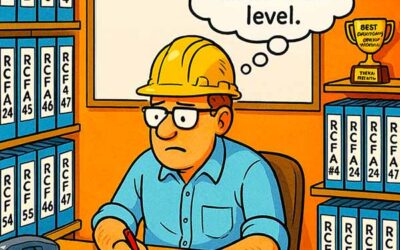
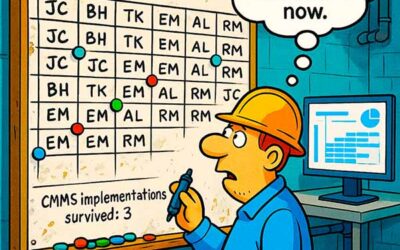
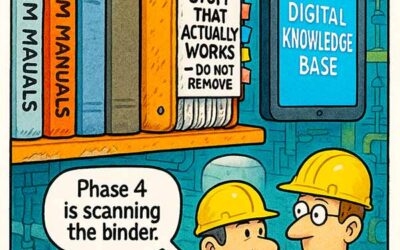
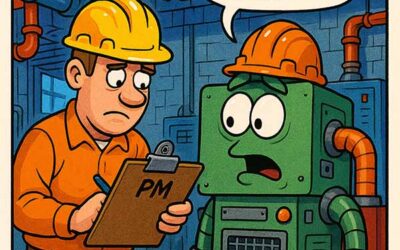
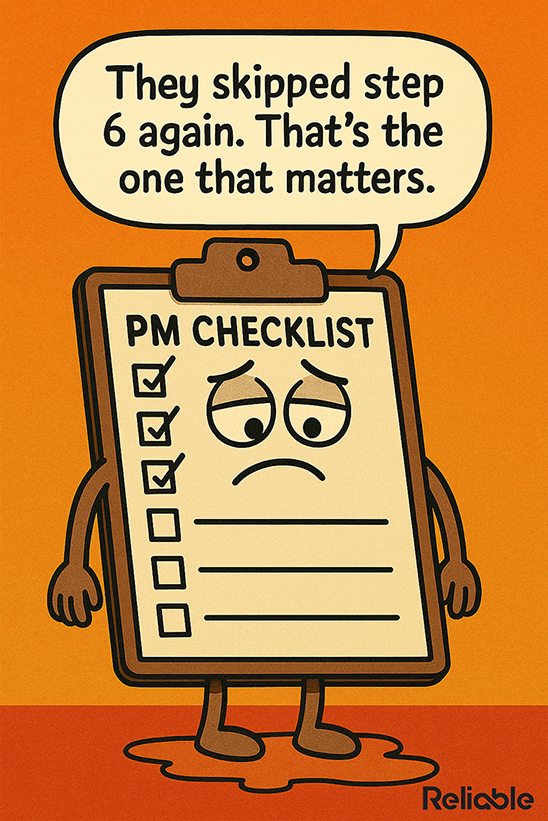
This cartoon highlights the truth: the checklist itself knows which step matters most, but technicians under pressure sometimes skip it. That choice undermines the entire PM program. Reliability depends not only on having procedures, but on the discipline to execute them entirely. The real lesson? Preventive maintenance checklist best practices aren’t about paperwork—they’re about keeping machines alive.
The Real Cost of Skipped PM Steps
Every box left unchecked is a gamble. Industry studies suggest that as much as 70% of rotating equipment failures are linked to lubrication errors, many of which stem from skipped inspection or service tasks. A missed grease point, an unchecked filter, or an ignored torque spec during reassembly may seem trivial in the moment. But add vibration, heat, and operating stress, and suddenly the skipped step reappears as a catastrophic failure.
One chemical plant I visited had a rash of pump failures. A root cause review found that a simple shaft alignment verification was repeatedly skipped. The job card called for it, but technicians considered it redundant. Over time, coupling wear accelerated, seals leaked, and pump lifespans were halved. The checklist hadn’t failed; the execution had. Following the preventive maintenance checklist best practices would have saved thousands of dollars in parts and prevented weeks of lost throughput.
Why Discipline in Preventive Maintenance Checklists Matters
The psychology of skipping steps is worth examining. Many PM tasks are repetitive, dirty, or inconvenient. Under time pressure, technicians rationalize: “I’ve done this a hundred times, and it’s never failed.” But reliability isn’t about averages, it’s about avoiding the outliers that cripple production.
Discipline comes from culture, not orders. Plants that treat PMs as “necessary evil paperwork” tend to have higher rates of skipped steps. Plants that link every checklist item to a known failure mode see higher compliance. In one automotive plant, leaders explained how each PM task was tied to warranty claims. When technicians understood that a skipped inspection could turn into a recall campaign, compliance skyrocketed.
The lesson: preventive maintenance checklist best practices must be supported by visible leadership. Supervisors must reinforce the purpose of each step, validate execution, and demonstrate to technicians that their work is essential, not optional.
Improving PM Checklist Design and Execution
A bloated PM document can be its own worst enemy. When technicians face a 12-page checklist filled with redundant or poorly explained tasks, they disengage. Best practice means designing checklists that are concise, targeted, and risk-weighted.
Practical improvements include:
- Risk-weighted steps: Bold or highlight the items that prevent high-probability or high-cost failures. A quick bolt-tightening check may prevent a $50,000 gearbox loss.
- Digital systems: Mobile apps can verify that each step is acknowledged in sequence, with photos or measurements uploaded as evidence. This reduces “pencil-whipping.”
- Feedback loops: If technicians encounter steps that add no value, they should flag them. Continuous improvement in checklist design increases buy-in.
- Training integration: Use PM tasks as real-time skill reinforcement. A checklist becomes a training tool when linked to skill matrices.
One refinery reduced its PM completion times by 30% after trimming redundant tasks and digitizing the workflow. Compliance also improved, as the process felt purposeful rather than bureaucratic. That’s the essence of preventive maintenance checklist best practices: remove noise, emphasize value, and make it easy to do the right thing.
Building a Culture Around PM Accountability
The best checklist in the world won’t matter if accountability is absent. Reliability is built on culture—people respecting the process and holding each other to standard. Accountability does not mean punishment; it means visibility.
Some plants conduct random spot checks, where supervisors reverify recently completed PMs. Others tie compliance to meaningful metrics such as Mean Time Between Failure (MTBF) or OEE. When reliability KPIs improve, leaders make it clear that PM discipline is a contributor.
Recognition is a powerful lever. In a packaging facility, teams who completed 100% of their PMs without skips for a quarter were celebrated with public recognition. Over time, PM compliance became a point of pride. Skipped steps dropped dramatically, downtime trended downward, and production stability improved.
That’s how preventive maintenance checklist best practices become part of daily operations, not through enforcement alone, but through recognition, feedback, and visible results.
The Strategic Value of Getting PM Right
There’s a bigger picture at stake. Skipped PM steps don’t just cause failures; they erode trust between maintenance and operations. When machines fail despite “completed” PMs, operators assume the process is worthless. That perception can doom continuous improvement initiatives before they start.
But when PM checklists are designed intelligently and executed faithfully, they drive measurable value:
- Lower maintenance costs per unit of production
- Higher asset availability
- Reduced emergency callouts and overtime
- Improved safety by preventing secondary failures (e.g., fires from seized bearings)
Industry leaders understand that a PM program isn’t just about avoiding downtime; it’s about strategic business performance. Consistent execution of preventive maintenance checklist best practices transforms reliability from a department function into a competitive advantage.
Closing Thought
The sad checklist in the cartoon speaks for every reliability engineer who knows the truth: the skipped step is the one that matters. Preventive maintenance is only as good as the discipline behind it. Every time a step is skipped, risk compounds.
Reliability is not built by plans; it’s built by consistent actions. The organizations that internalize best practices for preventive maintenance checklists, design smarter checklists, and hold themselves accountable are the ones that transform maintenance from a cost center into a performance driver.
Skip the step, and you pay later. Follow through, and you build reliability that lasts.