The Real Value Behind Predictive Maintenance ROI
Predictive maintenance ROI represents far more than a budget justification; it’s the measure of how effectively a plant transforms data into reliability and uptime. Every maintenance leader faces the same question: Is the investment paying off? The answer depends on how well technologies, people, and processes align.
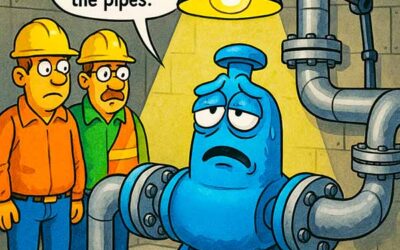
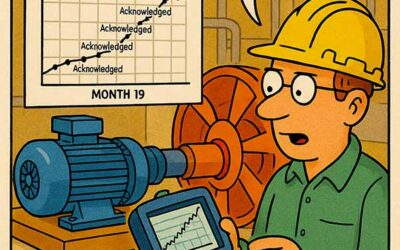
The cartoon says it best: vibration, thermography, motor current, and oil analysis all “smile” differently because they each perceive failure in their own way. Alone, they provide valuable snapshots. Together, they deliver a cinematic view of machine health, one that drives decisions, prevents downtime, and multiplies predictive maintenance ROI.
When every diagnostic tool speaks in harmony, predictive maintenance stops being a cost and starts becoming a competitive advantage.
Organizations that achieve measurable results from predictive maintenance don’t simply install sensors; they integrate intelligence. They combine technologies, cross-train teams, and continuously refine data interpretation. The outcome isn’t just cost avoidance – it’s operational agility, where maintenance becomes a profit enabler rather than a sunk cost.
Proving the Financial Impact of Predictive Maintenance
A precise predictive maintenance ROI calculation requires a comprehensive accounting of direct and indirect gains. Many plants underestimate the actual benefits by focusing only on avoided breakdowns. A complete ROI analysis should include:
- Reduced unplanned downtime: Quantify production hours saved.
- Lower maintenance costs: Include parts, labor, and overtime reduction.
- Extended asset life: Assign financial value to delayed replacements.
- Energy efficiency improvements: Track current draw and thermal load reduction.
- Safety and compliance benefits: Measure avoided incidents and penalties.
- Inventory optimization: Fewer emergency repair means lower parts inventory.
A robust predictive maintenance ROI model also considers soft returns, such as improved workforce morale, enhanced planning accuracy, and better customer delivery reliability.
Example: A chemical plant implemented vibration and thermography across 80 critical pumps. Within 12 months, failures dropped by 38%, overtime hours by 22%, and spare-part spending by $180,000. Predictive maintenance ROI exceeded 400%, a return not from technology alone, but from connected execution.
Integration: The Hidden Multiplier of Predictive Maintenance ROI
Integration turns good data into significant decisions. A vibration alert indicating bearing wear is valuable, but when that same asset also shows rising temperature via thermography and metal wear particles in oil analysis, confidence in the diagnosis spikes —and so does ROI.
Cross-technology integration enhances predictive maintenance ROI through:
- Fault correlation: Confirms issues across different detection methods.
- Prioritized response: Helps maintenance teams focus on verified risks.
- Reduced false positives: Minimizes unnecessary maintenance.
- Optimized scheduling: Enables condition-based interventions instead of rigid PM intervals.
- Faster root-cause analysis: Multiple perspectives converge on the problem source.
Plants that use a unified digital platform or CMMS to merge these data streams can build “smart asset profiles” that reveal real-time equipment health. The financial return grows significantly when management can visualize trends, forecast failure probability, and take action before downtime strikes.
In high-performing facilities, PdM systems integrate with ERP and production planning software, linking reliability directly to profitability. When a single system can forecast both asset health and financial impact, predictive maintenance ceases to be a maintenance initiative and becomes a business strategy.
Breaking Through the Barriers to Maintenance Success
Despite the potential, many programs plateau. The most common pitfalls preventing optimal predictive maintenance ROI include:
- Data fragmentation. Technologies operate in silos, making correlation difficult.
- Lack of standardization. Teams use different formats, frequencies, or alarm criteria.
- Insufficient training. Analysts interpret data inconsistently across technologies.
- Underdeveloped feedback loops. Findings aren’t linked to corrective action results.
- Poor executive buy-in. Leadership sees PdM as an expense, not an investment.
To break through these barriers, leading plants establish a Reliability Center of Excellence —a cross-functional group responsible for integrating data sources, validating savings, and maintaining documentation of the financial impact. Every avoided failure, every optimization should be logged and monetized. Over time, that record becomes the evidence executives need to justify expansion.
One often-overlooked dimension of predictive maintenance ROI is knowledge retention. Veteran technicians carry intuition that machines alone can’t replace. Digitally capturing and combining that intuition with PdM insights amplifies learning curves for new hires and ensures the system keeps getting smarter.
Predictive Maintenance ROI in the Age of AI and Analytics
Machine learning has supercharged predictive maintenance ROI potential. AI models trained on vibration, current, and oil data can now detect failure signatures weeks earlier than human analysts. These algorithms not only predict breakdowns, but they also calculate the economic impact of potential failures.
Predictive maintenance platforms now provide ROI dashboards that quantify real-time savings. Imagine knowing the financial value of each alert: “This avoided gearbox failure saved $42,000.” That’s the future, where predictive data translates instantly into dollar value.
Emerging trends increasing predictive maintenance ROI include:
- Edge computing: Faster local analysis with minimal latency.
- Sensor fusion: Combining multiple data sources into unified failure models.
- Cloud analytics: Cross-plant benchmarking and continuous model refinement.
- Digital twins: Simulating machine response to detect degradation early.
The next wave of gains won’t come from adding more sensors; it will come from making those sensors collaborate intelligently.
Turning Maintenance Insight into Sustainable Advantage
Predictive maintenance ROI isn’t a static metric; it’s a reflection of alignment between technology, process, and purpose. Each PdM method, such as vibration, thermography, oil analysis, and motor current, adds a unique voice to the maintenance orchestra. When those voices harmonize, they create not just insight, but foresight.
The highest ROI emerges when plants unify data, train teams to think across technologies, and turn condition monitoring into a management discipline. The return compounds with every failure prevented, every efficiency gained, and every insight shared.
In the end, predictive maintenance ROI measures not only cost savings but also organizational maturity; the ability to listen to machines before they break and to act on what they’re saying in time to make a difference.