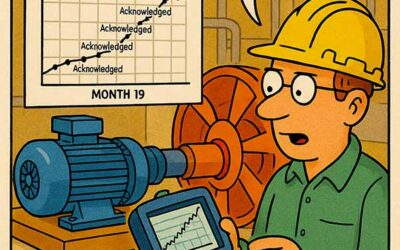


In the world of industrial operations, there is a peculiar psychological trap: when things are running perfectly, it feels like you are overpaying for maintenance. When things break down, it feels like you didn’t spend enough.
Predictive Maintenance (PdM) lives squarely in the center of this paradox. Unlike a new production line that increases output or a marketing campaign that drives a surge in leads, the primary “product” of a successful PdM strategy is … nothing. No smoke, no sirens, no frantic midnight phone calls, and no expensive unplanned downtime.
Because success looks like “business as usual,” the Return on Investment (ROI) often remains unrecognized by the C-suite. Avoided failures are counterfactual – they are events that didn’t happen – and because they aren’t formally costed on a ledger, they remain invisible right until the day the system fails, or more importantly, the day it doesn’t.
The Paradox of the “Nothing Happened” Metric
The fundamental challenge with PdM is that it aims to prevent an event from occurring. In traditional accounting, it is easy to measure the cost of a repair. It is much harder to measure the “profit” of a machine that simply kept spinning.
The Shift in Maintenance Maturity
Most organizations transition through three stages of maintenance maturity:
- Reactive: Fix it when it breaks.
- Preventive: Fix it on a schedule, regardless of condition, often leading to unnecessary part replacement and human-induced error.
- Predictive: Intervene when indicators reach a risk- and economics-based intervention threshold.
In the reactive phase, costs are erratic but highly visible. In the predictive phase, however, the ROI is often obscured. You are spending money on sensors, IT/OT integration, and analytical software to solve a problem that hasn’t manifested. To the untrained eye, this looks like an added expense with no immediate gain.
Why Silence is a Hard Sell
Imagine a PdM system flags elevated radial readings and specific harmonic patterns in a pump. Follow-up phase analysis and laser alignment verification confirm a coupling misalignment of 0.05 mm. If the technician corrects it during a scheduled break, the plant never stops. To the CFO, the day looked identical to any other day.
The ROI – avoiding a downtime event – remains a “ghost.” This is especially true when downtime costs are calculated improperly. True downtime costs are not just lost labor; they include contribution margin, scrap/waste, restart losses, safety risks, and potential contractual penalties. Depending on the industry, these costs can range from $5,000/hour in food processing to over $100,000/hour in semiconductor fabrication.
The Invisible Infrastructure: The Road to Data Maturation
One reason ROI remains hidden is the “trough of disillusionment” during the implementation phase. PdM is not a “plug-and-play” solution; the timeline for results varies by the type of analytics used.
Understanding the Ramp-Up Period
The “Data Maturation” period is often misunderstood. The time to value depends on the underlying model:
- Rule-Based/Physics-Based PdM: Can trigger alerts almost immediately by applying known physical limits to assets.
- Machine Learning (ML)-Based PdM: May require 6 to 12 months to capture seasonal variations, different operating modes, and a robust “normal” baseline.
During this window, the investment is highly visible on the balance sheet, but the system is still being tuned. If the system is poorly tuned, it may generate alarm fatigue, causing maintenance teams to lose trust before the ROI can ever be realized.
Optimizing the P-F Interval: The Economic Window
The ROI of PdM lives within the P-F Interval – the window between Potential Failure (the point at which a defect is first detectable) and Functional Failure (when the asset stops working).
Balancing Risk and Lifecycle Cost
A common misconception is that PdM means acting the second a defect is detected. However, acting too early can actually increase lifecycle costs by replacing parts that still had significant useful life.
True PdM ROI is found by acting within an economically justified window. This means using data to determine the “Sweet Spot”:
- Too Early: Premature replacement/high maintenance costs.
- Too Late: High risk of functional failure/safety incidents.
- The PdM Goal: Use lead time to order parts and schedule labor during planned downtime, minimizing the cost of the intervention while maximizing asset life.
OEE and Asset Criticality: Contextualizing the Gains
Many PdM business cases promise a blanket increase in Overall Equipment Effectiveness (OEE). However, PdM contributes primarily to the Availability component of OEE. These gains are only amplified when PdM is paired with disciplined planning and process controls.
| Plant Maturity | Baseline OEE | Potential OEE Gain | Primary Driver |
| Low | <70% | 5–10% | Eliminating frequent unplanned stops. |
| High | >85% | 1–3% | Refining intervention windows; process/quality focus. |
For PdM to be cost-effective, it must be strategically deployed on A-class assets – critical equipment where the cost of failure justifies the sensor and analysis overhead.
Human Factors: The Hybrid Intelligence Model
While modern physics-based and hybrid models can now encode complex relationships (like how ambient temperature affects NPSH margins and leads to cavitation), the best results still come from a combination of data and human domain knowledge.
The ROI becomes visible when data-augmented expertise allows a technician to prioritize work orders based on actual risk rather than a calendar. The algorithm provides the “what” and “when,” but the human expert often provides the “why” and the final validation.
Strategies to Make PdM ROI Visible
To secure long-term buy-in, maintenance leaders must move from “maintenance speak” to “business speak.”
1. The “Loss Avoidance” Ledger
To make the invisible visible, maintenance leaders must move away from simply tracking expenses and start documenting “Loss Avoidance.” Instead of a static budget, this ledger captures the financial delta between a controlled, predictive intervention and the chaotic, reactive failure that would have occurred otherwise.
To quantify this without a complex formula, look at the two primary buckets of savings:
- The Repair Delta: This is the difference in direct costs. A predictive fix usually involves less labor, lower-priced parts (since they aren’t rush-ordered), and no “collateral damage” to surrounding components that often occurs during a catastrophic break.
- The Total Value of Downtime: This is where the real ROI hides. It encompasses the contribution margin lost during the outage, the cost of scrap or wasted raw materials trapped in the line, the labor costs for restarting the process, and any contractual penalties for late delivery.
By documenting every “save” in these terms, you transform a maintenance event into a business victory. When you can show that a $2,000 bearing replacement prevented a $120,000 production loss, the ROI is no longer invisible – it becomes a line item for the next board meeting.
2. Documenting Severity with International Standards
Use recognized technical standards to validate your findings. For instance, if a sensor identifies vibration levels that exceed the typical alert thresholds for that specific class of equipment—referencing standards like ISO 20816 – don’t just report it as a “noisy motor.” Report it as a “validated mechanical defect exceeding international safety and reliability limits.”
This shifts the conversation from a technician’s opinion to an objective risk assessment. It provides the “proof of life” for the PdM system, showing that the technology is actively patrolling the boundaries of asset health.
3. Socializing the “Near Miss”
The greatest enemy of PdM is a short memory. When a defect is caught early, the resulting fix is often so seamless that the organization forgets there was ever a risk. To counter this, maintenance teams should “socialize” their wins.
Share the evidence: the thermal image showing a hot spot in a breaker that was minutes from tripping, or the spectral analysis showing the exact frequency of a failing gear tooth. By making the “Near Miss” tangible, you remind stakeholders that the current state of “business as usual” is a direct result of the predictive insights they’ve invested in.
The Silence of Success
Predictive Maintenance ROI is invisible for the same reason a good insurance policy is: you don’t notice it when it’s working. However, unlike insurance, PdM doesn’t just compensate you for a loss; it prevents it.
The day everything fails is the day you realize the true cost of not having predictive insights. But for the forward-thinking organization, the goal is to keep that ROI invisible – to keep the plant quiet and the profit margins steady. The “invisibility” of PdM ROI isn’t a sign of failure; it is the ultimate proof that the strategy is working.