When Discovery Feels Like Déjà Vu
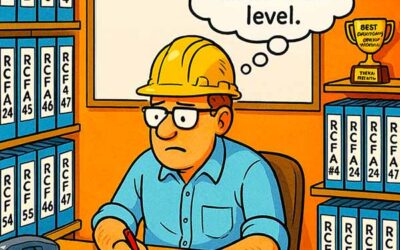
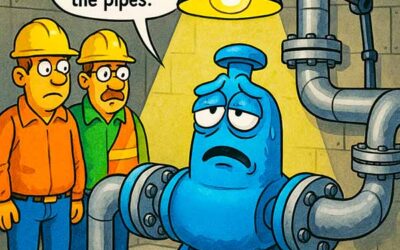
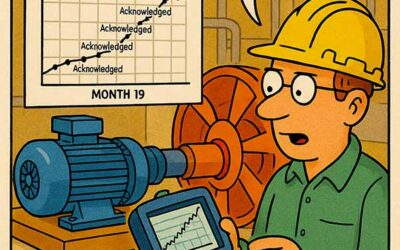
Every reliability professional has witnessed this scene: an eager manager pointing at a P-F curve, eyes wide with revelation, declaring, “So, we can fix things before they fail?” The maintenance team sighs – they’ve been saying the same thing for 15 years.
This cartoon captures a universal frustration: predictive maintenance program implementation isn’t new, but it’s treated like a groundbreaking innovation every time a new executive or consultant “discovers” it. The concept has existed for decades, yet most plants still live reactively, fighting fires instead of preventing them.
Predictive maintenance is not a new technology. It’s a philosophy of awareness, the discipline of reading what machines tell you long before they fail. The technology (AI, sensors, analytics) only amplifies that awareness. What keeps organizations stuck is not the lack of capability, but the lack of commitment.
Predictive maintenance only works when leadership listens, invests, and integrates it into how the business operates, not just how it repairs equipment.
Why Predictive Maintenance Program Implementation Lags Behind
Despite endless case studies and conference talks, the average plant still struggles to move from preventive to predictive maintenance. The reasons are rarely technical; they’re organizational.
Predictive maintenance program implementation requires data consistency, cultural buy-in, and financial patience. Leadership often wants instant ROI, but reliability maturity is cumulative. It grows from discipline: consistent inspections, meaningful measurements, and relentless root-cause analysis.
The irony? Most plants already have the data they need. Vibration readings, oil samples, thermography, and ultrasonic analysis, all collected faithfully. But without integration and context, these become disconnected snapshots instead of predictive intelligence.
Technology without discipline is just expensive noise.
The P-F curve visually reminds us: potential failure (P) is detectable long before functional failure (F). The earlier you act, the cheaper the correction. Yet, too often, management funds new assets and sensors but ignores the systems and people required to interpret what those assets reveal.
Predictive maintenance isn’t a tool purchase. It’s a decision-making framework that connects operations, maintenance, and reliability into one feedback ecosystem.
The P-F Curve: The Heart of Predictive Maintenance
The predictive maintenance program implementation process begins with a fundamental truth: every failure gives warning signs. The P-F curve represents the time between those warnings and the actual breakdown.
At the top of the curve, equipment operates at full potential. As degradation begins, subtle indicators emerge: a rise in vibration, a slight increase in temperature, and minor contamination in the oil. These signals mark the “P” point, where potential failure becomes detectable.
From that moment, the clock is ticking. Every day that passes without intervention narrows the window for cost-effective repair. By the time the “F” point arrives, you’re facing functional failure, unplanned downtime, and often, secondary damage.
The organizations that master predictive maintenance understand that managing this curve isn’t about guessing; it’s about measuring with intent. They track indicators across multiple technologies (vibration, infrared, oil analysis, acoustic emission) and correlate those readings with real-world performance data such as load, temperature, and speed.
Predictive maintenance doesn’t replace human expertise; it augments it. The combination of analytics and operator intuition creates a reliability culture where surprises vanish and uptime becomes predictable.
Data Without Action Is Just Expensive Storage
One of the biggest traps in implementing a predictive maintenance program is data paralysis. Plants often invest heavily in sensors and dashboards, only to drown in raw data they can’t interpret.
An authentic predictive maintenance culture translates that data into decisions:
- Detect: Early fault indicators appear through condition monitoring tools.
- Diagnose: Skilled analysts interpret anomalies using baselines and trends.
- Decide: Maintenance planners schedule intervention before failure.
- Verify: The intervention’s impact is measured and fed back to refine the model.
Without these four steps, predictive programs collapse into “digital dust collection.” Managers see graphs, but no outcomes. Planners receive alerts, but no priorities. Reliability engineers analyze data that no one acts upon.
Predictive maintenance isn’t about forecasting doom; it’s about scripting success.
Predictive maintenance success isn’t measured by terabytes collected, but by downtime avoided. The most advanced programs use AI and machine learning not to replace human reasoning but to surface patterns that human experts can validate.
The result? Maintenance transforms from reactive firefighting to proactive optimization. Failures no longer feel random; they become predictable events in a managed system.
Culture Eats Strategy—and Predictive Maintenance—for Breakfast
Technology can’t overcome cultural inertia. For predictive maintenance program implementation to succeed, leadership must move from fascination to ownership. That means funding training, redefining KPIs, and incentivizing early action instead of crisis response.
In reactive cultures, technicians are rewarded for heroics—fixing failures at 3 AM. In predictive cultures, they get rewarded for avoiding that call altogether. This shift requires executives to see reliability as a profit driver, not a maintenance expense.
The cultural transformation begins when leadership realizes predictive maintenance is not about avoiding cost – it’s about enabling performance. Plants with predictive programs report improvements in OEE, safety, and asset utilization. But these gains are unlocked only when communication flows both ways – from the control room to the boardroom.
When technicians feel heard, data gets context. When managers understand the P-F curve, budgets become strategic. And when reliability becomes part of business language, uptime becomes a competitive differentiator.
The Path Forward: Integrating Predictive Maintenance Into Strategy
The final evolution of predictive maintenance program implementation comes when it’s no longer treated as a “maintenance project” but as part of corporate strategy.
That requires measurable KPIs:
- Percentage of assets under condition monitoring
- Mean time between failure (MTBF) improvements
- Cost avoidance per predictive intervention
- Percent of planned vs. unplanned maintenance hours
Predictive programs must be tracked with the same rigor as production output or safety metrics. The goal is to demonstrate that reliability drives profitability, not just availability.
Leaders should invest not just in tools, but in capability maturity:
- Standardize data collection and failure classification.
- Integrate condition data with CMMS and ERP systems.
- Educate managers to interpret maintenance data as financial intelligence.
- Communicate results visibly—make avoided failures part of performance reports.
Predictive maintenance only becomes powerful when it informs strategy. Once reliability enters the financial conversation, it never leaves.
Turning Predictive Maintenance Into a Competitive Advantage
The cartoon’s humor is timeless because the situation is timeless. Predictive maintenance isn’t a new revelation; it’s old wisdom rediscovered by every generation of managers.
Predictive maintenance program implementation succeeds not through technology, but through conviction. It demands cross-functional alignment, steady leadership, and respect for the knowledge already within the maintenance team.
When companies stop “discovering” predictive maintenance and start living it, downtime becomes the exception, not the rule.
And when leadership finally embraces the message the maintenance crew has been saying for decades – that fixing before failure is common sense – reliability stops being a department and becomes the culture.