

Predictive Maintenance Isn’t Optional – It’s Inevitable
When the plant floor starts sounding like a rock concert, you don’t need earplugs—you need a plan. High decibel readings, elevated vibration signatures, or rising temperature profiles aren’t just anomalies—they’re pre-failure whispers. In today’s fast-paced production environment, ignoring them isn’t just negligent—it’s strategic malpractice.
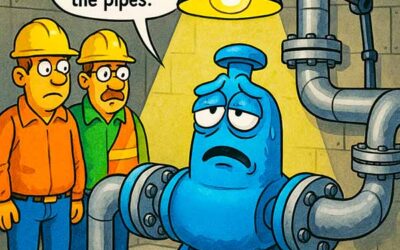
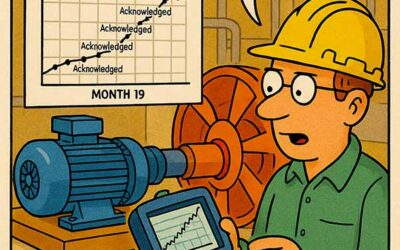
The cartoon might be whimsical, but the message is serious: the bearing is crying, and your sensors are screaming for attention. It’s time we stopped treating predictive maintenance like a luxury and started viewing it as core infrastructure.
The Language of Machines: Noise, Heat, and Vibration
Machines don’t speak English—they speak in patterns. A sudden rise in decibels is the bearing’s equivalent of yelling, “I’m in pain!” Just as a doctor reads symptoms, reliability professionals must learn to interpret data from acoustic sensors, ultrasound tools, and vibration monitors.
In the cartoon, a team of instruments stages an “intervention” for a distressed bearing. It’s funny, yes, but it’s also a parable. The team didn’t wait until failure. They listened early, analyzed accurately, and showed up before downtime showed up first.
Why “Run to Failure” is the Most Expensive Maintenance Strategy
The logic behind “if it ain’t broke, don’t fix it” dies a slow and painful death every time a critical asset fails mid-cycle. Bearings, gears, and motors have known failure modes and predictable degradation curves. Waiting until they seize or crack is a tactical failure with strategic consequences.
A failing bearing that screams today will be a seized shaft and production stoppage tomorrow. Predictive tools—like those depicted in the cartoon—exist to turn unplanned downtime into a thing of the past. The ROI isn’t hypothetical. It’s immediate, measurable, and game-changing.
The Human Side of Machine Failures
Let’s talk psychology. Plant personnel are often overwhelmed, under-resourced, and running lean. Amid the pressure, it’s easy to normalize abnormal sounds or delay inspections. But like the cartoon’s distressed bearing, machines often suffer silently—until they don’t.
Creating a culture where alarms, alerts, and unusual patterns are treated with urgency isn’t about paranoia—it’s about respect. Respect for the machine, the process, the operator, and the bottom line. Your maintenance culture either listens or it loses.
Intervention Isn’t Criticism—It’s Commitment
Intervention, as shown in the cartoon, doesn’t have to mean finger-pointing or blame. It’s about teamwork, shared responsibility, and trust in your tools. Predictive maintenance is a form of professional compassion—seeing the signs, believing the data, and taking action before irreversible damage occurs.
The decibel meter, ultrasound probe, and laptop didn’t arrive to punish the bearing—they came to protect it. That’s the role of your PdM program. Not to micromanage, but to mitigate. Not to interrupt, but to inform.
Final Thought: Listen Before It Breaks
A predictive maintenance program that’s used reactively is no better than a smoke alarm with dead batteries. The bearing in the cartoon is personified for humor, but it reflects a real-world truth: machines give us chances to intervene. They telegraph failure. And those signals—decibel spikes, thermal images, FFTs—are gifts.
Ignore the noise, and you’ll pay the price. Listen early, act decisively, and your machines will thank you—with uptime, efficiency, and performance.
Bottom Line:
Predictive maintenance isn’t a technology trend. It’s an operational necessity. Ignore it, and you’ll hear more than just noise—you’ll hear the sound of failure rolling in.