Predictive Maintenance in Pulp and Paper: Turning Data into Plant Reliability
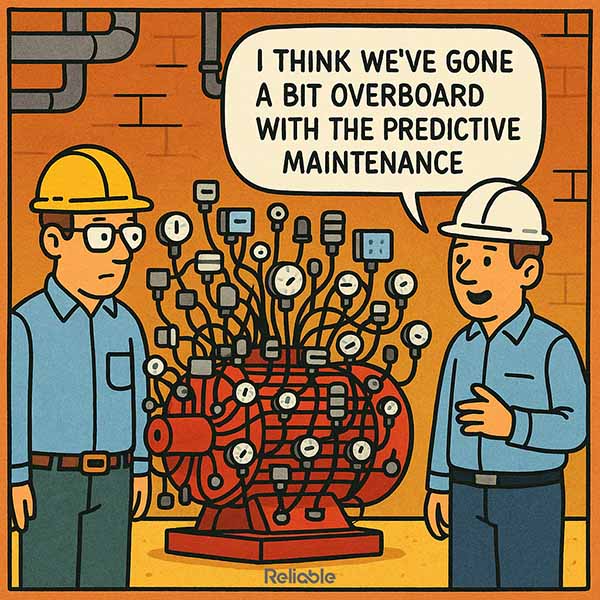
In pulp and paper mills, every roll, bearing, and pump tells a story, usually one written in heat, vibration, and wear particles. Few industries operate in harsher or more complex environments. Between steam, humidity, chemical exposure, and continuous operation, the line between productivity and downtime can be razor-thin. Predictive maintenance in pulp and paper operations enables early detection of warning signs before they turn into breakdowns.
Yet as the cartoon illustrates, enthusiasm for technology can backfire. A machine wrapped in sensors is not the same as a machine managed intelligently. The true advantage of predictive maintenance lies not in the quantity of data, but in the integration, interpretation, and action that follow the data. The challenge is moving from connected equipment to connected insight.
Why Predictive Maintenance in Pulp and Paper Is So Valuable
Paper production depends on relentless uptime. Machines run 24/7, often for weeks between shutdowns, and any unplanned stoppage disrupts the delicate balance of process flows, steam systems, and pulp quality. Traditional preventive maintenance - based on time or usage - has served mills for decades, but it’s no longer enough to meet today’s precision and efficiency demands.
Predictive maintenance in pulp and paper shifts the paradigm from reacting to preventing. By continuously tracking asset condition, mills detect anomalies before they cause product defects or safety risks. For example:
Refiners: Detect bearing wear through vibration and temperature trends.
Dryer cylinders: Monitor thermal imbalance before it affects paper moisture.
Pumps and agitators: Identify misalignment or cavitation through frequency analysis.
Roller bearings: Reveal lubrication issues or micro-pitting through oil analysis.
Each of these insights extends the mean time between failures, reduces unplanned shutdowns, and saves thousands in maintenance and energy costs. But collecting data is only half the battle; understanding it is where the reliability payoff begins.
Combining Technologies for Better Condition Awareness
Many mills fall into the trap of “technology stacking,” deploying multiple PdM tools without integration. The cartoon humorously exaggerates this, but it reflects a fundamental problem: disconnected sensors and redundant measurements flood teams with data they can’t interpret quickly enough to act on.
The secret is synergy. Each predictive maintenance technology offers a specific window into machine health:
Vibration analysis detects imbalance, looseness, and misalignment.
Oil analysis uncovers contamination, oxidation, and component wear.
Thermography reveals hot spots, misaligned couplings, and electrical overloads.
Ultrasound detects friction, leaks, and early-stage bearing damage.
Motor circuit analysis identifies insulation weaknesses and rotor faults.
When these tools are combined through a central analytics platform, mills gain a multidimensional understanding of each asset. For instance, a change in vibration might prompt an oil test, which then confirms rising iron levels, pinpointing both mechanical and lubricant degradation.
This connected view transforms predictive maintenance in pulp and paper from sensor management into performance management, an essential shift for scaling reliability.
Building a Scalable Predictive Maintenance Framework
Implementing predictive maintenance isn’t about installing technology; it’s about designing a repeatable process. Mills that succeed in predictive maintenance in pulp and paper build programs on four foundational pillars:
Criticality Ranking:
Prioritize assets based on production impact, failure frequency, and replacement cost. A small bearing on a key calendar roll may deserve more attention than a large gearbox on a redundant conveyor.Technology Alignment:
Match the monitoring method to the failure mode. Don’t deploy infrared cameras on assets that fail from lubrication issues; use oil analysis or ultrasound instead.Data Integration:
Consolidate information across technologies and link it to your CMMS or EAM. The value lies in trend visibility, seeing minor deviations over time rather than reacting to isolated alarms.People and Process:
Training technicians and analysts is critical. Without context and consistency, even the best predictive maintenance program becomes just another collection of charts and alarms.
A scalable framework evolves through continuous learning. Each data point refines the understanding of asset behavior, and each failure prevented builds confidence in the system.
Turning Predictive Data into Actionable Intelligence
The biggest challenge in modern maintenance isn’t lack of data, it’s too much of it. Mills equipped with hundreds of sensors can easily generate millions of data points daily. Without intelligent filtering and correlation, this flood of information overwhelms planners and engineers.
To overcome this, leading pulp and paper operations are embracing AI-driven analytics and edge computing. These systems process data locally, detect patterns, and alert maintenance teams only when specific parameter combinations exceed thresholds. For example:
A subtle increase in vibration frequency and oil debris count may indicate bearing surface fatigue.
A thermal imbalance combined with elevated motor current could point to drive misalignment.
Ultrasound readings plus a pressure drop in the steam system might flag an early-stage leak.
Artificial intelligence accelerates diagnosis, but it doesn’t replace expertise. The real power comes from combining machine learning with human judgment, using algorithms to highlight anomalies and engineers to interpret their stories. This human/digital partnership makes predictive maintenance in pulp and paper both scalable and sustainable.
Quantifying the Business Impact
The ROI of predictive maintenance in pulp and paper is substantial when implemented correctly. Studies and mill reports consistently show:
25–35% reduction in unplanned downtime
10–20% increase in equipment life
8–12% drop in energy usage through optimized machine efficiency
30–40% reduction in maintenance costs due to fewer emergency repairs
Beyond financial metrics, predictive maintenance enhances safety and product quality. By catching equipment degradation early, mills reduce the risk of fires, leaks, or product defects caused by process instability.
Perhaps most importantly, predictive maintenance empowers maintenance teams to shift from firefighting to foresight. Instead of racing to fix breakdowns, they focus on continuous improvement and process optimization.
Avoiding the “Sensor Forest” Trap
As shown in the cartoon, it’s easy to go overboard with instrumentation. More sensors can actually dilute effectiveness when teams can’t keep up with analysis. The best programs use fewer, smarter sensors with higher data fidelity and clear diagnostic goals.
A good rule of thumb: for every sensor installed, define why it exists, what failure it detects, and what action will follow when it alarms. If that can’t be answered, it doesn’t belong in the system. Simplifying technology creates clarity, and clarity creates results.
Conclusion
Predictive maintenance in pulp and paper is not about collecting data; it’s about connecting insight. When vibration, oil, thermal, and acoustic technologies are used together with purpose, they form a predictive ecosystem that drives uptime, safety, and performance.
The pulp and paper industry’s future belongs to mills that can see problems before they happen and act before they escalate. The cartoon’s message is both funny and wise: complexity isn’t sophistication. True reliability comes from strategy, not saturation. The smartest maintenance programs will be those that measure less but understand more.