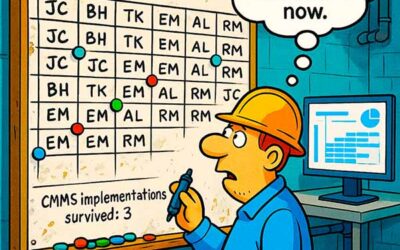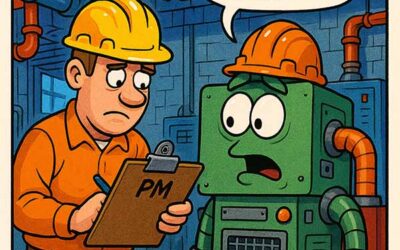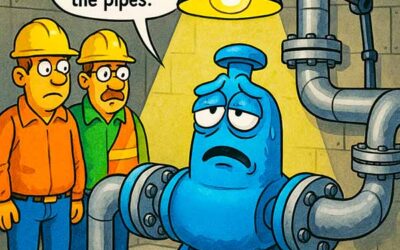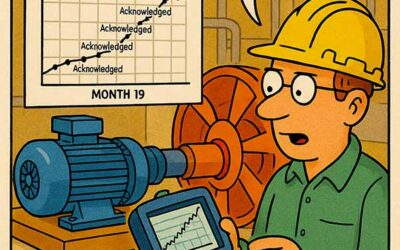


The cartoon of Motor #47 – a unit revived more times than anyone can count – represents a universal reality: many motors don’t fail unexpectedly; they fail repeatedly because the early warning signs were never measured, interpreted, or acted on. Predictive maintenance for electric motors breaks this pattern by identifying mechanical, electrical, thermal, and lubrication deterioration long before it becomes a rewind-or-replace event.
What follows is a rigorously accurate view of how predictive techniques help plants stop repeat failures, reduce operating losses, and make better long-term decisions for every motor in the fleet.
Why Predictive Maintenance for Electric Motors Matters
When motors fail, they almost always give measurable signals. These signals appear across multiple domains – current, vibration, temperature, friction, and insulation condition – and they appear months before insulation burnout, bearing seizure, or efficiency collapse. Predictive maintenance for electric motors captures those signals, converts them into trends, and reveals degradation modes while corrective actions are still inexpensive.
Electrical, Mechanical, Thermal, and Lubrication Indicators You Can Detect Early
- Electrical Stress
Voltage imbalance exceeding 1% (the NEMA MG-1 threshold for nameplate operation) begins to elevate stator heating. Beyond 1%, derating applies. Online monitoring includes voltage/current imbalance, ESA, temperature rise, and harmonic distortion.
Offline diagnostics – including Insulation Resistance (IR) and surge testing – are performed during shutdowns and trended over years, not in real time. Surge comparison is valuable for detecting turn-to-turn faults, but it is not a routine monthly test. - Mechanical Degradation
Misalignment, unbalance, looseness, and bearing wear are visible in vibration signatures. Early-stage bearing analysis includes BPFO, BPFI, BSF, and FTF; the full set of rolling-element defect frequencies. - Thermal Behavior
Rising winding temperatures, hot spots, cooling blockages, and ventilation problems appear early in infrared thermography. These are strong indicators of overload, contamination, or restricted airflow. - Lubrication Condition
Under-lubrication and over-lubrication are among the most common contributors to bearing failure. Ultrasound (Acoustic Emission) is the most sensitive tool for identifying lubrication-related friction weeks or months before damage appears in vibration or temperature. High-frequency vibration analysis supports ultrasound by confirming early mechanical impacts.
Predictive tools provide the data required to break the “run-to-failure” cycle.
Using Predictive Data to Decide Rewind vs. Replace
Motor rewinds are effective when performed using modern best practices: accurate coil geometry, controlled stripping methods, and correct insulation systems. But predictive data helps determine whether a rewind restores performance or if a replacement is more economical and reliable.
How Predictive Data Drives Better Lifecycle Choices
- Recurring Degradation Patterns
If vibration, ESA, temperature rise, or ultrasound friction levels show repeated early-stage degradation, the root cause is systemic. Rewinding a motor without correcting upstream loading, cooling, alignment, or power-quality issues guarantees another failure cycle. - Energy Performance Changes
Instead of linking core damage to declining power factor – an incorrect causal relationship – the focus should be on unexplained increases in no-load real power losses and elevated temperature rise.
A 100 HP motor running continuously at $0.10/kWh can cost $650–$1,300 more per year due to a 1–2% efficiency drop, small on paper but significant across a fleet. - Stator Core Condition
Thermal stripping above ~660°F (349°C) does not “anneal” the steel but damages the interlaminar insulation (core plate coating). This causes shorted laminations and higher core losses. Many shops increasingly use chemical or mechanical stripping to limit thermal stress and preserve efficiency. - Structural Changes and Natural Frequencies
Vibration trending can reveal changes in structural natural frequencies, bearing seat wear, or frame distortion, issues a rewind cannot correct. - Efficiency Standards
When predictive data confirms rising losses, upgrading to IE3/IE4 (IEC) or NEMA Premium/Super Premium motors may offer a better lifecycle payoff.
Predictive maintenance for electric motors adds rigor to repair-replace decisions that historically relied on habit or guesswork.
Implementing Predictive Maintenance for Electric Motors
An effective predictive program combines online monitoring, offline diagnostics, and regular trending intervals. The tools aren’t exotic; the consistency and interpretation matter far more.
Core Components of a Predictive Motor Program
1. Vibration Analysis
Monitor misalignment, unbalance, looseness, and bearing defect frequencies (BPFO/BPFI/BSF/FTF).
Typical intervals:
- Critical motors: Monthly
- Essential motors: Quarterly
- General-purpose motors: Semi-annually or annually
2. Electrical Signature Analysis (ESA)
ESA detects load anomalies, rotor bar defects, eccentricity, voltage imbalance, and current asymmetry.
Important nuance: ESA requires 40–50% of rated load for accurate detection. At light loads, slip is minimal, and rotor bar frequencies overlap with line frequency, masking faults.
3. Infrared Thermography
Identify cooling blockages, hot bearings, and anomalies in winding temperature.
4. Ultrasound for Lubrication
Ultrasound detects friction increases (dBµV) long before vibration or heat appears. It is the most effective tool for establishing precision lubrication intervals.
5. Offline Insulation Diagnostics
Perform IR/PI and surge testing during shutdowns, not continuously.
All readings must be temperature-corrected to 40°C to avoid misinterpretation.
Predictive maintenance for electric motors requires integrating all these signals rather than relying on any single measurement.
Predictive Insights Turn Aging Motors Into Manageable Assets
Motor #47 is funny because we’ve all met its counterpart, a motor kept alive through endless repairs rather than data-driven decisions. Predictive maintenance for electric motors ends that cycle by replacing anecdotal thinking with objective, physics-based insight.
Practical Actions to Break the Rebuild-Repair Loop
- Define acceptable electrical, thermal, and mechanical operating envelopes.
- Trend data across months, not moments, to expose degradation patterns.
- Treat every rewind as an engineered reset with full documentation.
- Evaluate energy performance routinely.
- Integrate vibration, ESA, ultrasound, and thermography into a unified health assessment.
When predictive maintenance for electric motors becomes routine, motors stop being legends of survival and become assets with predictable, manageable life cycles.