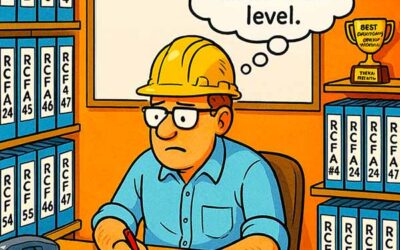
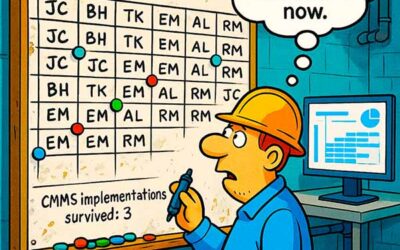
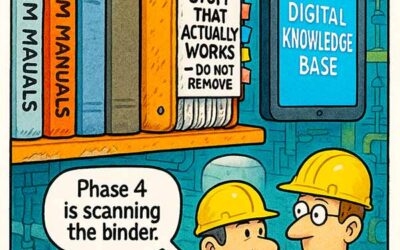
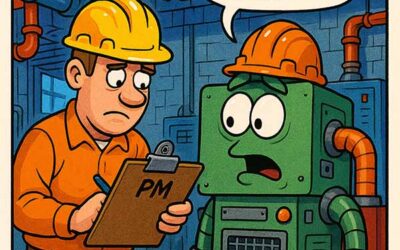
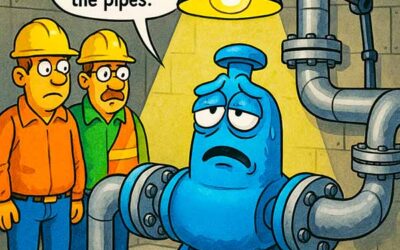
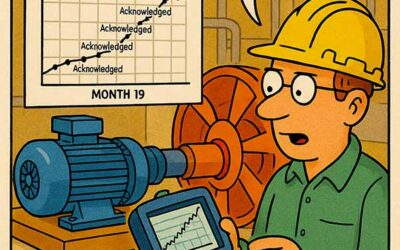
The cartoon says it all: a pump routinely spills sludge on the shop floor, but because it’s predictable, it’s celebrated as a triumph of machine learning. “We’ve trained it to fail gracefully,” the worker says. That’s not reliability—that’s resignation wrapped in data science.
In today’s maintenance culture, predictive technologies are often misunderstood as the end goal. But there’s a critical distinction we must confront: predictable machine failure vs. reliability. Just because we can anticipate a failure doesn’t mean we’ve solved anything. We’ve just become better at tolerating dysfunction.
Predictable Failure Is Not Operational Excellence
Let’s be blunt—forecasting the timing of a breakdown does not eliminate its cost.
Imagine a car that breaks down every Friday. You can plan your weekend around it, maybe even schedule the tow truck in advance. But is that car reliable? Of course not. It’s a liability with a calendar. The same logic applies in industrial settings. Predictability might reduce the surprise, but it doesn’t remove the disruption, waste, or loss.
Predictable machine failure vs. reliability matters because predictability alone allows mediocrity to entrench itself in our systems. Maintenance teams become firefighters with better calendars. Production loses throughput. Quality dips. And leadership scratches their heads wondering why the plant is “under control” yet still underperforming.
Forecasting is a tactical tool. Reliability is a strategic objective.
Machine Learning Without a Reliability Mindset Misses the Point
Machine learning, AI, and predictive analytics are powerful. But when we frame success around accurate predictions rather than failure elimination, we trap ourselves in a passive cycle of expectation.
The cartoon’s line, “We’ve trained it to fail gracefully,” is more than humor—it’s a cautionary tale. It captures how easy it is to conflate technological sophistication with meaningful progress. If your ML model tells you a pump will fail in 42 hours and it fails in 42 hours, that’s a technical success. But if the pump still fails, it’s a business failure.
The true role of predictive tools is to identify incipient failure modes so we can engineer them out of the system entirely. If you’re not using machine learning to reduce failure rates, you’re just building smarter workarounds.
In the predictable machine failure vs. reliability discussion, ML should serve reliability—not the other way around.
Turning Data into Design Decisions
Real reliability begins where data ends—at the decision point. Predictive insights should drive action: redesign, re-lubrication, operator training, material upgrades, or process changes.
If you’re not making those decisions, you’re not improving reliability—you’re just collecting expensive diagnostics.
That’s the dirty secret of many condition monitoring programs: they’re long on insight but short on action. We detect degradation early, file it away, and wait until the failure window opens. The system becomes reactive by design—only better informed.
To break out of that cycle, your reliability program must:
- Prioritize failure elimination over failure management
- Design for maintainability, not just availability
- Integrate cross-functional insights from engineering, operations, and MRO
- Use predictive data to fuel proactive root cause analysis and system redesign
When failure patterns become clear, don’t just schedule them—challenge them. Predictable failure is a signal that something is persistently wrong, not that the system is under control.
From Forecasting Failure to Engineering Reliability
Predictable machine failure vs. reliability comes down to intent. Forecasting says, “We accept failure, let’s just time it better.” Reliability says, “Let’s make failure the exception, not the expectation.”
That shift is cultural as much as technical. It requires a leadership mindset that values uptime over insight, and performance over prediction. Here’s how to begin making that transition:
- Stop celebrating accurate failure forecasts. Start rewarding failure elimination.
- Use predictive analytics to inform design changes. Don’t just plan maintenance around failure modes—remove the failure modes.
- Make data actionable. A great dashboard means nothing without execution.
- Challenge legacy norms. Just because a pump “usually does this” doesn’t mean it should.
Reliability is about performance consistency, not performance expectation. It’s the difference between hoping your machine doesn’t fail and knowing it won’t—because the system is engineered that way.
Conclusion: Don’t Accept Predictable Dysfunction
The next time someone touts their ability to forecast asset failure down to the hour, ask this: Why does the asset keep failing?
In reliability, graceful failure is still failure. Predictability is a symptom. Reliability is the cure.
If your machines “usually do this,” it’s time to ask why you’re still allowing them to.