

Famous Last Words: “It’s Only Off by 0.5mm…”
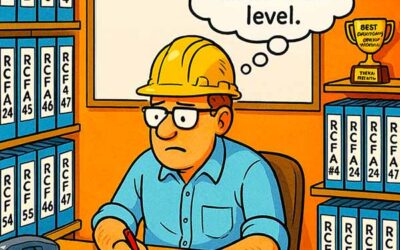
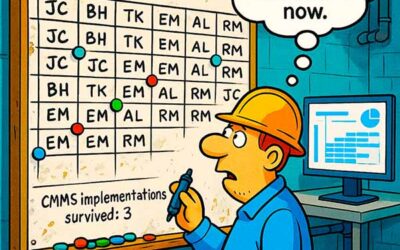
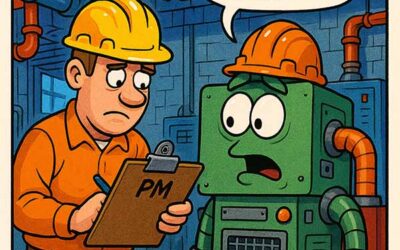
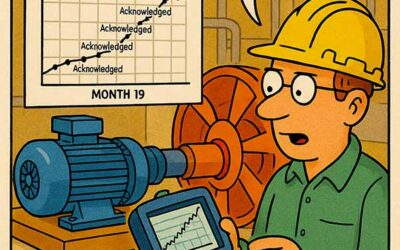
One of the most dangerous phrases in maintenance: “It’s only off by 0.5mm—what could go wrong?” In heavy equipment, especially mining or construction, the answer is: a lot. This cartoon perfectly captures that tension. A tech, surrounded by mismatched parts, unknowingly stands at the edge of a breakdown. The message? Precision in spare part selection isn’t just a best practice—it’s a frontline defense against failure.
Modern equipment operates under tight tolerances. OEMs design parts to exact specifications based on load, temperature, vibration, and operational cycles. Deviating from those specs—by even a fraction of a millimeter—can introduce problems like misalignment, accelerated wear, mechanical binding, and cascading failure.
Let’s break down why precision in spare part selection is so critical, how poor fits create systemic risk, and how to build reliability from your parts shelf outward.
Tiny Variations, Massive Consequences
It’s tempting to substitute a “close enough” component when the correct one isn’t in stock. But in doing so, you risk shifting the entire failure curve left. A shaft that’s slightly undersized might spin within its housing. A bearing with the wrong clearance might run too hot or misalign under load. A gear that’s 0.5mm off in width could affect backlash and cause uneven stress on the drivetrain.
These tiny mismatches rarely fail immediately. Instead, they slowly degrade performance—manifesting as increased vibration, elevated temperatures, or early fatigue cracks. By the time these symptoms are detected, secondary components may already be damaged.
One plant used a replacement part that “nearly matched” an OEM spec. It fit during installation but caused minor eccentric loading. Six months later, the motor shaft sheared during a production cycle. Postmortem analysis found wear consistent with misalignment and excessive loading. The original deviation? 0.7mm on the gear hub depth.
Precision in spare part selection isn’t just for perfectionists—it’s a financial, safety, and operational imperative.
Understanding GD&T: The Language of Precision
If you’re serious about precision in spare part selection, you need to speak GD&T—Geometric Dimensioning and Tolerancing. GD&T is the standardized symbolic language used in engineering drawings to define the allowable variation in part geometry. It tells you not just the size of a feature, but how perfect—or imperfect—it can be while still functioning as intended.
GD&T defines:
- Form (flatness, straightness, cylindricity)
- Orientation (perpendicularity, parallelism, angularity)
- Location (position, concentricity)
- Runout (circular or total)
Why does this matter for spare parts? Because two gears with the same nominal dimensions might behave very differently if one has tighter tolerances for runout and perpendicularity. A bearing housing might “fit” dimensionally but still misalign the shaft if it lacks the correct position tolerance.
Most reliability failures trace back to misalignment, vibration, or uneven load distribution—all of which GD&T directly governs. If your maintenance or procurement team doesn’t understand how to read or request GD&T callouts, you’re flying blind when validating parts.
Practical steps:
- Train your team to read GD&T—especially in critical systems like gearboxes, turbines, or compressors.
- Ask vendors for detailed tolerance drawings when sourcing third-party parts.
- Use GD&T notations in BOMs for critical replacement components.
- Require GD&T conformance certificates from precision parts suppliers.
In short: GD&T bridges the gap between engineering intent and real-world performance. If you ignore it, you’re guessing. If you embrace it, you’re engineering reliability into every spare part.
Precision in Spare Part Selection: Your First Line of Defense
Maintenance professionals often focus on root cause analysis after a failure—but the process of prevention starts much earlier, at the point of part specification and procurement. Precision in spare part selection means verifying every aspect of a part’s compatibility: dimensions, tolerances, material grade, hardness, surface finish, and treatment process.
This is especially vital in critical assets—pumps, gearboxes, conveyor drives, compressors—where incorrect fits can translate to multi-day shutdowns.
Some key practices:
- Never rely on visual inspection to verify compatibility. Parts may look identical but differ in key tolerances.
- Build digital BOMs (Bills of Materials) with complete specs—not just part numbers—to eliminate ambiguity.
- Establish sourcing standards with suppliers, ensuring substitutes meet or exceed OEM specs and tolerances.
Don’t leave this to memory or gut feel. Institutionalize the precision.
Building a Culture Around Precision and Verification
People don’t accidentally install the wrong part—they do it when under pressure, short on time, or missing documentation. To eliminate these conditions, create systems that make precision easy and error visible.
Steps to institutionalize precision in spare part selection:
- Cross-train maintenance and procurement staff to understand the risks of mismatches and the cost of short-term convenience.
- Use laser scanning or 3D measurement tools to verify critical parts where drawings are unavailable.
- Label all non-OEM parts as such in inventory systems. Include deviation documentation and require engineer approval before use.
- Set up a QA process for incoming parts to verify tolerances, not just order accuracy.
In many organizations, the storeroom becomes the weakest link. Investing in storeroom discipline pays back exponentially in uptime.
Think Long-Term: Parts Fit, Risk, and Asset Strategy
A precision mindset also changes how you manage asset lifecycles. Use this rule of thumb: if a part will outlast the installer’s memory, it needs documentation.
Create reliability dossiers for assets, including:
- Complete part specs with tolerance ranges
- Historical failures related to improper parts
- Approved vendors and qualified substitutes
- Notes on tribal knowledge (“this part is commonly confused with…”)
Link this data into your CMMS or EAM system. It ensures that ten years from now, someone isn’t guessing whether that slightly wider seal will still work on the backup pump.
Also, work with engineering and OEMs during equipment commissioning to ensure you have proper spec documentation. Too often, the part details disappear into project archives and aren’t captured in live systems.
Don’t Let 0.5mm Be the Start of a Disaster
Precision in spare part selection is often viewed as a luxury in reactive environments. But in reality, it’s a low-cost, high-impact reliability strategy. A $60 misfit part can lead to a $600,000 production loss.
The cartoon sums it up as “Famous Last Words, Volume 2.” Don’t make it a trilogy.
Instead, embed precision at every stage of your parts process—from procurement to installation—and make it a cultural norm. The next time someone says, “It’s just off by a hair,” remind them: the devil’s in that decimal.