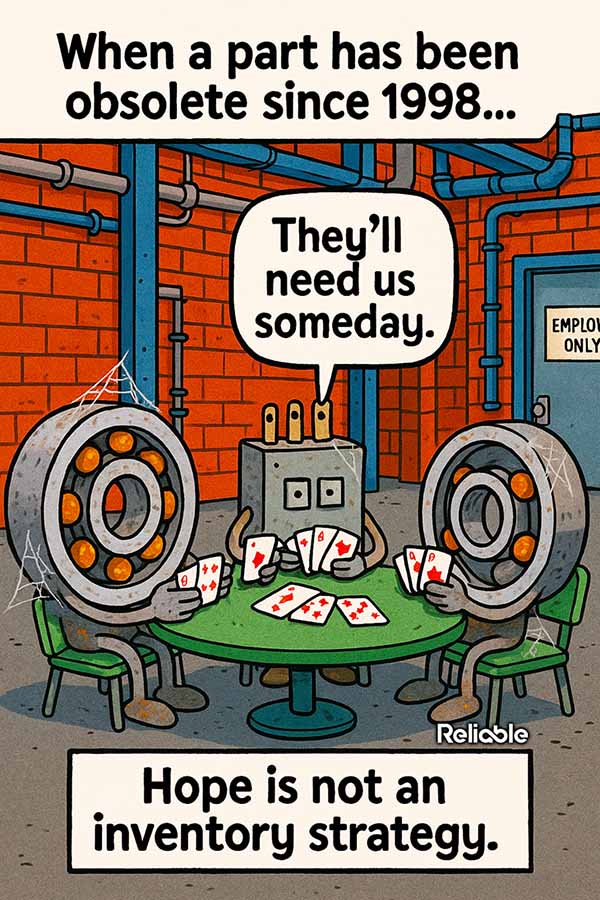

Somewhere in every storeroom sits a shelf of parts for machines that stopped being sold when dial-up was still a thing. The original supplier may be gone, drawings may be incomplete, and the standing plan is often to hope the part outlasts the equipment it supports. Learning how to plan for spare parts obsolescence replaces that hope with a defined response for the day a critical component can no longer be sourced from an acceptable supplier in the time the plant needs it.
Obsolescence is a normal life-cycle risk for items that depend on external supply, software, or technical support. The practical question is whether a site identifies that risk early enough to choose among stocking, repair, alternate sourcing, or redesign before a shortage becomes a line-down event.
How to Plan for Spare Parts Obsolescence Before It Bites
Planning begins with knowing what you hold and what it keeps running. That sounds basic, yet weak spare parts management makes obsolescence risk hard to see when parts, assets, alternates, and criticality are disconnected. A clean relationship between those records lets the plant distinguish a manageable nuisance from a serious continuity risk.
Once that link exists, obsolescence risk becomes something you can scan for deliberately. Manufacturer end-of-life or product-change notices, declining supplier count, loss of repair support, and parts that can no longer be quoted are all useful signals. Mature monitoring treats those signals as inputs to a standing review rather than discoveries made during a breakdown.
Any externally supplied part can face obsolescence while the asset is still in service. Planning determines whether the plant has a response before availability or support disappears.
Not every obsolete part deserves the same response. The highest attention belongs where supply risk combines with meaningful consequence: safety or environmental exposure, production or quality impact, long recovery time, weak repair options, or no qualified substitute.
That triage keeps the effort affordable. Stocking against every conceivable obsolescence risk would tie up large amounts of cash and shelf space. A targeted policy uses inventory, alternate sourcing, repair, or redesign where the consequence of an unavailable part justifies the cost.
Spotting the Spare Parts Most at Risk
A good obsolescence review sorts the parts list by exposure, and a handful of traits commonly mark the components worth examining first. Naming them turns a vague concern into a working list.
- Single-source items: only one supplier still makes or stocks the part, with no drop-in equivalent available.
- Long-lead specialties: castings, custom electronics, or built-to-order assemblies that take many months to reproduce.
- Aging platforms: control systems and drives from a generation the manufacturer has already stopped supporting.
- Critical, low-usage parts: components that rarely fail but shut a whole line down the moment they finally do.
The lead-time column deserves special attention because a part that takes six months to obtain is not obsolete, but it can create a similar continuity risk. Efforts to reduce spare parts lead time through qualified alternate sources, repair options, or supplier agreements can reduce that exposure; strategic stocking may still be justified where those options are weak.
It helps to capture this in a simple obsolescence risk register: the part, the assets it supports, the supply or support risk, the consequence of unavailability, and the selected response. A short, actively maintained list of genuine exposures is more useful than a huge spreadsheet that is never reviewed or acted on.
The review cadence should match the rate at which the technology and supplier base change. A site might combine a periodic portfolio review with event-driven checks whenever a supplier issues an end-of-life, product-change, or support notice. Fast-changing electronics may need closer attention than stable mechanical components.
Choosing a Deliberate Response for Each Risk
Once the exposed parts are known, planning means selecting a deliberate response before a failure forces the decision under pressure. The available responses vary by item and may include a last-time buy, repair or refurbishment, alternate sourcing, life extension, redesign, or retirement of the supported asset.
A last-time buy can be appropriate when a part is about to disappear and the remaining demand is reasonably predictable. The quantity should consider more than failure history: remaining asset life, installed population, shelf life and preservation, repair yield, expected consumption, and the consequences of both shortage and excess stock.
A last-time buy is inventory insurance. Its value depends on buying enough to cover credible demand without creating excess, degraded, or unusable stock.
Where a last-time buy is impractical, qualifying an alternate may be the better response. That might be another manufacturer’s equivalent, a qualified replacement from a specialist source, or a modern component adapted to the existing application where legally and technically appropriate. Engineering should verify form, fit, function, interfaces, performance, safety, software or firmware compatibility, and any applicable certification or regulatory requirements before the substitute is needed in an emergency.
Redesign can remove a specific obsolescence exposure by replacing an unsupported drive, controller, or other component with a supported alternative. It does not remove obsolescence risk permanently, and it may introduce integration, validation, training, or future support costs. The choice should be based on remaining asset life, consequence, lifecycle cost, and implementation risk.
Why Obsolescence Plans Quietly Fall Apart
Plants can understand the concept and still get caught short when ownership and review routines lapse. Obsolescence management works only if the register, supplier information, and selected responses stay current between crises.
- Nobody owns the review: obsolescence sits between purchasing, engineering, and maintenance, so it belongs to no one.
- The register goes stale: it gets built once for an audit and never updated as vendors change and parts quietly age.
- Cost gets counted one way: inventory carrying cost is visible, while downtime exposure, expedited sourcing, emergency engineering, and redesign costs may be left out of the comparison.
- Alternates go unqualified: a substitute is assumed to work and only ever tested the night the original finally fails.
The business case should compare the carrying and obsolescence cost of strategic inventory with the expected consequence and duration of a shortage. In some cases, a strategic buy can reduce spare parts costs over the remaining asset life; in others, repair capability, alternate sourcing, or redesign is the better economic choice.
Keeping the plan alive is mostly about ownership and cadence. Assign a named owner, set a review frequency that matches the risk and rate of supplier change, and include major exposures in the appropriate reliability, engineering, or asset-management review.
It also helps to connect the register to the money the plant already tracks. When a strategic buy is evaluated beside downtime exposure, repair cost, expedite cost, and redesign alternatives, the decision becomes a risk-and-lifecycle-cost choice rather than a simple argument about idle inventory.
Turning Hope Into a Real Strategy
The point of this work is to make the decision calmly while there is still time to choose among credible options. A plant that plans for obsolescence still faces disappearing parts. It meets them with a current register, a selected response, and a funding or engineering path where one is required.
None of it requires exotic tools or a large team. It requires a clean link between parts and assets, an honest look at which components are truly exposed, and the discipline to pick a response before the market picks one for you.
The habit compounds over time. An obsolescence risk caught early can prevent a line-down scramble, preserve repair or sourcing options, and capture technical knowledge before people or suppliers disappear from the picture.
Hope is an expensive inventory strategy because it tends to send the invoice at the worst possible moment. A real plan moves the decision to a point where the plant still has options.
A practical way to start is with a pilot. Take a small set of the most critical assets, identify the parts whose supply or support would be hardest to replace, and record the response you would use if each became unavailable.
That exercise turns a vague concern into a ranked list of actions. Revisit it on a defined cadence and whenever supplier or asset conditions change, and obsolescence becomes a managed lifecycle risk instead of a surprise discovered during a breakdown.