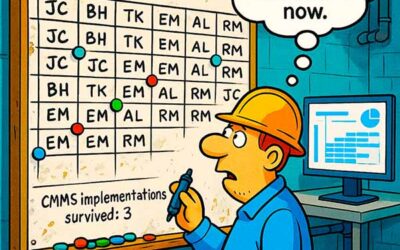
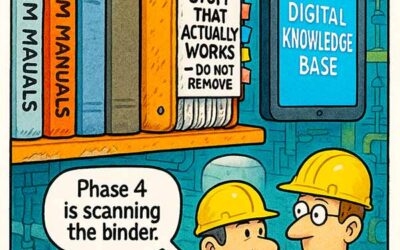
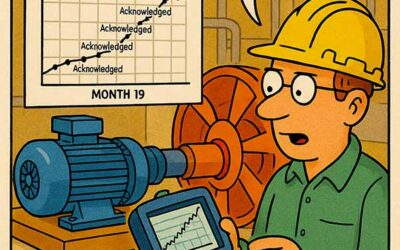
When it comes to reliability engineering, few concepts have as profound an impact as the PF curve. The cartoon above conveys a painful truth: you have only a small window to act between potential failure and actual failure. Miss it, and gravity, both literal and metaphorical, takes over.
This isn’t just theory; it’s a survival guide for industrial plants. In this post, we’ll explore PF curve best practices for early failure detection, showing how to turn diagnostic foresight into operational advantage.
Why the PF Curve Matters for Reliability Engineers
The PF curve (Potential Failure to Functional Failure) illustrates the crucial gap where early detection can save equipment, money, and uptime. Reliability engineers know that once degradation begins, the clock starts ticking.
Best practices for early failure detection mean:
- Identifying the earliest warning signs of degradation.
- Matching detection technologies to the failure mode.
- Building predictive maintenance schedules that align with asset risk.
Ignoring the PF curve is like watching a boulder roll toward a cliff, without stepping in. Proactivity is the line between control and chaos.
Using Condition Monitoring for Early Failure Detection
Condition monitoring is the frontline tool for exploiting the PF curve window. Techniques include:
- Vibration analysis to flag imbalance or misalignment.
- Oil analysis to detect contamination, wear metals, and chemical degradation.
- Infrared thermography to reveal overheating before damage occurs.
- Ultrasound to catch leaks or early bearing defects.
The best practice is not to deploy every tool everywhere, but to match technologies to asset criticality and known failure modes. A reliability engineer who aligns detection methods with PF curve best practices creates a layered defense against unplanned downtime.
Take bearings as an example. A bearing doesn’t explode into failure. It whispers first through microscopic wear debris detectable in oil analysis, then through ultrasonic noise, and finally by measurable vibration. Each stage presents an opportunity to act. The earlier you catch it, the cheaper and safer the intervention will be.
Building Proactive Maintenance Strategies with PF Curve Insights
Early detection only matters if it drives action. That’s why PF curve best practices for early failure detection require embedding insights into work processes. This includes:
- Aligning CMMS (Computerized Maintenance Management Systems) with condition data.
- Prioritizing work orders based on lead time to failure.
- Training operators to recognize and report early indicators.
Consider gearboxes. Oil analysis might show rising particle counts three months before vibration exceeds thresholds. If that data gets buried in a spreadsheet instead of driving a prioritized work order, the PF window closes unused. The lesson: technology without process is wasted potential.
The real art is balancing false alarms with timely interventions. Overreacting can waste resources; underreacting can trigger catastrophic breakdowns. The PF curve teaches that timing is everything.
Culture Change: Shifting from Reactive to Predictive
Perhaps the most challenging part of adopting PF curve best practices isn’t technology, it’s culture. Plants accustomed to fighting fires must adopt a predictive mindset. Key shifts include:
- Metrics that matter: Moving from mean time to repair (MTTR) to measuring detection-to-action intervals.
- Operator involvement: Empowering frontline workers with tools and training to spot degradation.
- Leadership support: Ensuring management rewards proactive saves, not just heroic breakdown recoveries.
A pump failure avoided may never make the front page of a maintenance report, but it often represents hundreds of thousands of dollars saved. In reliability, glory should go to those who prevented the crash, not those who cleaned up the wreck.
Calculating ROI from PF Curve Best Practices
Early detection isn’t just about avoiding failures, it’s about proving value to the business. Reliability engineers who apply PF curve best practices for early failure detection can quantify savings in several ways:
- Avoided downtime costs: Compare unplanned production loss versus planned intervention.
- Maintenance labor optimization: Show reduced overtime and emergency callouts.
- Asset life extension: Prolong equipment operation by intervening earlier.
- Reduced spare parts consumption: Replace a bearing instead of an entire gearbox.
For example, preventing a single unplanned turbine shutdown can save millions in lost production. Even smaller wins, like catching a motor bearing defect weeks in advance, translate into significant savings when multiplied across fleets of assets. By tracking avoided failures, you demonstrate that condition monitoring is not just a technical exercise but a bottom-line driver.
Closing Thoughts
The PF curve cartoon makes it clear: “Catch degradation early, or enjoy the crash.” Reliability engineers must master the narrow window between potential and functional failure. By applying PF curve best practices for early failure detection, plants gain more than uptime; they gain control, foresight, and resilience. The alternative is costly, chaotic, and entirely preventable.