
Overgreasing Bearings Causes Premature Failure – Here’s Why That Should Scare You
In the world of reliability, failure modes fall into two buckets: the obvious and the overlooked. Everyone spots dry bearings. But the ones bloated with grease? They’re often praised—until they explode.
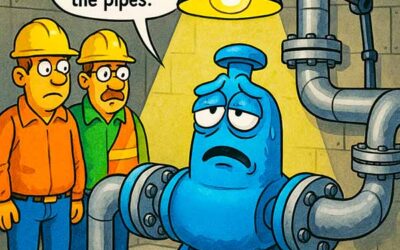
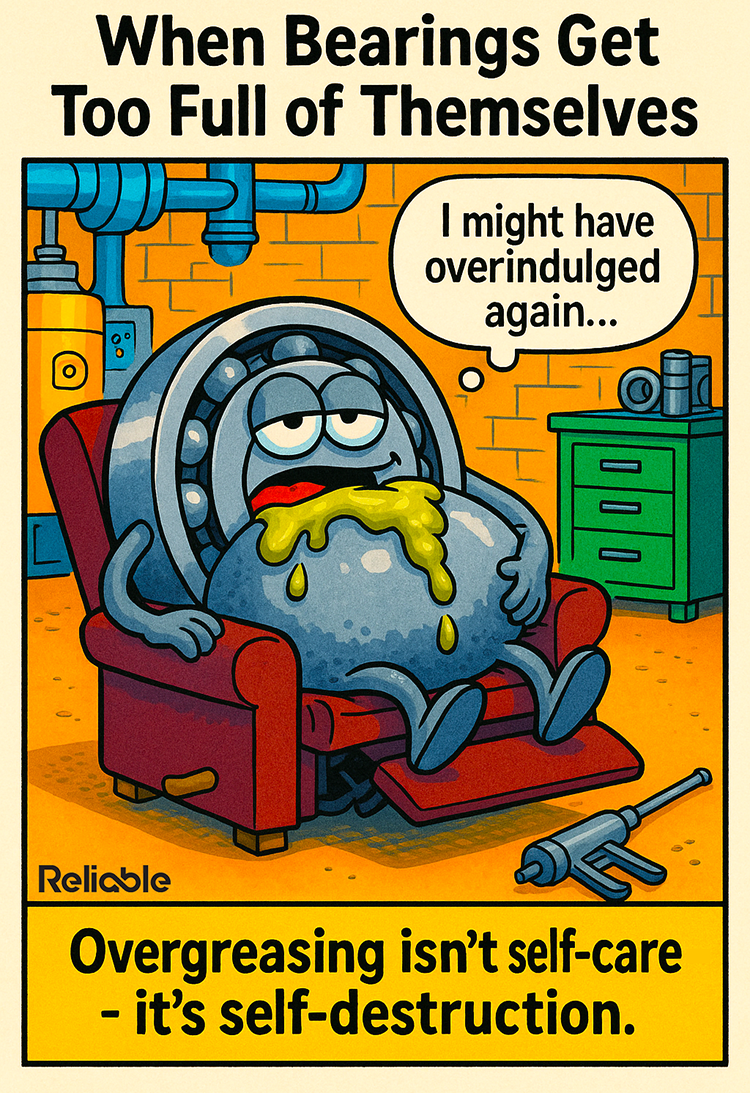
That’s the irony behind this cartoon. A bloated bearing slouched in a chair, greasy belly bulging, moaning, “I might have overindulged again…” It’s funny—until you realize it’s your plant next. Overgreasing bearings causes premature failure, and it’s more prevalent than most people realize.
We assume lubrication is inherently good. But like overeating, more isn’t better. It’s self-destruction disguised as maintenance. Let’s unpack the mechanisms behind it—and more importantly, how to stop the madness.
Understanding Why Overgreasing Bearings Causes Premature Failure
Grease has one job: deliver oil to the contact zone. That’s it. Everything else—thickeners, additives, texture—is secondary. But what happens when we go beyond what’s needed?
Three critical failure paths emerge when you overgrease:
- Thermal overload – Excess grease increases churning resistance. That turns to heat, raising operating temperatures. Elevated heat oxidizes the oil faster, shortens grease life, and accelerates wear.
- Seal compromise – Too much grease creates pressure. That pressure blows past bearing seals, ejecting grease and sucking in contaminants. What was clean becomes compromised—fast.
- Mechanical damage – As grease churns, it loses structure. It no longer flows. This causes voids, poor film formation, and ultimately metal-on-metal contact. Grease that’s too thick or too plentiful becomes an enemy, not a protector.
Here’s the worst part: overgreasing masks itself as proactive care. But in truth, overgreasing bearings causes premature failure through indirect, cascading mechanisms that rarely show up in basic RCA. If you’re not looking for it, you won’t find it.
The Telltale Signs That Your Plant Is Guilty of Overgreasing
It’s easy to spot after the fact—a failed bearing, gobs of expelled grease, and a motor that’s running 20°C hotter than spec. But smart reliability teams detect the signs earlier.
Here’s what to look for if overgreasing is silently shortening your asset life:
- High bearing housing temps even after recent lubrication
- Grease leakage or purge around seals, particularly dark or burnt
- Increased ultrasonic or vibration signals post-lube PM
- Sudden post-PM failures—a massive red flag
- Softened grease texture in inspections, often whipped or broken down
The pattern is familiar: someone hits the bearing with “just a few more pumps,” thinking it’s preventive. But within hours or days, temperature spikes or failures show up—and few connect the dots. But the truth remains: overgreasing bearings causes premature failure, and the data supports it.
A Better Model: Precision Lubrication in a World Obsessed with “More”
Most maintenance programs are built on a flawed foundation: the belief that adding grease is always good. This mindset creates systemic overgreasing—PM instructions like “apply 3–5 pumps” with no consideration of bearing type, volume, or RPM.
To flip the script, shift to precision lubrication:
- Define exact quantities. Calculate the required grease volume using bearing dimensions and lubrication frequency based on speed and duty cycle.
- Use ultrasound-assisted greasing. This allows technicians to monitor acoustic feedback and stop as soon as optimal fill is reached—no guessing.
- Match grease type to application. Using incompatible greases creates another failure mode entirely, but overgreasing makes it worse by flooding incompatible formulas together.
- Create feedback loops. After every PM, verify temperature, vibration, and purge behavior. This closes the loop and catches overgreasing events in real time.
- Train and retrain. The most effective plants run short courses on grease application basics. They reinforce one key message: overgreasing bearings causes premature failure.
Remember: It’s not about how much you apply. It’s about how much stays and does its job.
Don’t Let a Grease Gun Become a Weapon
Let’s be blunt: grease guns are often weapons of mass destruction. One untrained tech, one overzealous lube route, and one $50 bearing becomes a $50,000 motor rebuild.
This is why cultural change matters. Plants must move from reactive lubrication to proactive precision. From time-based PMs to condition-based insight. From “a few more pumps” to “just enough, based on feedback.”
So next time someone says, “It can’t hurt to add a little more,” show them this cartoon. Then show them the failure log.
Because if there’s one truth we can bank on, it’s this:
Overgreasing bearings causes premature failure—every time, everywhere, and preventably.