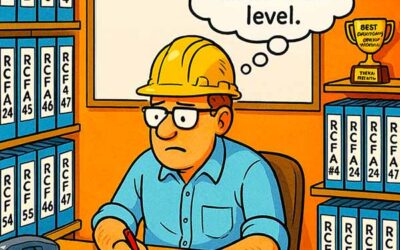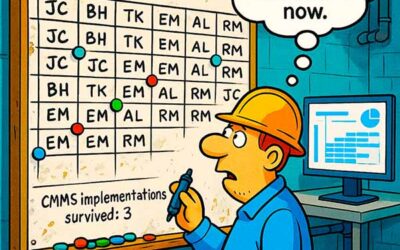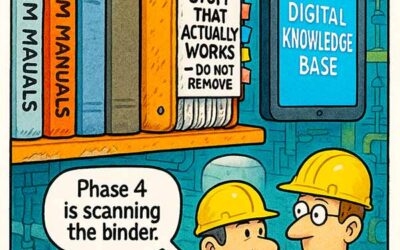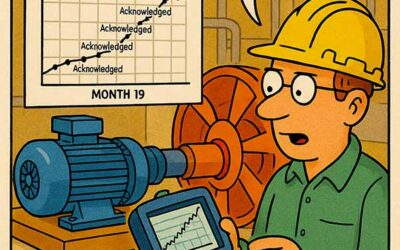


Mean Time Between Failure (MTBF) is one of the most referenced reliability metrics in industry, but it’s also one of the most debated. For reliability engineers, MTBF can either be a powerful planning tool or a misleading comfort blanket, depending on how it’s applied. The cartoon shows it best: assets don’t feel reassured by being “timed like it’s a race.” Instead, engineers need to understand how MTBF fits within the larger reliability framework.
In this article, we’ll unpack mean time between failure (MTBF) best practices for reliability engineers, explain where MTBF adds value, highlight its pitfalls, and demonstrate how to pair it with more innovative tools for improved decision-making.
The Role of Mean Time Between Failure in Reliability Engineering
When applied correctly, MTBF supports the development of maintenance strategies, spare parts stocking, and life-cycle planning. Reliability engineers often rely on it for:
- Spare parts planning: Estimating when critical spares will be needed.
- Lifecycle cost analysis: Predicting asset replacement schedules.
- Benchmarking: Comparing equipment types, brands, or vendors.
But MTBF alone doesn’t tell the whole story. Reliability engineers need to remember that it is an average. Real-world assets fail along distributions, not neatly at the mean.
Common Pitfalls in MTBF Use
Even experienced engineers fall into traps when overvaluing MTBF:
- Overconfidence in averages: A 5,000-hour MTBF doesn’t guarantee reliability for 5,000 hours.
- Ignoring failure distributions: Infant mortality and wear-out curves vanish when only the mean is reported.
- Misleading stakeholders: Presenting MTBF as a reliability guarantee can create false expectations.
One best practice is to always pair MTBF with probability curves or Weibull plots, so leadership can see variability instead of just averages.
Best Practices for Reliability Engineers Using MTBF
Reliability engineers can maximize MTBF’s usefulness by applying these principles:
- Use MTBF as a comparative metric, not predictive. Compare equipment classes, vendors, or maintenance approaches, but don’t assume MTBF predicts when the subsequent failure will occur.
- Contextualize MTBF with failure mode data. Link MTBF values to actual failure modes, not just aggregated downtime.
- Leverage Weibull analysis. Use Weibull to model failure distributions, then express MTBF as part of a larger reliability profile.
- Tie MTBF into risk-based decision-making. Use it in conjunction with risk priority numbers (RPN) or criticality rankings.
- Communicate limitations. When presenting MTBF, reliability engineers should explain the variability behind the number to stakeholders.
By following these best practices, MTBF becomes less of a misleading stopwatch and more of a decision-support tool.
Case Examples: MTBF in Practice
Consider a fleet of centrifugal pumps in a chemical plant. The reported MTBF is 18 months. Management assumes this means pumps will last reliably for 18 months before a major failure, so they schedule overhauls accordingly. In practice, some pumps fail at 6 months due to seal leakage, while others run nearly 3 years without issue. The average number hides the reality that different failure modes are at play. A better practice is to split MTBF by failure mode (seal, bearing, or motor) and apply Weibull distributions to each.
Another case: an aerospace supplier proudly advertised an MTBF of 20,000 hours for a component. However, when the field data was analyzed, failures were heavily clustered around 2,000 hours due to a design weakness. The inflated MTBF number came from test bench conditions, not actual use. This disconnect illustrates why reliability engineers must ground MTBF in a real operating context.
Smarter Metrics Beyond MTBF
For reliability engineers building mature programs, MTBF must evolve into a supporting role. Stronger practices include:
- P-F curve analysis: Defines the warning period between defect detection and functional failure.
- Condition-based monitoring: Vibration, oil analysis, and thermography give real-time insight instead of averages.
- Overall inspection effectiveness (OIE): Ensures frontline inspections catch issues before they grow.
- MTTR (Mean Time to Repair): When paired with MTBF, it gives a fuller view of availability.
- Failure reporting and analysis (FRACAS): Turns every incident into data for improving reliability models.
These metrics help reliability engineers move from “timing failures” to actively managing asset health.
A Framework for Reliability Engineers
Here’s a structured way engineers can apply mean time between failure best practices:
- Collect accurate failure data – log every event with detail (time, mode, cause).
- Segment by failure mode – avoid lumping together mechanical, electrical, and human-induced issues.
- Run Weibull analysis – identify infant mortality, random, or wear-out patterns.
- Overlay with MTBF – use MTBF as a secondary indicator, not the headline metric.
- Communicate in risk terms – “70% probability of failure within 12 months” tells leadership more than “MTBF is 18 months.”
This approach keeps MTBF in the conversation but ensures richer, more actionable reliability insights frame it.
Final Thoughts
The best practices for reliability engineers using Mean Time Between Failures (MTBF) boil down to this: treat MTBF as a supporting character, not the star of the show. By contextualizing MTBF within Weibull analysis, linking it to actual failure modes, and complementing it with proactive metrics like the P-F curve, reliability engineers can use it to guide smarter, risk-informed decisions.
In short, MTBF may not boost confidence on its own, but when used properly, it strengthens the reliability engineer’s toolkit and helps build a more robust, predictable operation.