The Endless Cycle of Reinvention
Walk into almost any plant and you’ll find the same ritual playing out: the rollout of yet another “bold new plan.” There’s a fresh logo, a motivational tagline, and maybe a new PowerPoint template. The maintenance management strategy is “reimagined,” the team dutifully nods, and performance metrics briefly spike before returning to normal.
The problem isn’t the effort or intent, it’s the execution. Too often, these new strategies are cosmetic updates to the same underlying issues. Leaders change the visuals, the phrasing, and the meetings, but not the systems that determine reliability performance. The result is maintenance déjà vu: different year, same failures.
A strategy that only looks new on paper isn’t progress; it’s maintenance theater disguised as improvement.
Every maintenance management strategy should begin with one brutally honest question: What problem are we truly solving? If the answer is unclear, the “new plan” is likely just a rebranded version of the old one.
Why Most Maintenance Management Strategies Fail
A maintenance management strategy fails not because the ideas are wrong, but because they never leave the whiteboard. Execution falters, accountability fades, and enthusiasm collapses once the novelty wears off. The failure pattern is remarkably consistent:
- Overemphasis on appearance. Managers focus on presentations and KPIs that look good in meetings rather than driving results in the field.
- Lack of continuity. When leaders rotate or priorities shift, strategies are abandoned midstream before they can bear fruit.
- Data distortion. Metrics are collected inconsistently, creating the illusion of progress that masks underlying weaknesses.
- Cultural fatigue. Frontline teams disengage after seeing multiple “transformations” that amount to little more than paperwork changes.
The hard truth: a maintenance management strategy built on aspiration rather than discipline is destined to collapse.
What a Real Maintenance Management Strategy Looks Like
A proper strategy doesn’t rely on slogans or grand gestures. It builds momentum through deliberate, measurable change. The best organizations understand that success lies in evolution, not revolution.
1. Define the Mission in Measurable Terms
A strong maintenance management strategy begins with clarity: what does success look like, and how will it be measured? “Improving uptime” is vague. “Reducing unplanned downtime by 20% within 12 months” is actionable. Ambiguity kills accountability.
2. Strengthen Data Integrity
Data quality determines decision quality. Incomplete work orders, missing root causes, and unverified downtime logs all poison the analytics feeding your strategy. Before chasing AI or predictive tools, fix the fundamentals: naming conventions, coding accuracy, and technician compliance.
3. Build Feedback Loops
Strategies die in silence. Establish mechanisms for technicians, planners, and engineers to give structured feedback after every significant task. When field data informs management decisions, improvement accelerates.
4. Develop Leadership Consistency
Leadership turnover shouldn’t reset the strategy. Mature organizations document and institutionalize their maintenance management strategy so progress survives personnel changes. Reliability doesn’t thrive in resets. It thrives in continuity.
5. Prioritize Behavior Over Buzzwords
A new CMMS or dashboard doesn’t improve reliability unless it changes behavior. The real test: are technicians performing better inspections? Are planners scheduling smarter? If not, technology is only masking weak process discipline.
The Psychology of Constant Reinvention
Why do maintenance leaders keep falling for the “new strategy” trap? Because new feels productive. Rolling out a bold initiative gives the illusion of progress until the hard work of execution begins. It’s easier to design new charts than to enforce consistent standards.
However, effective maintenance management isn’t built on excitement; it’s built on predictability. The most reliable organizations in the world are often the least flashy. They have boring consistency, not constant novelty. Their secret is repetition: executing simple, effective practices every day until reliability becomes cultural muscle memory.
An excellent maintenance management strategy doesn’t need to feel exciting. It just needs to work; quietly, predictably, and permanently.
Transforming Strategy Into Tangible Results
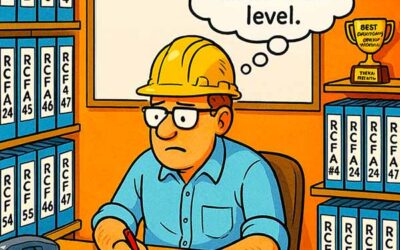
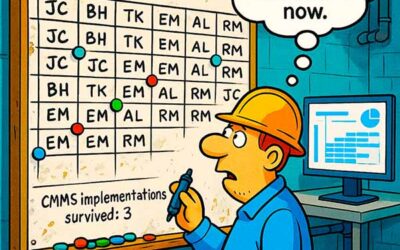
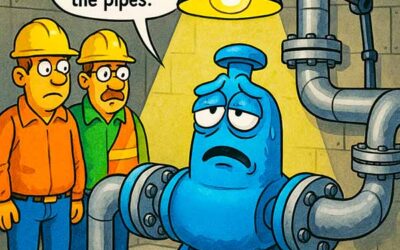
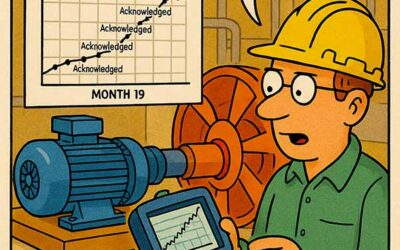
The cartoon says it all: “I’ve completely reimagined everything, just like before!” It’s the perfect metaphor for leadership churn that mistakes motion for progress. The truth is, you don’t need to reimagine everything; you need to make something stick.
Here’s how to translate plans into real-world impact:
- Focus on lagging and leading indicators. Track emergency work percentage, PM compliance, and mean time between failures (MTBF) to see whether the change is genuine.
- Visualize reliability maturity. Use dashboards and scorecards to make progress visible across departments, not just to management.
- Standardize what works. Document successful processes, then replicate them site-wide. Don’t reinvent excellence, scale it.
- Close the communication loop. Report improvements back to frontline teams to reinforce their impact and sustain motivation.
When strategy becomes tangible on the plant floor, when people can see and feel improvement, it transforms from a concept into a movement.
The Long Game: Sustaining Momentum
The most critical test of a maintenance management strategy isn’t how well it launches—it’s how well it lasts. Many initiatives achieve short-term gains, only to collapse when attention shifts. To prevent this, maintenance leaders must:
- Protect strategy time in weekly schedules to review performance and barriers.
- Align the incentive structure with long-term reliability goals, not just immediate production output.
- Institutionalize success through documentation, training, and digital workflows.
This is the difference between programs and systems. Programs end; systems evolve. The goal isn’t a better launch. It’s perpetual improvement.
Final Thought
Maintenance success doesn’t require reinvention; it requires persistence. The most effective maintenance management strategy is one that compounds small, consistent actions into significant reliability gains. It’s not about replacing your plan every year. It’s about refining it until excellence becomes inevitable.
When you’re tempted to roll out your next “bold new strategy,” pause and ask: Does this plan fix what’s broken, or just rename it? Because the plants that win in the long run aren’t the ones with the newest plans, they’re the ones with the most disciplined ones.