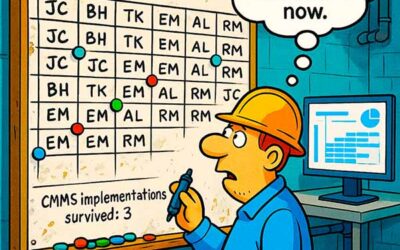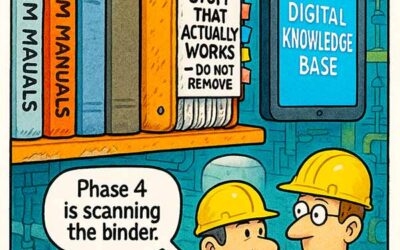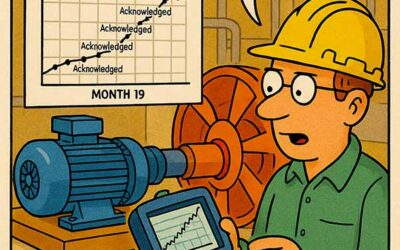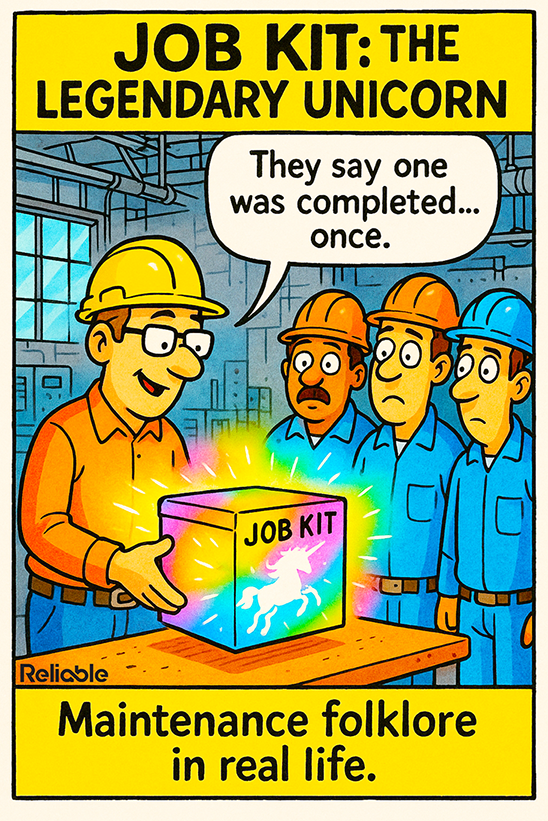

In maintenance departments worldwide, “job kits” are often discussed in hushed tones; everyone’s heard of them, some claim to have seen one, and a few even swear they once used one. But like the cartoon suggests, job kits are viewed more as mythical creatures than practical tools. The glowing box labeled Job Kit, and the line “They say one was completed… once” perfectly illustrates the cultural gap between what we know should exist and what actually does on the plant floor.
The truth is, maintenance job kitting best practices aren’t magic. They’re methodical, disciplined steps that remove uncertainty from maintenance execution. Plants that consistently use job kits see measurable gains in productivity, wrench time, and schedule compliance. The real trick isn’t knowing what to do; it’s committing to do it every single time.
Why Maintenance Job Kitting Fails Before It Starts
Most plants fail at kitting not because the idea is flawed but because ownership is missing. A maintenance planner might prepare a bill of materials, only to find out the parts aren’t in stock. A storeroom clerk may pull the parts, but has no visibility into the actual work order. The technician shows up, half the parts are missing, and the kit, if it exists, is no longer relevant. The system collapses.
At the heart of effective maintenance job kitting best practices lies clarity:
- Planner: Defines scope, parts, tools, permits, and resources.
- Stores personnel: Validate inventory, reserve or procure parts, and assemble the kit.
- Supervisor: Confirms kit readiness before assigning labor to the job.
When any one of these steps breaks down, job kits become a joke instead of an advantage. The key is accountability. Each participant must understand that a job kit isn’t “optional”; it’s part of the workflow, as essential as the work order itself.
Consider this rule of thumb: a job kit isn’t “done” until a technician can pick it up and start the job without leaving the area for any reason. Anything less is folklore.
Building a Repeatable, Scalable Kitting System
Kitting must evolve from an occasional best effort into a consistent process, one that’s auditable, measurable, and repeatable. That begins with standardization. Every work order that qualifies for planning should automatically trigger a kitting workflow.
A typical maintenance job kitting best practice follows this sequence:
- Work order approved and planned.
- Bill of materials (BOM) verified and adjusted based on site conditions.
- Parts availability checked in the CMMS or ERP system.
- Missing items ordered with lead times noted.
- Kit physically assembled, labeled, and placed in a designated staging area.
- Technician notified that the kit is ready before the scheduled start date.
Plants that achieve this level of repeatability often use color-coded bins, RFID tracking, or barcodes linked to CMMS records. The system ensures that anyone, from planner to technician, can instantly know a kit’s status.
Job kits turn planning into production when they’re managed like assets, not afterthoughts.
Technology can accelerate this maturity. For example, integrating stores data directly with planning modules allows real-time verification of parts availability. Advanced systems even automate reorder triggers, eliminating manual checks. The payoff is enormous: reduced waiting time, improved schedule accuracy, and better use of maintenance labor.
Quantifying the Payoff: What Proper Job Kitting Delivers
The measurable impact of effective job kitting is rarely disputed; it’s the implementation that lags. According to SMRP data and multiple independent studies:
- Wrench time rises from an average of 30% to 45–55%.
- Schedule compliance can increase by up to 40%.
- Emergency work decreases as planned work efficiency grows.
- Reliability metrics such as MTTR (mean time to repair) and equipment availability improve consistently.
Technicians love well-built kits because they remove frustration. No more hunting for missing bolts, misplaced gaskets, or shared tools. Every item is ready before the first wrench is turned. That’s the operational manifestation of maintenance job kitting best practices, efficiency you can see and measure.
Plants that adopt robust kitting practices often find that reliability metrics improve even without significant capital investments. It’s not new equipment that drives the gain; it’s better organization. The myth of the “unicorn job kit” disappears when systems are aligned around a repeatable process.
From One-Time Effort to Cultural Habit
Sustaining job kitting requires the same discipline as preventive maintenance. Without structured oversight, even the best system decays. Kits get cannibalized, BOMs go stale, and storeroom labels fade into irrelevance. The result: chaos disguised as progress.
To prevent this decline, successful organizations implement several core controls:
- Weekly audits of all staged job kits.
- Visual management tools (color tags, readiness boards, or digital dashboards).
- Technician feedback loops – missing or incorrect parts are logged immediately.
- Performance tracking using metrics like “percent of work orders started with complete kits.”
When planners and supervisors review this data weekly, it fosters continuous improvement. Over time, the kits get better, the processes smoother, and the technicians more confident. What was once a mythical “job kit” becomes a trusted operational tool.
Culturally, that shift is transformative. Teams start expecting kits, not hoping for them. Planners take pride in accuracy. Supervisors schedule confidently, knowing materials won’t derail work. The result isn’t just higher productivity, it’s belief. Maintenance becomes proactive, predictable, and respected.
Beyond the Kit: Integrating Reliability and Precision
Advanced organizations take kitting beyond parts and tools. They integrate procedure sheets, precision maintenance specs, torque values, inspection checklists, and lubrication instructions directly into the kit. Each package becomes a complete maintenance solution—technical, procedural, and logistical.
This evolution aligns directly with maintenance job kitting best practices, where kits represent more than convenience; they embody quality control. Every wrench turn follows defined standards, every replacement part is verified, and every technician operates with precision.
Some companies even digitize their kits, embedding QR codes that link to digital instructions, safety procedures, and OEM references. This hybrid approach bridges the gap between traditional maintenance and modern Industry 4.0 practices.
Conclusion
The “legendary unicorn” job kit is only a myth because most plants never commit to making it real. In truth, job kitting isn’t about fantasy; it’s about discipline, accountability, and design. The glowing box in the cartoon represents something every maintenance organization can achieve: the power of preparation.
When a job kit is built correctly, the right parts arrive on time, the work is executed efficiently, and downtime is minimized. It’s one of the simplest and most cost-effective levers for improving reliability.
Maintenance job kitting best practices turn maintenance from firefighting into orchestration. When done consistently, the unicorn becomes routine, and reliability finally becomes repeatable.