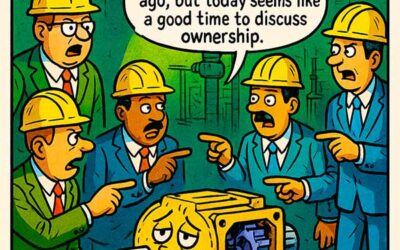
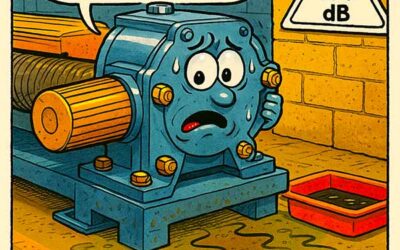
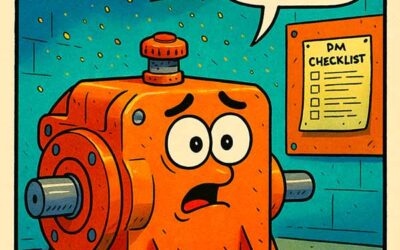
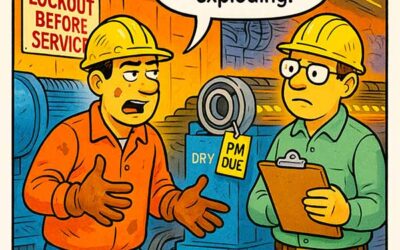
In maintenance and production environments, there’s a familiar tension between efficiency and safety. When deadlines loom, shortcuts feel justified, until someone gets hurt. This cartoon captures that reality with precision: a bandaged technician reflecting, “It slowed me down … once.” That “once” is the cost of neglecting machine guarding safety best practices.
Machine guards aren’t nuisances or bureaucratic red tape; they’re the final barrier between human life and mechanical energy. The goal isn’t to slow people down; it’s to prevent moments that stop everything forever. When guarding is viewed as integral to reliability rather than an obstacle to productivity, the plant culture changes, and so do the results.
Why Machine Guarding Safety Best Practices Exist
Machine guarding rules exist because machines don’t forgive mistakes. Every rotating shaft, pinch point, and exposed belt is a potential life-altering hazard. OSHA’s machine guarding standard (29 CFR 1910.212) was written after decades of incidents that demonstrated the consequences of prioritizing speed over safety.
Guards, interlocks, and barriers create separation between energy and anatomy. Yet even today, many maintenance teams still treat them as optional, removing them for “just a quick adjustment” or bypassing them “for testing.” Those few moments of exposure have led to countless injuries and fatalities.
Every guard removed for speed eventually costs more time in recovery.
The purpose of machine guarding safety best practices is to eliminate gray areas. No matter how urgent the job, the rule is simple: if a guard is off, the work stops. Safety isn’t a policy—it’s a precondition for productivity.
The Hidden Risks That Undermine Guarding Programs
Even well-meaning maintenance teams unintentionally compromise safety. Over time, minor deviations accumulate into systemic risk. Guards are left loose after PMs, interlocks are overridden to diagnose faults, and inspection checklists become pencil-whipped rituals.
The most common pitfalls that erode machine guarding safety best practices:
- Defeated interlocks: Temporary bypasses that become permanent “workarounds.”
- Missing fasteners: Guards that rattle loose and aren’t replaced immediately.
- Improper modifications: Fabricated access panels or cutouts that weaken protection.
- Poor visibility: Operators can’t see moving parts, leading them to remove guards unnecessarily.
- Inadequate training: Technicians don’t understand why each guard exists or how to reinstall them correctly.
These failures often stem from culture, not competence. When workers feel pressured to “keep it running,” safety becomes negotiable. Changing that mindset means elevating safety from rule-following to a reliability strategy.
Building Maintainability into Machine Guarding Design
One of the main reasons guards get removed is poor design. When it takes ten minutes and two tools to access a grease fitting, technicians are tempted to skip the process altogether. Actual machine guarding safety best practices start at the design stage, balancing accessibility with protection.
Key design strategies include:
- Quick-release systems: Guards that use captive fasteners or hinges reduce reinstallation time.
- Transparent materials: Polycarbonate or mesh panels allow visual inspection without removal.
- Modular sections: Enable access to specific components instead of removing large panels.
- Integration with CMMS: Work orders should specify guard removal and reinstallation steps as part of the maintenance task.
- Feedback loops: Encourage technicians to suggest design improvements for recurring issues.
Plants that involve maintenance teams in guard design see higher compliance and fewer accidents. When safety design aligns with workflow reality, guards stay where they belong, on the machine.
Good design makes safety the easiest option, not the hardest one.
Turning Machine Guarding Compliance into a Reliability Asset
The best organizations don’t treat safety and reliability as separate silos—they integrate them. Strong safety systems reinforce disciplined maintenance practices. Guard checks ensure that technicians work methodically, which directly improves equipment reliability.
Every audit, lockout verification, and guard inspection builds operational discipline, the same mindset that drives precision lubrication, torque accuracy, and PM optimization. The ripple effect is profound: fewer injuries, less unplanned downtime, and higher technician confidence.
Implementing machine guarding safety best practices can also reduce insurance premiums, lower the total cost of ownership, and enhance your brand’s reputation for responsibility. The return on safety investment isn’t abstract; it’s visible in every avoided incident and every uninterrupted shift.
Creating a Culture That Respects the Guard
Policies and procedures mean nothing without cultural buy-in. When supervisors praise “getting the line running fast,” they unintentionally reward risk-taking. The most reliable plants shift the narrative: real heroes are those who stop work to fix a missing guard, not those who bypass it to meet a quota.
Building that culture involves:
- Visible leadership: Managers conducting safety walkdowns and reinforcing standards.
- Near-miss reporting: Rewarding transparency over punishment.
- Refresher training: Regularly explaining the “why” behind guarding requirements.
- Peer accountability: Encouraging technicians to remind each other when guards are off.
When employees understand that safety is not a delay but a design principle, they begin to take ownership of it. That’s when guarding stops being “in the way” and becomes part of “the way we work.”
Conclusion
Speed impresses until it injures. Guarding slows you down, once, before something far worse stops you completely. The lesson is simple: machine guarding safety best practices aren’t just about following OSHA rules; they’re about valuing the hands, eyes, and futures that keep plants running.
Efficiency without safety is an illusion. The real leaders in maintenance and reliability know that the fastest way forward is the one that ensures everyone goes home with all their fingers attached.
Because in the end, as the cartoon reminds us: Speed is great, until it’s stitches.