
The Problem with Event-Only Improvement
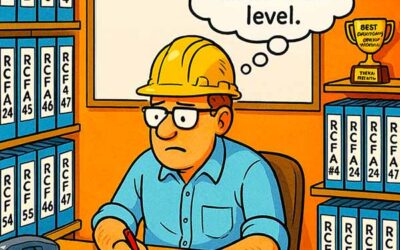
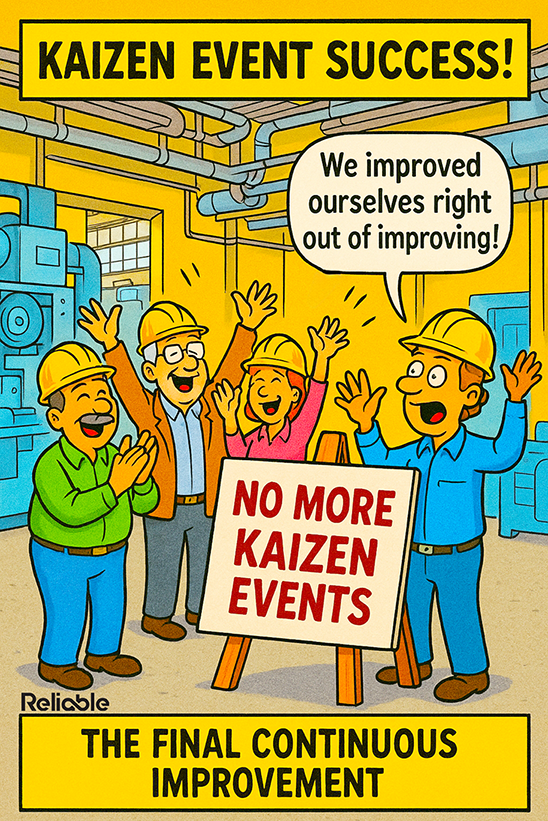
The cartoon’s humor strikes close to home: teams celebrating that they’ve “improved themselves right out of improving.” It’s funny because it’s painfully true. Many plants hold a handful of energetic Kaizen events, generate immediate wins, and then stop. Within months, the same inefficiencies, unplanned downtime, and waste resurface.
This is the trap of event-based improvement – a burst of progress followed by complacency. True reliability can’t be achieved in a few workshops or “Lean weeks.” It demands a mindset of continuous improvement, not episodic improvement.
Kaizen for plant reliability isn’t about perfecting processes once; it’s about designing systems that continuously evolve. Reliability failures occur not because the plant doesn’t know what to fix, but because it fails to sustain the improvements. Without integration into maintenance systems, the best Kaizen event fades into a memory rather than becoming a mechanism for resilience.
In short, Kaizen is not an event; it’s a way of thinking that prevents improvement fatigue.
From Kaizen Events to Reliability Systems
For Kaizen to truly enhance reliability, improvement must move from projects to processes. This means embedding continuous improvement within the fabric of daily maintenance operations.
Here’s how world-class plants make that transition:
- Root Cause Analysis (RCA): Kaizen thinking transforms RCA from a post-failure exercise into a preemptive reliability tool. Teams look for underlying systemic weaknesses, not just immediate causes.
- Preventive and Predictive Maintenance Optimization: Small Kaizen cycles refine task intervals and methods, preventing over-maintenance and under-maintenance alike.
- 5S and Visual Management: Orderliness, cleanliness, and visual control support reliability by reducing uncertainty and improving inspection precision.
- Autonomous Maintenance: Operators own first-line care: cleaning, inspection, lubrication – creating more uptime and fewer reactive calls.
By linking Kaizen to reliability engineering, improvements multiply rather than decay. The plant becomes a self-correcting system where every improvement feeds back into performance.
Making Kaizen for Plant Reliability Sustainable
Short-lived improvements destroy credibility. Reliability leaders know sustainability depends on habits, not heroics. Making Kaizen for plant reliability last requires structural reinforcement through people, process, and culture.
- Empowered Frontline Teams
Kaizen thrives when those closest to the work own the improvement. When an operator spots a recurring leak or a misaligned bearing and acts to eliminate the cause, that’s real Kaizen. Empowerment means authority to act, not just to suggest. - Standardization and Documentation
Every improvement must become part of standard work. If a lubrication interval is optimized or an inspection checklist is improved, it must be documented, shared, and communicated to staff. Otherwise, knowledge leaves when people do. - Leadership Engagement
Leaders sustain Kaizen through visible participation. They walk the floor, asking “why,” and celebrating small wins. Reliability-focused leadership doesn’t chase metrics; it builds environments where metrics naturally improve. - Systemic Reinforcement
Digital tools like CMMS, performance dashboards, and failure logs can lock in Kaizen gains. Data-driven feedback loops reveal patterns early, making continuous improvement measurable and repeatable.
When plants stop “doing Kaizen” and start living Kaizen, reliability ceases to depend on motivation. It becomes embedded in the system’s DNA.
Kaizen for Plant Reliability in Action
A plant in the chemical sector once struggled with chronic pump failures every six months. They ran several Kaizen events to address the issue—standardizing procedures, adjusting lubrication schedules, and improving alignment. The problem seemed solved until a year later, failures returned.
The lesson? The improvements were never reinforced. The CMMS still used outdated job plans, new hires were trained on old standards, and leadership stopped reviewing performance data.
When they relaunched their Kaizen effort with a sustainability focus, the results changed dramatically. The new Kaizen cycles were shorter but embedded into daily operations. Maintenance and operations teams met weekly to discuss small wins and failures. Work instructions were updated in real time. Within 18 months, pump MTBF increased by 240%.
That’s Kaizen for plant reliability, incremental improvement, institutionalized, and measured.
Reliability excellence isn’t achieved in a burst of innovation. It’s the product of relentless consistency. Every improvement, no matter how small, becomes a building block for stability.
Expanding Kaizen Beyond Maintenance: Driving Reliability Across the Plant
While Kaizen for plant reliability often starts in maintenance, its principles can transform every department when applied strategically. Extending Kaizen beyond maintenance integrates lean manufacturing, TPM (Total Productive Maintenance), and condition-based maintenance into a unified reliability framework.
Key areas where plants can expand Kaizen thinking include:
- Asset Management and Equipment Reliability – Applying Kaizen tools such as 5 Whys analysis, value stream mapping, and SMED (Single-Minute Exchange of Dies) can dramatically improve uptime, reduce setup time, and minimize equipment changeover losses.
- Energy Efficiency and Sustainability – Continuous improvement methods identify process inefficiencies that drive unnecessary energy use, supporting ISO 50001 and green manufacturing goals.
- Maintenance Planning and Scheduling Optimization – Embedding Kaizen into maintenance planning creates predictable workflows, improves work order accuracy, and strengthens CMMS data quality.
- Predictive Maintenance Integration – Combining Kaizen with predictive technologies like vibration analysis, oil analysis, and infrared thermography helps teams detect degradation trends early and implement countermeasures before failures occur.
- Workforce Development and Training – Structured Kaizen activities develop employee problem-solving skills, improve safety culture, and increase ownership of reliability results.
Kaizen’s connection to reliability-centered maintenance (RCM), overall equipment effectiveness (OEE), and lean reliability engineering ensures that every improvement links directly to measurable performance. Plants that align Kaizen with maintenance KPIs, MTTR, availability targets, and cost of poor reliability (COPR) see exponential returns.
This approach transforms Kaizen from a short-term workshop tool into an integrated reliability ecosystem, driving efficiency, sustainability, and operational resilience across the plant.
Kaizen as the Core of Reliable Culture
The ultimate goal of Kaizen for plant reliability is cultural, not procedural. When employees view improvement as part of their identity, not just their job, reliability becomes self-sustaining.
In mature organizations, you don’t see “Kaizen events” on the schedule because improvement is constant. The mindset shifts from “What’s the next initiative?” to “What’s the next opportunity?” Teams stop waiting for direction and start creating it.
This cultural transformation produces the highest form of reliability: adaptive reliability, a system that learns faster than it fails. The plant’s reliability metrics improve not because leaders demand it, but because the culture expects it.
The humor in the cartoon: “We improved ourselves right out of improving!” is a warning disguised as a joke. True reliability programs never run out of opportunities. Every solved problem reveals another layer of potential.