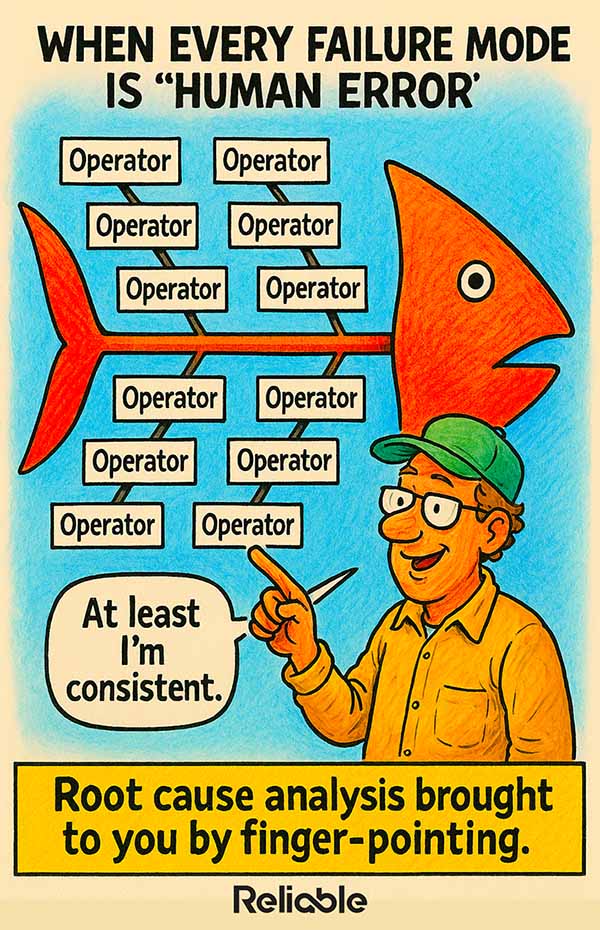

Every maintenance team has been there. A pump fails, a bearing seizes, a motor trips offline, and the investigation wraps up with two words: human error. The report gets filed, the supervisor moves on, and three months later the same failure happens again. If your team wants to know how to improve root cause analysis, the first step is blunt: stop treating the operator’s name as an acceptable final answer.
The phrase “human error” shows up on failure reports with alarming regularity. In some organizations, it becomes a catchall category for incident investigations. That should raise eyebrows. It tells you almost nothing about what actually went wrong, and it increases the likelihood that the same failures will cycle through your backlog for years.
Why “Human Error” Kills Your Ability to Improve Root Cause Analysis
Labeling a failure as human error feels like closure. Someone made a mistake, you identified who, case closed. But that conclusion skips the most important question: why did the person make that mistake in the first place?
Was the procedure outdated? Was the technician undertrained on that specific equipment? Was the task scheduled during a shift change with no proper handoff protocol? Was the lighting in the area so poor that misreading a gauge was practically inevitable?
When “human error” becomes your default failure category, the problem often lives in your investigation process, not on the plant floor.
These are system-level questions, and they point to system-level fixes. Writing “operator error” on a form addresses none of them. It assigns blame, then moves on. The underlying conditions that produced the failure remain untouched, waiting to cause the next one.
A structured approach like the 5 whys technique forces investigators past that first convenient answer. Each successive “why” peels back another layer of the system that allowed the failure to occur. By the third or fourth layer, operator blame often stops being a sufficient explanation.
How to Improve Root Cause Analysis: Practical Steps That Work
Fixing a broken investigation process requires changes at every level, from the forms your team fills out to the expectations in your planning meetings. Here are the moves that produce measurable results.
Remove “Human Error” from Your Report Templates
This sounds dramatic, but it works. Delete it from your dropdown menus, your checkboxes, your report templates. When the option disappears, investigators have to dig deeper by default.
Replace it with categories that drive corrective action:
- Procedure gap: missing, outdated, or unclear work instructions
- Training deficiency: task performed without adequate preparation or certification
- Environmental factor: poor lighting, excessive noise, temperature extremes, ergonomic constraints
- Design flaw: controls that invite misoperation, unclear labeling, confusing HMI layouts
- Organizational factor: scheduling pressure, inadequate staffing, missing handoff protocols
Each of these categories points directly to something you can fix. “Human error” points to a person you can blame. The difference in outcomes can be significant: teams that categorize failures by system factors instead of individual blame are more likely to identify corrective actions that prevent recurrence.
The goal of every investigation should be a corrective action you can engineer into the system, not a name you can write on a report.
That kind of sustained improvement compounds. Fewer repeat failures means fewer emergency work orders, which means more time for planned maintenance, which means better overall asset performance. The investigation process is the hinge that connects reactive firefighting to proactive reliability.
Build Investigations Around Evidence
Too many root cause investigations start with a conclusion and work backward. The supervisor already “knows” what happened. The report confirms the assumption. This is confirmation bias wearing a hard hat, and it’s endemic in maintenance organizations.
Effective root cause failure analysis starts with physical evidence. What does the failed component look like under magnification? What do the operating logs show in the 48 hours before the event? What were the process parameters trending toward?
Good investigation habits to enforce:
- Preserve the failed component for analysis before rebuilding or discarding it
- Interview operators and technicians within 24 hours while memories are fresh
- Review the last three work orders on the asset looking for patterns
- Verify the task was performed per the current procedure, and verify that the procedure itself is current and correct
When you follow the evidence, you often find that the “human error” was a predictable outcome of the conditions the person was working under. A technician who reinstalls a bearing incorrectly because the work instruction references a superseded part number made the immediate error, but the deeper cause is a system weakness that set that technician up to fail.
Train Your Investigators
Most plants invest heavily in operator training and almost nothing in investigation training. The people filling out root cause reports rarely have formal instruction in failure analysis methods, interviewing techniques, or evidence preservation.
Training on structured investigation methods can pay for itself quickly when it improves the quality of corrective actions. When investigators learn to ask better questions, they find better answers. When they find better answers, corrective actions are more likely to prevent recurrence instead of just checking a compliance box.
Nobody trains the investigators. That’s why the same failures keep showing up with the same two-word explanation attached.
Pair classroom training with a mentorship model. Have experienced investigators review reports from newer team members before they’re finalized. The feedback loop matters as much as the initial instruction, because good investigation technique is a practiced skill, not something absorbed from a slide deck.
Making the Shift Stick
Changing how your plant investigates failures takes more than a memo. It requires leadership commitment, consistent follow-through, and visible accountability when teams revert to old habits.
Track the quality of your investigations alongside the quantity. Useful metrics include:
- Percentage of investigations that identify a systemic corrective action (example target: above 80%)
- Repeat failure rate for investigated events, tracked on a rolling 12-month basis
- Time from event to completed investigation (set a site-specific target; many teams aim for less than 30 days)
- Ratio of single-factor conclusions to multi-factor findings (watch for overuse of single-cause explanations)
Reliable plants treat every failure as a data point. The investigation process determines whether that data drives improvement or gathers dust. A mature predictive maintenance strategy depends on understanding why things fail, and that understanding only develops when investigations dig deeper than the nearest operator.
The next time someone reaches for “human error” on a failure report, push back. Ask the five whys. Examine the system. The real root cause is often hiding one or two layers beneath the convenient answer, waiting for someone willing to look.