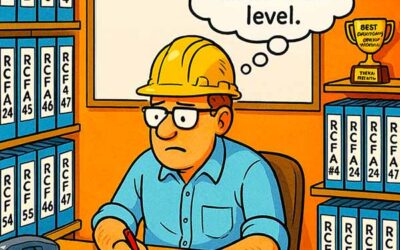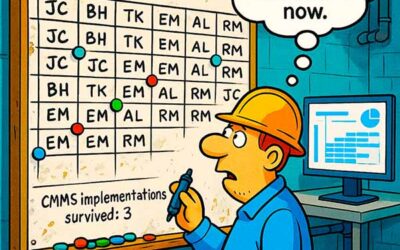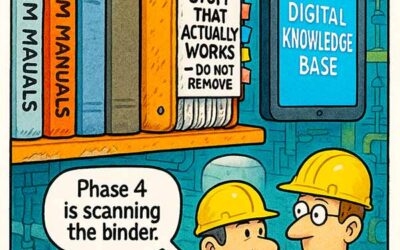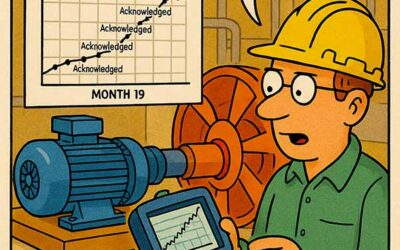


In the cartoon, a smiling technician stands beside a hydraulic press, dripping fluid onto the floor, and proudly says, “She’s just glistening from effort.” It’s funny until you realize how often that attitude shows up in real plants. Across manufacturing, leaks are dismissed as usual “sweating” rather than treated as urgent reliability red flags. Yet every drop reveals a story: seal fatigue, fitting loosening, or overpressure cycles quietly stressing the system.
Leaks are not a nuisance. They’re a sign of system decline. Implementing a structured hydraulic maintenance inspection checklist converts those symptoms into measurable data, preventing unplanned downtime, safety incidents, and costly waste.
Why Every Facility Needs a Hydraulic Maintenance Inspection Checklist
Hydraulic systems drive industrial motion —lifting, pressing, molding, and clamping — with immense power. That power also creates risk. Even a pinhole leak at 3,000 psi can eject fluid at velocities exceeding 120 mph, fast enough to penetrate skin and cause serious hydraulic injection injuries. Pressures as low as 100 psi can still cause harm.
Without a disciplined inspection process, these leaks silently grow, compromising performance and safety. A hydraulic maintenance inspection checklist ensures no critical point is overlooked, protecting both assets and personnel.
Unchecked leaks lead to:
- Energy losses through pressure inefficiency
- Safety hazards, including slip zones and injection risks
- Environmental contamination and cleanup liability
- Accelerated seal and pump wear
- Lost productivity from unplanned downtime
Ignoring leaks reflects maintenance denial. Discipline restores control.
Core Components of a Hydraulic Maintenance Inspection Checklist
A well-designed hydraulic maintenance inspection checklist blends visual, analytical, and standards-based practices. The goal isn’t just spotting leaks, it’s understanding why they occur and preventing recurrence.
Visual and Functional Checks
- Inspect hoses, connectors, and fittings for wet spots or sheen.
- Observe pooling under pumps, valves, and actuators.
- Examine reservoirs for fluid aeration or foaming, potential indicators of air ingress, incorrect fluid formulation, depleted anti-foam additives, or excessive return line turbulence.
- Verify pressure, temperature, and flow readings against baselines.
- Check vibration, noise, and abnormal motion patterns.
Fluid Health and Analysis
Fluid condition drives system reliability. Each inspection should include:
- Fluid sampling for contamination, water content, oxidation, and viscosity shifts.
- Follow ISO 4021 sampling procedures and compare particle count results (analyzed per ISO 11500 or ISO 4407) to ISO 4406 cleanliness codes.
- Measure acid number (ASTM D974), viscosity (ASTM D445), and water content (ASTM D6304) to establish performance trends.
- Establish baseline measurements during commissioning and after major fluid changes—without these reference points, degradation trends cannot be reliably identified.
- Confirm correct fluid type and additive balance relative to OEM specifications.
- Viscosity measurement at both 40°C and 100°C provides insight into the fluid’s Viscosity Index (VI); a drop in VI signals chemical degradation or contamination.
Filter and Component Integrity
- Replace filters based primarily on differential pressure per OEM specifications (often monitored via ISO 23309 indicators).
- For advanced CBM, integrate data from online contamination sensors governed by ISO 11943.
- Recognize that filter media can degrade chemically or mechanically, even if the differential pressure remains acceptable.
- Inspect seals, gaskets, and O-rings for brittleness or flattening.
- Check cylinder rods for scoring, coating wear, or flaking (chrome or ceramic).
- Verify fasteners meet torque requirements.
- Examine return and suction lines for vibration fatigue or abrasion.
Building Discipline Around Inspections and Data Tracking
Even the most detailed hydraulic maintenance inspection checklist only works when rigorously applied and verified.
1. Assign Ownership
Each hydraulic circuit should have a responsible technician. Ownership reduces leak tolerance and fosters proactive care.
2. Standardize and Digitize
Transition from paper forms to digital inspections integrated with your CMMS or EAM. Timestamped entries and automatic alerts improve traceability and trend analysis.
3. Integrate Predictive Maintenance Tools
Combine inspection data with predictive technologies for multidimensional insight:
- Thermal imaging to identify friction hotspots, internal leakage, and energy inefficiency. Thermal imaging also provides qualitative diagnostic insight into pressure loss and frictional heat-induced leakage, even though it cannot quantitatively measure pressure.
- Vibration analysis per ISO 20816 (or ISO 13373 for detailed diagnostics), detecting bearing wear, pump cavitation, misalignment, fluid hammering, and flow turbulence.
- Oil analysis to trend contamination, oxidation, and additive depletion.
- Ultrasonic testing for pinpointing pressurized leaks and suction-side air ingress.
4. Continual Review and Calibration
Reassess the checklist quarterly:
- Are sampling points representative per ISO 4021?
- Have new fluids or seal materials altered test protocols?
- Are results trending toward higher ISO 4406 codes or increased TAN (AN) values?
Discipline transforms inspections from paperwork into predictive defense.
Turning Inspections into Competitive Advantage
A comprehensive hydraulic maintenance inspection checklist not only prevents leaks but also elevates operational maturity. Plants that execute consistently outperform those that don’t, because they control degradation instead of reacting to it.
When inspection becomes habitual, technicians evolve from parts changers to pattern recognizers. They detect hose chafing before rupture, varnish formation before sticking valves, and micro-leaks before downtime.
The Economics of Early Detection
A small hydraulic leak producing one drop per second wastes roughly 400 gallons annually. With mid-grade hydraulic fluids priced at $10–25 per gallon—higher for synthetics or fire-resistant types—fluid replacement costs alone can reach $4,000–10,000 per year.
Risk-Based Inspection Frequency
Inspection frequency should be risk-driven, not fixed. Use Failure Mode and Effects Analysis (FMEA) or criticality rankings to determine intervals:
- Ultra-critical systems – shift-by-shift checks
- High-risk assets – daily or weekly
- Moderate-risk systems – biweekly or monthly
This structured approach ensures that resources align with both the consequences and the probability of failure.
Aligning with Industry Standards
To ensure consistency and compliance, align your hydraulic maintenance inspection checklist with globally recognized frameworks:
- ISO 4413 – Hydraulic fluid power systems and safety requirements
- ISO 17359 – Condition monitoring and diagnostics
- ISO 11171 – Hydraulic filter performance testing
- ISO 20816 / ISO 13373 – Vibration evaluation and diagnostics
- ISO 11943 / ISO 23309 – Particle counters and differential pressure indicators
- ISO 4021 – Extraction of fluid samples
- SAE J1227 – Hydraulic hose inspection and maintenance
- ANSI/NFPA T2.6.1 – Hydraulic component and safety recommendations
Referencing these standards ensures your program meets both regulatory and engineering best-practice benchmarks.
Turning Denial into Discipline
The cartoon’s humor captures a mindset: the willingness to rationalize small leaks rather than address them. But precision maintenance begins with accountability.
A hydraulic maintenance inspection checklist transforms hidden problems into actionable data, dismantling the “normal sweating” myth. It creates visibility, drives repeatable routines, and institutionalizes discipline.
Building a Maintenance Mindset
- Curiosity over complacency: Ask why a leak occurred, not just where.
- Evidence over intuition: Let data, not assumptions, guide action.
- Accountability over avoidance: Measure progress publicly.
When discipline becomes identity, reliability follows.
Putting It Into Practice
Hydraulic leaks don’t appear overnight—they evolve through neglect. A precise hydraulic maintenance inspection checklist catches degradation early, turning chaos into control.
So next time someone says the press is just “glistening from effort,” hand them a checklist, and maybe a mop. The first builds reliability. The second cleans up what the checklist could have prevented.