
1. Why Wrench Time Still Matters—But Why It’s So Often Misunderstood
Wrench time—the percentage of a technician’s shift spent physically turning wrenches—has been a cornerstone metric in maintenance for decades. On paper, it’s simple: increase wrench time, and you increase productivity.
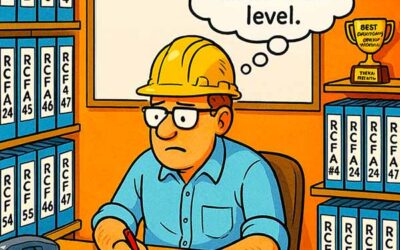
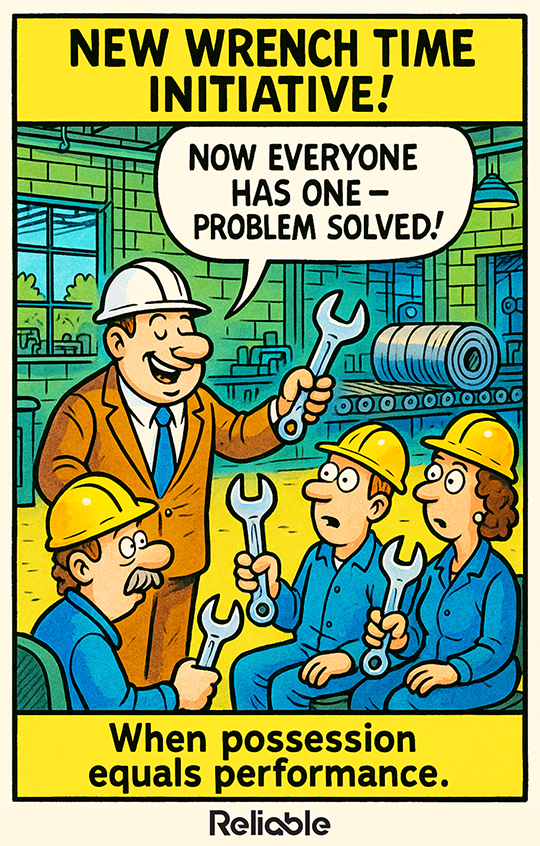
But as the cartoon humorously shows, “giving everyone a wrench” doesn’t automatically make the plant more efficient. In fact, it highlights how oversimplified solutions can distract from the real issues.
Handing out more tools doesn’t fix inefficiency; it just arms the chaos with better equipment.
When organizations chase higher wrench time percentages without understanding the systemic barriers behind low productivity, they’re measuring motion, not effectiveness. Studies show that in most plants, only 25–35% of a maintenance technician’s shift involves actual hands-on work. The rest disappears into delays: waiting on permits, parts, instructions, or approvals.
The real question isn’t “How do we make people turn wrenches more often?” but “What prevents them from doing it?” Improving wrench time in maintenance starts with removing obstacles, not adding pressure. It’s a systems problem, not a personnel one.
2. The False Promise of “Tool-Based Productivity”
Many leaders confuse availability with performance. When they see low wrench time, they assume the fix is to “equip the team better.” So, they hand out more tools, tablets, or software and call it progress. But as the cartoon suggests, that’s like handing everyone a wrench and declaring victory.
To improve wrench time in maintenance, you must understand that tools, without planning and coordination, solve nothing. Productivity comes from readiness, not possession. The difference between a high- and low-performing maintenance team isn’t the number of wrenches, it’s the number of barriers removed before work starts.
In most plants, low wrench time is caused by:
- Missing or late materials: Techs spend 15–20% of their time searching for parts or waiting on stores.
- Unclear job scope: Work orders lack detail, leading to confusion or rework.
- Poor scheduling: Crews are reassigned mid-shift or pulled into emergencies.
- Permit and safety delays: Time wasted waiting for approvals or lockout/tagout support.
- Inefficient communication: Supervisors, planners, and craftspeople operate in silos.
When you measure and fix these constraints, wrench time improves automatically, without gimmicks or hollow initiatives.
3. Building the Foundation: Planning and Scheduling Discipline
Every world-class maintenance organization that has sustainably improved wrench time in maintenance has one thing in common: disciplined planning and scheduling. Without these functions working in harmony, wrench time will always plateau.
A well-structured planning and scheduling process includes:
- Dedicated planners, not part-time ones: A planner should not be “half mechanic, half administrator.” Their full-time job is ensuring work packages are complete – parts, permits, tools, procedures, and safety considerations—before the technician arrives on site.
- Work order quality: Planners must build standardized job plans with clear task steps, estimated durations, and required materials.
- Effective scheduling: A schedule should assign specific jobs to specific people for specific time windows, minimizing travel and idle time.
- Feedback loops: After each job, planners should gather technician input to update task durations, part lists, and procedural notes.
Plants that follow this discipline typically see wrench time rise from 25% to 45%. The gains come not from working harder, but from working prepared. A technician with everything staged and ready will accomplish more in four hours than an unprepared one can in eight.
4. Moving Beyond Wrench Time: The Right Metrics for Real Improvement
A narrow obsession with wrench time can distort behavior. Teams start “gaming the metric” by skipping safety checks, cutting corners, or underreporting delays. True performance improvement requires metrics that capture value-added work, not just activity levels.
If you want sustainable progress, track complementary metrics such as:
- Work Order Completion Rate: Percentage of scheduled jobs finished as planned.
- Planned vs. Unplanned Work Ratio: A higher ratio means more control and predictability.
- Mean Time to Repair (MTTR): Measures how quickly equipment is restored to service.
- Preventive Maintenance Compliance: Indicates whether scheduled tasks are consistently executed.
- Mean Time Between Failures (MTBF): Validates that maintenance work actually improves reliability.
When these indicators improve, wrench time naturally follows. The goal isn’t just to get technicians turning wrenches longer; it’s to ensure that every wrench turn contributes directly to asset reliability and uptime.
5. Turning Insights into Sustainable Culture Change
Improving wrench time in maintenance requires cultural alignment across operations, maintenance, and management. Technicians need to see that efficiency isn’t about surveillance, it’s about support. Supervisors must view planning and scheduling not as bureaucracy, but as a performance multiplier.
Consider a practical roadmap:
- Audit your current state. Time studies, observation logs, or maintenance management software can reveal hidden inefficiencies.
- Establish a baseline. Know your actual wrench time percentage before implementing changes.
- Invest in training for planners and schedulers. Most plants underinvest in these roles even though they have the highest leverage.
- Eliminate reactive work. Every unscheduled breakdown cancels dozens of planned work hours.
- Celebrate systemic wins. Recognize improvements in uptime, quality, and flow – not just wrench time percentage.
Once teams experience the benefit of smoother workflows and fewer frustrations, the conversation shifts from “we need higher wrench time” to “we’re finally getting meaningful work done.”
Closing Thought: Measure the Right Things, for the Right Reasons
The manager in the cartoon, proudly distributing wrenches, embodies a common leadership trap, confusing symbolic action for systemic progress. Metrics like wrench time are essential, but they’re not ends in themselves. They’re diagnostic tools.
Improving wrench time in maintenance is about enabling people, not counting minutes. When leaders focus on preparation, planning, and removing friction from daily work, they elevate both performance and morale. The best plants don’t just measure wrench time; they make it matter.