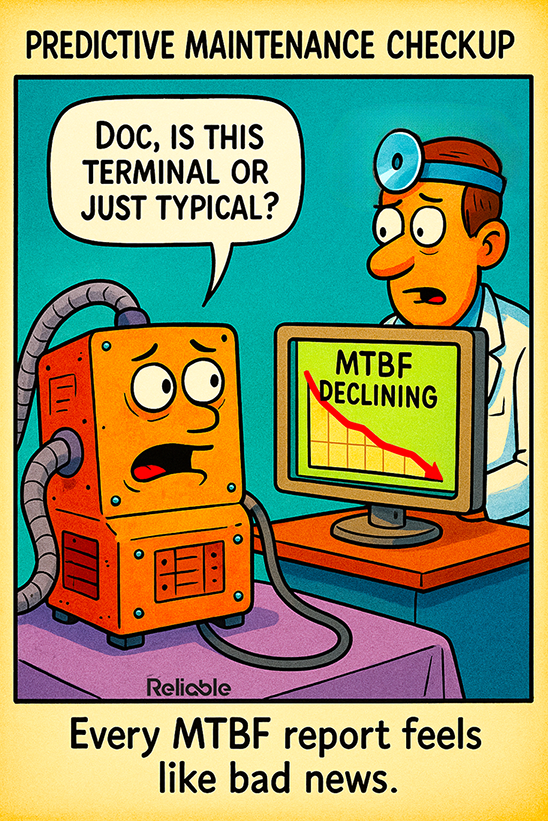

Every maintenance manager has faced it: the dreaded MTBF report showing a declining trend. It’s like a bad medical checkup for your machines. Mean Time Between Failure (MTBF) tells you how long equipment operates before it breaks down, and when that number drops, it’s a signal that reliability is deteriorating somewhere beneath the surface.
A falling MTBF isn’t just a symptom of machine wear—it’s a mirror reflecting how your organization manages reliability.
Improving MTBF requires more than replacing parts faster or scheduling more PMs. It means changing how the organization thinks about reliability, learning from failure patterns, and connecting data to decisions. Let’s break down how to improve MTBF in maintenance using practical, measurable strategies that work in any industrial environment.
Why Understanding MTBF Is Key to Asset Reliability
MTBF is often misunderstood. Many treat it as a simple performance score, higher is good, lower is bad—but it’s far more than that. MTBF is a reliability signature. It reflects how well your maintenance strategy prevents failure recurrence, manages asset health, and integrates predictive insights.
When teams report a declining MTBF, it usually indicates one of the following:
- Maintenance tasks are poorly prioritized (reactive vs. preventive).
- Root causes are misdiagnosed or left unresolved.
- Component quality or operating conditions have changed.
- Maintenance intervals are mismatched with real-world failure behavior.
A better approach to how to improve MTBF in maintenance begins with accurate failure data. That means defining what constitutes a “failure.” Is it any unplanned stop? A loss of function? A deviation from tolerance? Consistency in how you define failure directly affects MTBF calculations—and the conclusions you draw from them.
Once you establish data integrity, MTBF becomes a diagnostic tool. It tells you where to look, not what to fix. When properly analyzed, MTBF reveals which assets are chronic offenders, which systems need design review, and where operational practices undermine equipment life.
Root Cause Elimination: The Foundation for Better MTBF
A declining MTBF curve rarely improves without addressing the underlying mechanisms that cause repeat failures. Many plants perform Root Cause Analysis (RCA) after a major breakdown, but they stop short of implementing true Root Cause Elimination.
To reverse MTBF decline:
- Collect comprehensive failure data. Don’t just log symptoms—document environmental conditions, duty cycles, and process variations at the time of failure.
- Quantify impact. Use Pareto charts to identify which 20% of assets or failure types cause 80% of downtime.
- Integrate predictive diagnostics. Tools like vibration analysis, infrared thermography, or oil analysis can validate hypotheses about degradation trends.
- Implement corrective actions that prevent recurrence. Replace short-term fixes (“replace bearing”) with systemic interventions (“improve alignment procedure,” “install contamination controls”).
One of the most overlooked aspects of how to improve MTBF in maintenance is closing the loop. Every RCA must feed its findings back into the maintenance plan, training, and CMMS documentation. The goal is to institutionalize lessons learned so the same issue never appears twice in your history log.
MTBF rises naturally when an organization learns faster than its equipment fails.
When reliability leaders execute this cycle consistently, MTBF doesn’t just recover, it stabilizes and then climbs steadily, reflecting an organization that learns faster than its assets fail.
Using Predictive Maintenance Data to Boost MTBF
Predictive maintenance (PdM) has transformed how we understand equipment health. It replaces time-based assumptions with condition-based reality. Sensors and analytics tools detect early-stage degradation, bearing fatigue, imbalance, misalignment, or contamination—long before functional failure occurs.
But PdM data only improves MTBF when it’s properly contextualized. The key is correlation:
- Correlate condition data with process parameters. Vibration spikes may align with load increases or startup cycles.
- Correlate failure data with maintenance actions. Did MTBF drop after switching lubricants or changing shift patterns?
- Correlate cost data with MTBF. Improving reliability on the wrong assets wastes resources; target high-criticality equipment first.
The most advanced teams build integrated dashboards that link PdM outputs to CMMS histories. When vibration data or oil analysis results trigger automatic work orders, it creates a closed feedback system. Over time, this process drives a measurable rise in MTBF because each intervention is based on evidence, not schedule.
Predictive analytics also enable statistical forecasting. Weibull analysis, for instance, can model failure probability based on historical trends, helping you anticipate optimal replacement intervals. This data-driven foresight is central to how to improve MTBF in maintenance without inflating maintenance budgets.
Predictive analytics turn MTBF from a backward-looking metric into a forward-looking advantage.
Predictive maintenance (PdM) has redefined reliability. Instead of relying on fixed schedules, it continuously monitors asset health through sensors, analytics, and trend data. But to truly influence how to improve MTBF in maintenance, predictive systems must do more than detect—they must inform, prioritize, and optimize.
From Raw Data to Actionable Insight
Data alone doesn’t improve Mean Time Between Failure – context does. Vibration spikes, temperature increases, or rising contamination levels mean little without understanding the machine’s operating condition. PdM platforms that correlate data streams with process variables—speed, load, pressure – help determine whether anomalies are cause for concern or just operational noise.
The best-performing teams don’t drown in dashboards; they focus on failure precursors. For example, an early-stage bearing defect detected through ultrasonic analysis may not trigger immediate downtime, but it becomes a marker in the asset’s reliability history. Tracking these micro-patterns allows planners to predict degradation velocity and intervene before MTBF is compromised.
Integrating Predictive Analytics with CMMS
To make predictive data practical, integrate it with your Computerized Maintenance Management System (CMMS). When condition thresholds are crossed, automated work orders should trigger with relevant diagnostics attached. This creates a closed-loop workflow, data feeds decisions, decisions feed outcomes, and outcomes feed new data.
Over time, MTBF improves because maintenance becomes proactive, not reactive. Failures are prevented by design, not discovered by surprise.
Predictive Models That Forecast Reliability
Machine learning adds a new dimension to how to improve MTBF in maintenance. Algorithms trained on historical sensor data can forecast the probability of failure weeks in advance. These models evolve as new data arrives, refining their accuracy.
When MTBF becomes a leading indicator, reliability shifts from chance to choice.
The result? Maintenance teams transition from reacting to predicting, and MTBF transforms from a lagging indicator into a leading one. Each data point becomes a step toward reliability maturity, where every failure avoided compounds into measurable uptime.
Building a Maintenance Strategy That Sustains MTBF Gains
Once MTBF improves, sustaining it requires an aligned strategy across people, processes, and technology. Reliability-centered maintenance (RCM) principles help determine the most effective mix of preventive, predictive, and corrective tasks for each asset.
To sustain long-term gains:
- Standardize work quality. Inconsistent lubrication or torque procedures can erase MTBF improvements overnight.
- Enhance skills and ownership. Train operators in early detection and basic maintenance care—autonomous maintenance extends MTBF dramatically.
- Benchmark progress. Compare MTBF trends across similar asset classes or sister plants to identify best practices.
- Reevaluate intervals. As reliability improves, revisit maintenance frequencies to optimize cost without compromising uptime.
A culture of precision maintenance, where every bolt torque, bearing fit, and cleanliness standard matters—is the invisible backbone of reliability. Technology amplifies it, but discipline sustains it.
Organizations that fully understand how to improve MTBF in maintenance treat their maintenance programs like continuous experiments. They refine strategies based on data, validate improvements with metrics, and communicate wins across the enterprise.
Conclusion: Turning the MTBF Report into Good News
MTBF reports don’t have to be bad news, they can be early warnings that guide smarter decisions. A declining trend is not a verdict but an invitation to look deeper into your failure data, human practices, and design assumptions.
Improving MTBF means uniting three reliability dimensions:
- Technical: Using predictive diagnostics and precision maintenance.
- Analytical: Leveraging failure data for trend analysis and RCA feedback.
- Cultural: Building a mindset that treats every failure as a learning opportunity.
When these elements align, your machines stop asking, “Is this terminal or just typical?” and start performing like healthy, predictable assets with measurable reliability gains.
The ultimate goal of how to improve MTBF in maintenance is not to chase a number, it’s to create a self-correcting reliability system where data, people, and processes continuously elevate each other. That’s when every MTBF report finally feels like good news.