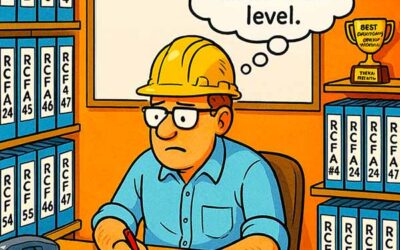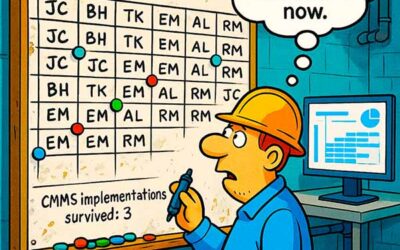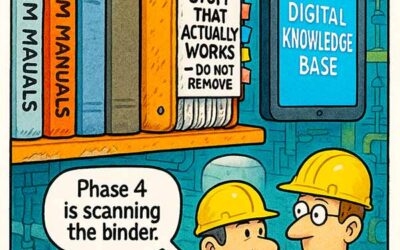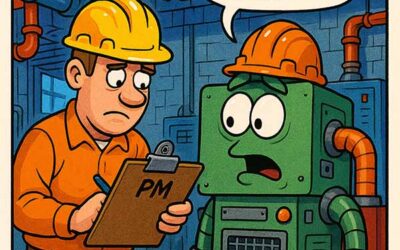

Walk into any plant and ask leadership about reliability. You’ll hear the right words: uptime targets, mean time between failures, condition monitoring rollouts, the new CMMS implementation. (The CMMS slide is always polished.)
Then ask the planner what percentage of preventive maintenance work orders closed on time last quarter. The answer tells you what’s really going on.
PM compliance is the most honest metric in maintenance. It cuts past strategy decks and kickoff energy, and measures one thing: when an asset needed care on a specific date, did anyone actually show up?
The Number Most Plants Don’t Want to See
The benchmark for world-class PM compliance lives somewhere around 90 percent, with the work itself completed inside a 10 percent window of the scheduled date. That’s the SMRP standard. Most plants land between 50 and 70 percent once they measure it honestly.
The gap between those two numbers is mostly a culture problem dressed up as a maintenance problem.
When schedules slip, the cause usually sits upstream of the technician. Something else in the operation took priority. A breakdown elsewhere, a production rush, a parts shortage, a planner who couldn’t get a window.
Each individual delay carries a defensible story behind it. (The pattern is what matters.)
When PM compliance slips below 80 percent, you’ve slid from preventive maintenance into reactive maintenance with a calendar attached for show.
That’s the part most reliability programs dance around. The schedule exists, the work orders are open, the dashboard is configured.
The actual execution has drifted into firefighting with extra paperwork. Leadership reviews the green tiles, signs off, and moves on. The technicians see the gap clearly, and the gap reads as a value statement they didn’t ask for.
What Falls Apart When PMs Slip
Skipped or delayed PMs don’t fail loudly. That’s the trap. The asset usually keeps running.
Lubrication degrades quietly. Belts stretch quietly. Bearings ride out their L10 life on borrowed time, and then on a late shift in a humid August week, the asset gives up.
The cost calculation almost always favors the PM. A scheduled lubrication takes 15 minutes. The unplanned bearing replacement that follows a missed lube cycle takes a full shift, sometimes more, plus the production loss, plus the secondary damage to the shaft and housing.
Industry studies have placed unplanned downtime costs in process industries somewhere between three and ten times the cost of planned work. Some sectors see worse multiples. The math isn’t subtle.
Here’s what gets eroded when PMs consistently slip:
- Equipment life shrinks, often by 20 to 40 percent versus a maintained baseline
- Warranty coverage gets voided, since most OEMs require documented service intervals
- Spare parts inventory swells to cover the unpredictability
- Insurance underwriters notice, and premiums reflect it
- Technicians lose trust in the schedule and start prioritizing by gut
That last one is the quiet killer. Once a technician stops trusting the schedule, the schedule stops being a schedule. It becomes a suggestion.
The Culture Question
Reliability leaders often frame PM compliance as a discipline issue. Discipline matters, and the signaling layer matters more.
When the plant manager defers PMs to chase a production target, they’re sending a message about what matters. Technicians read that message accurately. So do supervisors and the next shift’s planner.
Over a quarter or two, that quiet pattern becomes the operating culture, regardless of what the strategy slide says.
Every deferred PM is a small communication from leadership about which promises the organization actually keeps.
A PM kept on schedule, by contrast, says something else. It says the asset matters and the technician’s time was worth protecting. It says the planner’s craft was respected.
These observations show up in hard data: turnover rates, apprentice retention, the willingness of skilled trades to stay through a tough quarter.
The Trap of Optimization Before Compliance
Plenty of reliability programs jump straight to PM optimization. RCM workshops, PMO sessions, condition monitoring tied to dynamic intervals. Useful work, all of it.
The trouble is that optimization assumes a stable baseline. If you can’t actually execute your PMs on time, you can’t tell whether the interval was wrong or whether the execution was wrong. The data is contaminated.
A plant running 55 percent compliance that launches an optimization project is, in most cases, polishing the wrong surface. The first job is to stabilize compliance, even at suboptimal intervals, then optimize from a clean baseline.
Practical Moves That Move the Number
Some plants have pushed compliance from the 60s into the high 80s without adding headcount. The patterns repeat.
They protect the schedule. PMs get a fixed window each week, treated like a production run. If something must displace them, it requires a documented override at the supervisor level, rather than a hallway conversation.
They right-size the PM book. A plant carrying 14,000 active PMs with a small crew has built a paperwork exercise rather than a maintenance program. Pruning the redundant, the obsolete, and the calendar-based work that should have been condition-based is often the highest-leverage move available.
They measure compliance weekly, rather than monthly. Monthly numbers absorb too much noise. Weekly numbers force conversation while the cause is still fresh.
A planner who knows compliance gets reviewed Monday morning behaves differently from one whose number gets averaged into a 30-day blur.
They tie compliance to operations, beyond just maintenance. Reliability is a plant deliverable owned across functions, with maintenance as one stakeholder among several. When the production manager owns part of the compliance number, scheduling conflicts get resolved differently.
A few specific things to watch for in your own program:
- Are PMs being closed on time but executed sloppily? (Check rework rates.)
- Are technicians signing off without doing the steps? (Audit randomly.)
- Are intervals being silently extended in the CMMS to make the number look better? (This happens more than anyone admits.)
What On Time Actually Means
The 10 percent window matters. A monthly PM done 10 days late falls outside on-time. A quarterly PM done three weeks late is barely a PM at all.
The bearing measures only one thing: whether the lubrication arrived when it needed to.
Defining the window tightly forces the planning function to actually plan. Loose windows allow drift, and drift compounds.
The asset is the only honest auditor. It either gets what it needs on the schedule it needs it, or it pays you back later with interest.
Across a few years, that interest gets expensive. The plant that protects its window pays in disciplined hours.
The plant that loses its window pays in catastrophic events, regulatory friction, and the creeping erosion of its operational license.
The Bottom Line
A high PM compliance number serves as evidence that the program actually exists, and that’s the value of tracking it.
When the number is real, when it’s measured tightly, when leadership protects it from the quiet trade-off pressure, every other reliability practice gets easier.
Condition monitoring data becomes interpretable. Root cause analyses get cleaner inputs. Optimization projects start producing real gains in the data.
When the number is theater, the dashboards stay green and the equipment keeps failing on its own quiet schedule.
Show up for the assets. They notice.