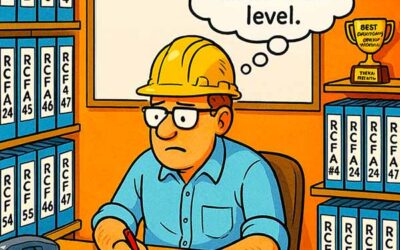
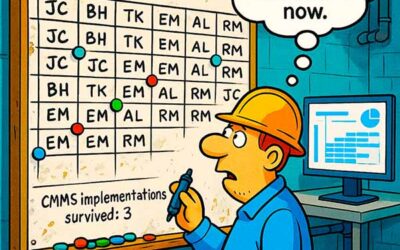
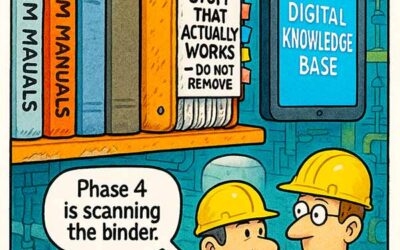
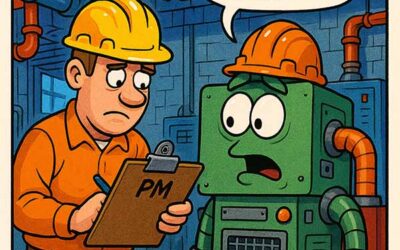
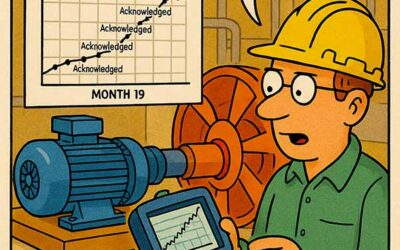
The cartoon hits uncomfortably close to home: reports go into a system labeled “corrective actions,” and nothing substantial ever emerges. Many plants track failures endlessly – reports, screenshots, technician comments, operator notes – yet equipment continues failing for the same reasons. The issue rarely stems from a lack of data. Instead, the FRACAS process collapses before corrective actions ever meaningfully influence the equipment’s performance.
A functioning FRACAS is not a database; it’s a closed-loop improvement mechanism. It captures failures, analyzes causal factors, defines actions, executes those actions, and objectively verifies their impact. When any stage weakens, the loop stalls, and the system becomes noise rather than knowledge.
Restoring the FRACAS process requires disciplined workflow, careful terminology, and precise alignment with accepted engineering guidance.
Why the FRACAS Process Fails in Many Plants
The FRACAS process typically falls apart between analysis and implementation. Plants often treat FRACAS as a reporting function rather than an improvement engine. Meanwhile, critical nuances—data structures, verification standards, and cross-functional roles—are overlooked.
It helps to anchor FRACAS within broadly recognized reliability frameworks. Standards such as MIL-STD-2155 (for tracking and analysis), ISO 14224 (for structured equipment reliability data), and IEC 60300-series guidance (on dependability management) provide a framework for a technically sound system. These do not dictate how every FRACAS should run, but they reinforce best practices in data quality, analysis rigor, and corrective-action validation.
Technical Gaps That Commonly Break the FRACAS Process
- Prioritization that underweights frequency
Many plants evaluate failures only by consequence. But a low-consequence failure occurring every week may consume more labor, introduce more instability, or indicate a systemic precursor to a significant event. Prioritization must reflect frequency × consequence, not consequence alone. - Causal analysis that stops at the symptom level
Recording “bearing overheated” is not a causal analysis. Structured tools—such as 5-Whys, fishbone diagrams, or fault tree analysis—are essential for mapping contributing factors at the component, human, and process levels. For complex failures, deeper mechanistic investigation may be required, but it must be proportional to the risk. - Corrective actions that don’t address mechanisms
A common issue: corrective actions are vague (“improve maintenance,” “enhance cooling”) instead of specific and technically grounded. The FRACAS process demands cause-to-action traceability. - Verification without predefined criteria
Teams often attempt verification after the fix is installed – yet no objective criteria were established during planning. Verification must be anchored in measurable expectations set before corrective actions are executed.
A FRACAS that captures failures but doesn’t validate improvements is just structured frustration.
Turning FRACAS Process Data Into High-Value Insight
A high-functioning FRACAS process turns failure data into insight – insight into conditions, mechanisms, and system behavior. But insight isn’t limited to maintenance. A mature FRACAS shifts the entire organization:
- Operations sees where procedures break down.
- Maintenance sees where components fail prematurely.
- Engineering sees specification gaps and design weaknesses.
- Procurement sees which vendor components underperform.
A frequently overlooked aspect: FRACAS is not only about fixing the broken pump, but it’s also about ensuring the next pump purchased does not inherit the same vulnerability. That design-feedback loop is one of the most powerful and underused strengths of a mature FRACAS.
A Tiered Analysis Approach With the Right Nuance
Tiering keeps the FRACAS process efficient:
- Tier 1: Rapid classification for minimal-risk events.
- Tier 2: Structured causal analysis for moderate-risk or recurring events.
- Tier 3: Comprehensive RCA for high-consequence or high-frequency failures.
Necessary clarification: Tiering cannot be based on consequence alone. High-frequency failures, though individually minor, often signal systemic issues: procedural drift, lubrication weakness, material selection problems, or component misapplication.
Adding a simple visual (e.g., a 3-level funnel) often helps teams internalize the tiering structure.
A failure’s importance is defined not only by its severity, but by how often it returns.
Engineering a High-Performance FRACAS Process Workflow
A well-designed FRACAS is sequential, auditable, and consistent; much like a manufacturing process. Each stage produces a defined output that feeds the next step. When the process is visible and standardized, repeatability improves dramatically.
The 5-Step FRACAS Process Workflow
1. Event Capture
Capture what happened, when it happened, operating conditions, alarms, supporting evidence, and recent work. ISO 14224’s data hierarchy is a strong model for maintaining this structure and consistency.
2. Causal Analysis
Apply structured methods: 5-Whys, fault tree analysis, fishbone diagrams, or task/sequence mapping.
For complex issues, deeper component-level or material-level analysis may be necessary—but only when justified by risk.
3. Corrective Action Definition
Actions must be specific, mechanism-based, and linked to measurable outcomes. Examples:
- Misalignment: Precision realignment with tolerance confirmation.
- Overheating: Install auxiliary cooling, correct fouled cooling paths, replace undersized components, or, if design limits are inadequate, temporarily derate equipment and initiate a Management of Change (MOC) review.
- Lubricant degradation: Select a lubricant with proper viscosity grade, additive system, compatibility, and oxidation stability; address thermal stress; or implement condition monitoring.
Critical: Define verification metrics during planning, not afterward. These metrics might include temperature thresholds, changes in vibration amplitude, reductions in contamination, or other physical indicators.
4. Execution & Tracking
Every corrective action must be entered into the CMMS, including ownership, deadlines, and required verification evidence. Off-system tracking virtually guarantees actions will disappear.
5. Effectiveness Verification
Verification must rely on measurable outcomes tied to the causal mechanism. Examples:
- Reduced amplitude at forcing frequencies
- Stabilized temperature profiles
- Lower oxidation rates or contamination counts
- Improved process parameter stability
A corrective action has value only when its impact is visible in the equipment’s behavior.
Making the FRACAS Process a Performance Engine, Not Paperwork
A FRACAS becomes powerful when organizations embed ownership, transparency, and cross-functional engagement into the loop. FRACAS is not a maintenance-only function. It is an enterprise-level improvement mechanism.
Three Improvements That Strengthen Any FRACAS Process Immediately
1. Make the loop visible with dashboards
Track open actions, overdue actions, recurrence rates, and verification outcomes. Visibility creates urgency and prevents stagnation.
2. Assign corrective actions by technical domain (not department)
- Resonance, fluid-film instability, or variable-speed vibration → Vibration specialists / mechanical engineering
- Electrical degradation events → Electrical engineering
- Human-performance or procedural drift → Operations leadership
- Component design weaknesses → Engineering / procurement
This avoids the terminology confusion between “dynamic instability” and other vibration dynamics phenomena.
3. Strengthen verification governance
Verification becomes credible only when the criteria are:
- Defined before implementation
- Quantitative
- Tied to the failure mechanism
- Documented
This is where most FRACAS processes quietly fail.