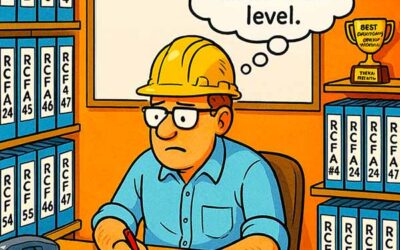
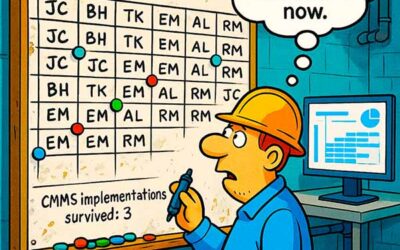
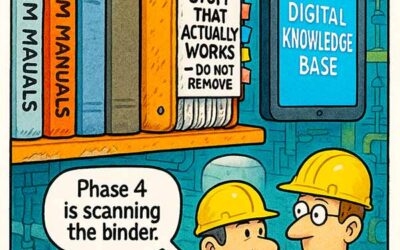
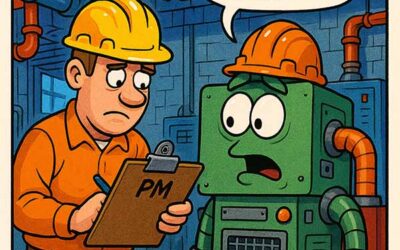
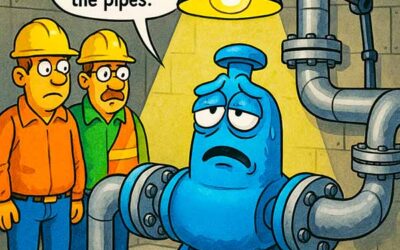
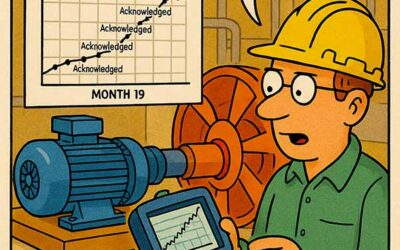
System failures are sneaky. We like to think in terms of one root cause, one bad bearing, one missed inspection—but sometimes reality hits harder. That’s when the fishbone diagram fills up, every branch crowded with causes, until the conclusion is as messy as the chart itself: everything is contributing. This cartoon captures that moment perfectly: the weary engineer declares, “So the root cause is… everything.” That’s the brutal truth of systemic failure.
Let’s unpack why “everything” isn’t a helpful answer, how to recognize systemic breakdowns, and what leaders must do to turn complex failures into focused improvements.
When Fishbone Diagram Root Cause Analysis in Maintenance Breaks Down
The fishbone (Ishikawa) diagram is a staple of root cause analysis. It’s visual, structured, and encourages teams to explore categories such as methods, machines, materials, manpower, and environment. In simple cases, such as a misaligned shaft or a poor weld, the diagram works beautifully.
But when the same component fails three times in a row, despite corrective actions, you have a different beast. At this point, the fishbone diagram doesn’t narrow down the problem. It bloats. Suddenly, every arrow is valid: poor training, weak procedures, wrong spares, weak supplier quality, skipped inspections, and flawed lubrication practices.
In other words, the problem isn’t a component anymore. It’s the system that manages the component.
The Trap of Treating Symptoms Instead of Systems
Too often, maintenance teams stop at the first “fixable” issue. Bad grease? Change it. Wrong torque? Retrain. No spares? Stock them. However, after three failures, the problem isn’t the grease, torque, or spares—it’s how the organization allows all three to occur simultaneously.
Here’s the trap: by treating symptoms piecemeal, you waste resources while the systemic rot continues. This is why fishbone diagram root cause analysis in maintenance can become misleading. It pushes you to list causes without ranking them by systemic impact.
Think of it this way: a house that collapses after multiple patch jobs doesn’t need another patch. It requires a foundation rebuild. Maintenance systems work the same way.
How to Spot When the System Is the Root Cause
So how do you know when your fishbone diagram has crossed into “everything is wrong” territory? Look for these signals:
- Recurring failures despite corrective actions: The system isn’t learning.
- Excessive categories filled in the diagram: Too many arrows point to systemic weakness.
- Inconsistent processes across shifts or sites: The system isn’t standardized.
- Low accountability for failures: Everyone blames the part; no one owns the process.
When these signs appear, your fishbone diagram isn’t wrong; it’s just telling you that the problem is bigger than the tool can solve.
At this stage, leaders must move from RCA to system reliability analysis. Instead of asking, “What caused this failure?” the better question is, “What system design allowed this failure to repeat?”
Moving Beyond Fishbone Diagram Root Cause Analysis in Maintenance
Here’s how to shift gears when the diagram says “everything”:
- System Mapping Instead of Symptom Listing
Create a reliability block diagram or workflow map that illustrates the connections between decisions, resources, and actions. This reveals bottlenecks in training, communication, or oversight. - Focus on Latent Conditions
James Reason’s “Swiss cheese” model applies: failures align because of latent weaknesses, poor policies, unclear roles, and inadequate oversight. Fix those, not just the failed part. - Prioritize with Risk-Based Thinking
Rank systemic contributors by impact, not frequency. A weak lubrication program might be less frequent than stockouts, but it is far more destructive. - Accountability at the System Level
Instead of asking, “Who torqued the bolt wrong?” ask, “Why doesn’t our system prevent incorrect torque?” This shifts accountability from individuals to leadership and processes.
When organizations make this shift, repeated failures start to disappear, not because the fishbone diagram has improved, but because the system itself has matured.
When Everything Is the Root Cause
The cartoon nails the irony: after the third failure, the fishbone diagram points everywhere. That’s not useless, it’s a clue. It’s telling you the problem isn’t with the component but with the way the system governs reliability.
When fishbone diagram root cause analysis in maintenance becomes too complex, it’s time to elevate your perspective. See the system. Rebuild the foundation. Because sometimes, the part isn’t broken, the system is.