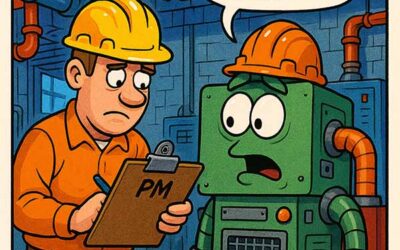
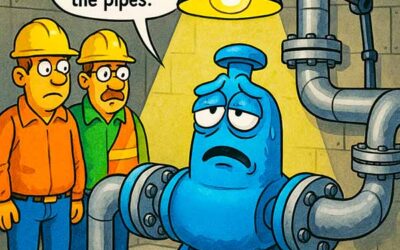
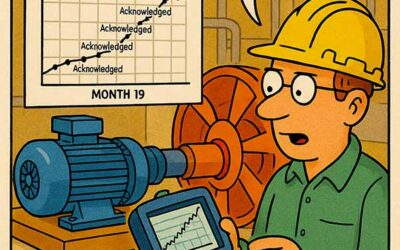
The cartoon of a gearbox gripping its PF interval like a lifeline captures a real problem in manufacturing: assets are always asking, “How much longer can I hold?” The PF curve, often reduced to a chart in a training deck, is in reality the heartbeat of every reliability program. It maps the time between the point of potential failure (P) – when we can first detect trouble—and the point of functional failure (F) – when the equipment stops doing its job.
The time in between, the P-F interval, is the critical runway maintenance teams rely on to act. If ignored, that runway shrinks, often leaving only emergency options. But with smart practices, organizations can extend the P-F interval in predictive maintenance, gaining more time to intervene, lowering risk, and creating breathing room for strategic decision-making.
What the P-F Interval Means in Predictive Maintenance
Predictive maintenance is built on the principle of early detection. The PF curve explains why. If you detect a bearing defect at P, you may have 3 months before it seizes at F. If you only catch it at vibration levels signaling imminent collapse, you may have 3 days—or less.
The length of the P-F interval directly determines whether your plant operates proactively or reactively. A compressed interval forces firefighting. A long one empowers planned interventions, optimized spare parts management, and safer work conditions.
Think of the PF interval as the difference between landing a plane on a full-length runway versus a short strip carved out of a jungle. One allows precision, safety, and confidence. The other demands risk, stress, and luck. Predictive maintenance extends that runway.
Tools and Techniques to Extend the P-F Interval
Extending the P-F interval in predictive maintenance isn’t about wishful thinking; it’s about applying proven technologies and disciplined practices that slow degradation and identify failure earlier.
1. Lubrication Excellence
Lubrication is often called the “lifeblood” of machinery—and with good reason. Contamination, improper viscosity, and over- or under-greasing accelerate wear, collapsing the PF interval. A precision lubrication program can dramatically extend the P-F interval by ensuring machines operate under optimal conditions.
- Oil Analysis: Tracks viscosity, contamination, and additive depletion long before catastrophic failure.
- Clean Storage and Handling: Prevents new oil from being dirtier than the oil it replaces.
- Grease Program Discipline: Applies correct amounts with the right tools, avoiding the over-greasing trap.
2. Vibration Analysis
Every rotating asset tells a story through vibration. Imbalance, misalignment, bearing defects, and looseness each create unique signatures. Detecting them early extends the PF interval from days to months.
Advanced analytics, trending, and even AI-driven diagnostics allow organizations to anticipate failure with precision. Instead of “waiting for the squeal,” teams can intervene long before breakdown.
3. Infrared Thermography
Thermal anomalies reveal problems invisible to the naked eye. Overheated motors, failing electrical connections, overloaded bearings—all show up on an infrared scan. By acting on these hotspots early, teams extend the PF interval and prevent fire, energy waste, and safety incidents.
4. Ultrasound Inspection
Ultrasound catches leaks, lubrication needs, and electrical discharge. It often detects issues even earlier than vibration. Adding ultrasound to the predictive toolkit adds another layer of P-F interval extension.
5. Operator-Driven Reliability
Operators are frontline sensors. With the right training, they detect changes in sound, smell, or feel faster than any sensor. Embedding operator rounds with structured checklists helps surface small issues that, if ignored, collapse the PF interval.
The secret is layering these technologies. One tool alone helps, but combining oil analysis, vibration, thermography, ultrasound, and operator care multiplies the early-warning runway.
Why Ignoring Degradation Shrinks the P-F Interval
Too many organizations fall into the trap of thinking, “If it’s running, it’s fine.” This attitude doesn’t just risk failure—it guarantees the PF interval will shrink unnoticed.
When degradation signals are ignored, consequences multiply:
- Compressed Runway: Detection occurs only when failure is imminent, reducing planning time to hours instead of weeks.
- Production Losses: Failures strike at peak demand, compounding costs.
- Safety Hazards: Rushed emergency repairs increase accident risks.
- Financial Impact: Emergency purchases, expedited freight, and collateral damage dwarf the cost of proactive care.
Ironically, many plants argue they can’t afford predictive technologies—while unknowingly paying 5–10x more by letting the PF interval collapse. The real cost isn’t the monitoring—it’s ignoring degradation until you’re out of options.
Case Example: Extending PF Interval with Oil Analysis
Consider a fleet of compressors where oil changes were scheduled by calendar. Failures continued because wear debris went unnoticed until late-stage bearing damage. After implementing routine oil analysis, the team began spotting microscopic particles of wear metals at point P.
By intervening with targeted lubrication adjustments, they extended the PF interval by 9–12 months per unit. Downtime costs dropped 60%, and maintenance planning shifted from crisis to control.
This is the practical power of extending the P-F interval in predictive maintenance—turning what used to be surprise breakdowns into predictable, preventable events.
Embedding P-F Interval Thinking Into Maintenance Culture
Technology is necessary, but culture makes it stick. To truly extend the P-F interval in predictive maintenance, organizations must rewire how teams think:
- Train operators and technicians in failure modes and signal recognition.
- Align maintenance and finance around lifecycle costs, not just immediate expenses.
- Reward proactive catches so teams see the value in early detection.
- Measure success not just in uptime, but in how early failures are identified and prevented.
This mindset shift transforms reliability from a “department” into a shared responsibility. Everyone on the shop floor contributes to extending the PF interval, whether by logging an unusual sound, maintaining lubrication standards, or analyzing data.
Beyond Technology: Slowing the Rate of Degradation
Extending the P-F interval isn’t just about earlier detection—it’s also about reducing how fast degradation progresses. This requires root-cause discipline.
- Alignment programs prevent vibration-induced wear.
- Contamination control prevents abrasive damage from particulates.
- Load management ensures assets aren’t overstressed.
- Environment controls reduce moisture and thermal cycling damage.
By slowing degradation at its source, you not only extend the PF interval—you also extend the total useful life of the asset.
Conclusion
The nervous gearbox in the cartoon clutching its PF interval captures the real challenge reliability teams face every day: how much time do we have left before this thing fails? The truth is, without proactive strategies, the answer is always “less than you think.”
Predictive maintenance offers the tools and discipline to extend the P-F interval—to lengthen the runway between potential failure and functional failure. With lubrication excellence, condition monitoring, operator involvement, and cultural buy-in, organizations can transform reliability from a firefight into a strategic advantage.
Every day gained in the P-F interval is more than just extra time—it’s reduced costs, safer operations, higher production, and a calmer, more confident workforce. The real question isn’t whether you should extend the P-F interval in predictive maintenance. It’s how aggressively you’ll pursue it.