

When Drawings Outlive the Process
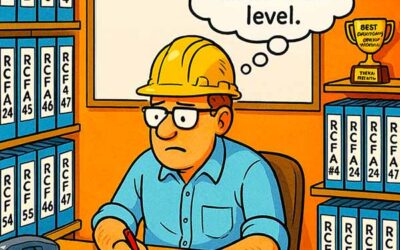
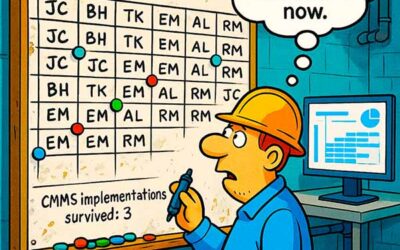
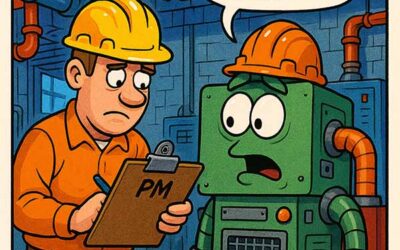
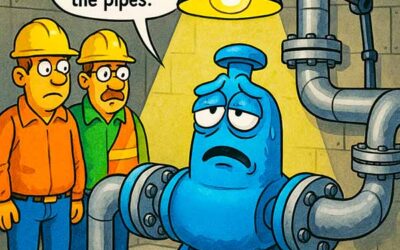
Every maintenance technician has faced it: a set of process drawings that look like they belong in a museum. In this cartoon, two workers stare at an ancient schematic so outdated it practically references dinosaurs. It’s funny, but only because it’s true. Across manufacturing, refineries, and utilities, outdated diagrams and manuals are still in daily use.
Outdated documentation isn’t just old, it’s operational fiction that breeds costly reality. When documentation no longer reflects the current plant condition, operations drift from design intent, safety controls weaken, and downtime risk climbs. A simple job can escalate into an outage because the drawings lied.
Plants evolve constantly. Piping gets rerouted, controls upgraded, assets replaced. Yet documentation often lags months—or years—behind. The greater the gap between “what’s drawn” and “what exists,” the higher the potential for confusion, inefficiency, and safety exposure.
Why Accurate Documentation Matters More Than Ever
Accurate documentation defines how systems operate, how maintenance is performed, and how failures are prevented. When it’s incomplete or outdated, small mistakes can ripple into severe consequences.
When drawings omit valves or equipment, personnel may over-rely on the P&ID and miss field isolation points. The risk arises from documentation–practice mismatch, especially where LOTO does not require dual field verification. A mislabeled motor can create an electrical hazard. A procedure written for obsolete equipment can trigger unsafe or unstable process conditions.
Common Failure Effects
- Safety Hazards: Incorrect isolation points or outdated LOTO data can lead to injury.
- Downtime Delays: Crews spend hours confirming details that should already be right.
- Maintenance Errors: Technicians repair or remove the wrong equipment.
- Training Gaps: New hires inherit outdated instructions as “truth.”
- Compliance Risk: Regulators treat documentation lapses as negligence.
When documentation fails, so does trust. Reliability depends on one shared truth; accurate, verified, and accessible records.
The Hidden Cost of Outdated Documentation
Documentation errors silently drain productivity. Industry benchmarking studies consistently show technicians spend 10–18% of wrench time searching for accurate documentation in low-digital environments; integrated CMMS/EDMS systems typically reduce that below 5%.
Even more costly are decisions based on bad assumptions. Planning, material requests, and scheduling all depend on correct data. Wrong information multiplies waste and delay.
Hidden Costs Include:
- Rework: Tasks redone due to inaccurate instructions.
- Material Waste: Parts ordered that don’t fit or aren’t needed.
- Extended Outages: Time lost reconciling drawings with reality.
- Reliability Erosion: Increased failures from incorrect maintenance execution.
Each undocumented change compounds uncertainty. Within a few years, drawings can become so unreliable that engineers treat them as “rough sketches.” That’s when risk becomes systemic.
Digital Transformation Done Right
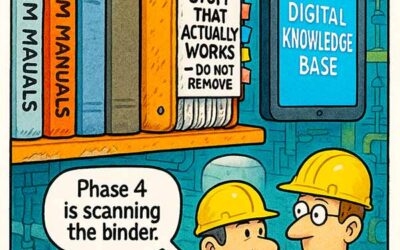
Most plants still manage documentation like it’s 1985—binders, PDFs, and spreadsheet-driven processes. Modernization requires converting those static records into structured, data-linked assets.
Leading integrated solutions—IBM Maximo + Hexagon SDx, AVEVA AIM + Unified Engineering, SAP EAM + COMOS, or Hexagon EAM + Smart P&ID – support structured data exchange and federated asset views. Full bi-directional synchronization of BOMs or hierarchies is achievable but requires robust data governance, master data management protocols, and—in most cases—custom integration middleware and significant change management.
Intelligent P&IDs and 3D models still require controlled authoring aligned with ISA-5.1/ISO 14617 symbol standards and governed by configuration-management practices (e.g., CFIHOS, ISO 15926, ISO 23247 for digital-twin frameworks). Automation aids accuracy but cannot replace disciplined verification.
Best Practices for Modernization
- Rebuild, Don’t Just Scan: Convert legacy drawings into data-centric P&IDs using current tools such as AVEVA Diagrams, Hexagon Smart P&ID, or Bentley OpenPlant PID 2023+ with full symbol-to-database linking.
- Implement Version Control: Require formal revision approval workflows.
- Link Every Document to Asset IDs: Ensure every tag, component, and procedure connects to the digital asset registry.
- Follow Global Standards: Apply ISO 14224 for equipment taxonomy and CFIHOS (current version) for structured data handover to operations.
- Integrate with Digital-Twin Strategy: Progressive owners are beginning to reference ISO 23247 in project specifications, signaling a long-term shift toward structured documentation as the foundation for digital-twin implementations.
- Enable Field Feedback Safely: Technicians report discrepancies via mobile CMMS apps, engineering controls document changes under formal authority.
- Adopt Cloud Access: Provide real-time retrieval of verified documents across teams.
When documentation lives in structured databases instead of file folders, it becomes searchable, auditable, and scalable across generations.
Linking Documentation to MOC
Even the best system fails without disciplined Management of Change (MOC). Every physical modification—piping reroutes, new sensors, altered control logic—should trigger document review.
A robust MOC link ensures no physical change exists unrecorded. Without it, digital chaos follows analog neglect.
Integration Steps
- Closure Discipline: Leading practice requires MOC closure only after documentation updates are completed and field-verified, though implementation discipline varies across industry.
- Independent Review: Updates should be reviewed and approved by qualified personnel independent of the change originator, a best practice for all process safety information and required by IEC 61511 for safety-instrumented system documentation.
- Cross-Discipline Sign-Offs: Require mechanical, electrical, and safety reviews.
- Traceable Audit Trail: Capture who changed what and when.
Per OSHA PSM 1910.119(l), EPA RMP 40 CFR 68.75, and API RP 750, any physical or procedural change affecting process safety must follow a formal MOC workflow with pre- and post-change risk assessments. ISO 55001 asset-management principles reinforce this via requirements for controlled operational processes.
From Drawings to Living Knowledge
Accurate documentation empowers people as much as processes.
When technicians know what’s real, they work faster and safer. When planners trust asset data, they schedule confidently. When auditors review records, the plant’s credibility strengthens.
Accurate documentation preserves explicit knowledge—equipment configurations, procedures, and specifications—while training programs must complement it with hands-on and tacit knowledge transfer. This dual approach builds competence and continuity as experienced personnel retire.
Documentation, when managed as an operational asset, links engineering precision with maintenance reality. The payoff: fewer errors, lower costs, greater uptime.
Summary
Accurate, verified documentation is the backbone of plant performance. It reduces risk, accelerates maintenance, and safeguards people. Plants that modernize their records and integrate them with MOC and forward-looking digital-twin strategies operate from clarity, not confusion.
The cartoon exaggerates for humor, but the message lands: When your maps predate your machinery, you’re navigating blind. In today’s data-driven plants, documentation isn’t paperwork, it’s performance infrastructure.