

Every maintenance professional knows that most failures don’t happen under supervision; they happen between inspections. The quiet hours between route-based readings are where early-stage faults grow into full-blown breakdowns. That’s where continuous vibration monitoring systems make the difference.
These systems keep a constant watch, turning every second of machine operation into usable data. Instead of relying on a few snapshots per month, they generate a living health record of each asset. When implemented well, they shift maintenance from reactive firefighting to intelligent prevention.
However, not every solution that claims to be “continuous” lives up to the name. Some collect excessive noise and miss key frequencies, while others fail to synchronize with data historians or CMMS platforms. The best systems deliver not just more data, but better data, turning information overload into actionable insight.
How Continuous Vibration Monitoring Systems Work
At the core of every vibration monitoring program is the accelerometer, a device that measures how machinery vibrates across frequencies. A continuous vibration monitoring system networks dozens or hundreds of these sensors, streaming data to gateways that feed local servers or cloud-based analytics.
Unlike handheld devices that capture a momentary signal, continuous systems measure constantly. High-frequency data is filtered, digitized, and compressed before transmission. The result is a detailed profile of machine behavior, speed fluctuations, harmonics, bearing frequencies, imbalance, and resonance patterns.
Edge computing now allows sensors to process and filter data locally, reducing bandwidth while flagging anomalies in real time. When vibration amplitude at a specific frequency exceeds a pre-set threshold, alerts can automatically trigger maintenance work orders or inspection requests.
These systems act as the plant’s nervous system, sensing subtle mechanical distress before human perception or scheduled inspections can detect it.
Why Continuous Vibration Monitoring Systems Outperform Periodic Checks
Route-based measurements provide valuable baselines but fail to capture transient events. A bearing may show no issues during a scheduled inspection, only to deteriorate days later under different loads. Continuous vibration monitoring systems remove this blind spot by collecting data 24/7 under all operating conditions.
Key Advantages:
- Constant data availability: The system records everything from minor resonance peaks to sudden amplitude spikes, ensuring no event goes unseen.
- High-resolution trend analysis: Continuous data enables precise fault trending and early detection of subtle frequency shifts.
- Automated intelligence: Algorithms analyze deviations in vibration signatures, identifying potential imbalance, looseness, or misalignment before they escalate.
- Remote monitoring: Engineers can view live machine health from anywhere, using dashboards that visualize asset condition across multiple sites.
This constant vigilance enables reliability teams to move from reactive to predictive, and eventually prescriptive maintenance. The earlier faults are detected, the more options teams have to plan repairs with minimal disruption.
Key Components of Continuous Vibration Monitoring Systems
High-Quality Sensors
Reliable vibration data starts with rugged, calibrated accelerometers capable of detecting a wide frequency range. Sensors with low noise floors and stable temperature performance capture signals cleanly even in harsh industrial environments.
Data Gateways and Networking
Gateways act as translators between analog signals and digital analytics platforms. Modern systems often use wireless mesh networks or Ethernet-based protocols for low-latency, high-integrity data transfer.
Analytics and Visualization Software
The analytics layer transforms streams of raw acceleration data into digestible formats such as spectrum plots, envelope analysis, RMS trends, and waterfall charts. The best software correlates vibration patterns with operating conditions, helping pinpoint the root cause instead of just flagging an alarm.
Integration with Maintenance Systems
The most powerful advantage comes from integration. Continuous vibration monitoring systems that feed data directly into CMMS or ERP systems close the loop between detection and action. When thresholds are breached, automatic work orders ensure nothing slips through the cracks.
Scalability and Security
A scalable system can start small, with a few critical machines, and expand plantwide. Cybersecurity should never be an afterthought; encrypted data channels and role-based access are essential to protect operational integrity.
The Economics of Continuous Monitoring
Investment in continuous vibration monitoring systems often raises eyebrows until the first major failure is prevented. The economics are simple: early detection saves exponentially more than the cost of installation.
Downtime in high-production facilities can cost thousands per minute. Catching a bearing defect weeks before it leads to a catastrophic failure prevents both lost output and collateral damage. Over time, these systems justify themselves through reduced mean time to repair (MTTR), improved mean time between failure (MTBF), and higher overall equipment effectiveness (OEE).
Moreover, continuous data enables condition-based maintenance strategies. Instead of servicing equipment by arbitrary calendar intervals, teams can schedule tasks precisely when indicators show performance degradation, eliminating wasted labor and extending component life.
Continuous Vibration Monitoring Systems and AI Integration
The frontier of predictive maintenance is automation enhanced by artificial intelligence. Continuous vibration monitoring systems now generate such vast datasets that AI algorithms can learn from them, identifying complex fault signatures long before they become visible through traditional analysis.
Machine learning models trained on years of vibration spectra can detect early-stage bearing defects or rotor imbalance with remarkable accuracy. As these systems evolve, they’ll shift maintenance programs from condition-based to predictive, and eventually to self-optimizing systems that automatically prescribe optimal maintenance actions.
This isn’t theoretical, it’s happening now. Companies deploying AI-enhanced monitoring have reported dramatic reductions in unplanned downtime and maintenance costs. The future of plant reliability lies in letting machines interpret their own signals and warn us before failure ever begins.
The Payoff: Reliable Insights and Confident Decisions
The ultimate goal isn’t data collection, it’s decision confidence. With continuous vibration monitoring systems, analysts no longer rely on assumptions or incomplete information. They see failure modes developing in real time, enabling proactive interventions.
This level of visibility allows maintenance managers to:
- Optimize maintenance budgets through targeted repairs.
- Justify capital expenditures using data-driven evidence.
- Benchmark asset performance across similar machines.
- Provide executives with quantifiable ROI on reliability investments.
Every sensor becomes a reliability storyteller. The narrative shifts from “what went wrong” to “what could go right if we act now.”
Bringing It All Together
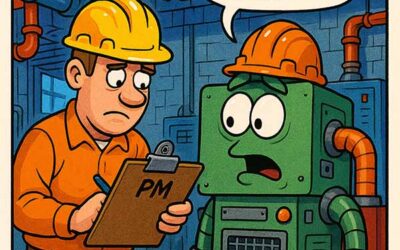
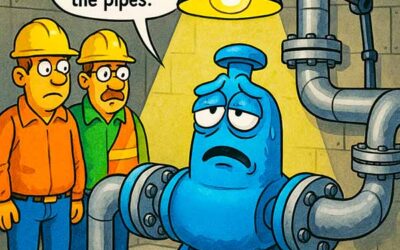
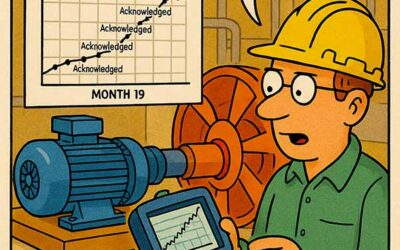
The cartoon says it best: “Some trend data, others trend disappointment.” Plants that rely on periodic checks often end in disappointment. Continuous vibration monitoring systems capture the whole story; every resonance, imbalance, and frictional whisper that signals what’s coming next.
When your machines speak, these systems ensure you’re always listening. They’re not just diagnostic tools; they’re operational insurance policies that deliver peace of mind with every data point collected.
The plants embracing continuous vibration monitoring aren’t simply adopting new technology; they’re redefining maintenance strategy for the data-driven era.