The Power of Combining Predictive Maintenance Technologies
In modern plants, maintenance teams face a paradox: they’re flooded with more data than ever, yet often still blindsided by failures. Each sensor, analysis report, and inspection tool tells its own story, but none capture the entire truth. That’s where combining predictive maintenance technologies changes the game.
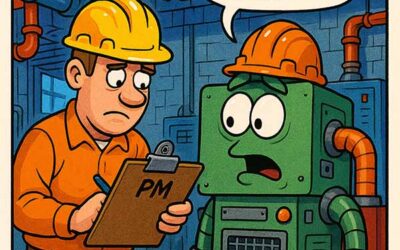
The cartoon “The Predictive Maintenance Dating App” says it best: a technician stands before a panel of eager diagnostic tools, each promising its unique magic: vibration analysis, thermography, oil analysis, ultrasound. His frustrated question, “Can’t I just use all of you?”, captures the ideal modern mindset.
Predictive maintenance isn’t about picking the “best” technology. It’s about orchestrating them. Like instruments in a symphony, each predictive technology plays a part; together, they create harmony. Plants that master this integration no longer react; they anticipate, interpret, and optimize equipment health with precision.
Why One Technology Alone Isn’t Enough
Every predictive maintenance technology provides a piece of the reliability puzzle.
- Vibration Analysis detects imbalance, misalignment, looseness, and bearing wear. It tells you when the heartbeat of your rotating equipment skips a beat.
- Thermography exposes abnormal heat patterns. It identifies failing motors, overloaded circuits, or friction caused by poor lubrication.
- Oil Analysis examines the machine’s lifeblood, tracking contamination, oxidation, and wear particles to predict component health.
- Ultrasonic Testing picks up the faint whispers: leaks, arcing, turbulence, and lubrication starvation that others miss.
Used alone, each of these is powerful but incomplete. A vibration alarm might indicate bearing distress, but without oil analysis, you won’t know whether contamination caused it. Thermography may show overheating, but it doesn’t reveal whether friction or electrical load is to blame. Ultrasound can detect air leaks, but can’t diagnose the mechanical source of vibration causing them.
Relying on a single data stream is like diagnosing a patient with only a stethoscope. You might hear symptoms—but you won’t understand the underlying cause. That’s why combining predictive maintenance technologies creates exponential value: it merges partial truths into full situational awareness.
The Synergy of Combined Insights
The magic lies in correlation. When data from multiple predictive technologies intersect, patterns emerge that no single sensor could reveal.
Consider a gearbox monitored through vibration, thermography, and oil analysis:
- Vibration data shows an increasing amplitude at a specific frequency, suggesting imbalance.
- Thermal imagery confirms a localized hot spot near the bearing housing.
- Oil analysis detects elevated ferrous particles, confirming metal-on-metal wear.
Individually, these observations could lead to cautious monitoring. Together, they confirm imminent failure and pinpoint its cause. The maintenance team acts decisively, preventing both secondary damage and unnecessary downtime.
This synergy applies across countless scenarios:
- Ultrasound + Vibration: Detect inadequate lubrication and validate bearing distress simultaneously.
- Thermography + Oil Analysis: Determine whether heat is due to contamination, oxidation, or friction.
- Vibration + Motor Circuit Analysis: Reveal both mechanical and electrical issues in motor-driven systems.
By combining predictive maintenance technologies, you move from symptom detection to cause validation—transforming maintenance from a reactive activity into a science of precision.
Integration: The Heart of Predictive Maintenance Technologies
The true challenge isn’t buying more tools; it’s integrating them. Many organizations own excellent PdM equipment, yet their programs remain siloed. Oil analysts don’t talk to thermographers, and vibration techs operate separately from ultrasound specialists.
Integration begins when data – and people – connect. Here’s how leading facilities make it work:
- Define a Common Objective. Instead of chasing more data, chase better decisions. Align all technologies around a single goal: reducing unplanned downtime by confirming faults early.
- Map Each Technology to Failure Modes. Use FMEA logic: vibration for imbalance, oil for contamination, thermography for frictional heat, and ultrasound for air and steam leaks.
- Centralize Data Storage. Whether through CMMS, EAM, or a cloud-based reliability dashboard, merge PdM data into a single visualization layer. This allows trend correlation and cross-validation.
- Standardize Reporting. Use consistent terminology, alarm thresholds, and rating systems. One database entry should tell the entire asset story, not four separate partial ones.
- Train Cross-Discipline Teams. A thermographer should understand basic vibration patterns. An oil analyst should interpret ultrasonic clues. Integration thrives on shared literacy.
Plants that master combining predictive maintenance technologies often uncover cascading savings—fewer redundant inspections, faster root cause analysis, and better asset prioritization.
From Data Collection to Diagnostic Intelligence
The next frontier is not more sensors, it’s smarter synthesis. When appropriately integrated, predictive maintenance data evolves into diagnostic intelligence.
Here’s how that progression typically unfolds:
- Data Collection: Each PdM tool gathers independent readings.
- Correlation: Shared software merges datasets and timestamps.
- Interpretation: Analysts or AI models cross-compare findings.
- Prediction: Algorithms forecast remaining useful life based on multivariate analysis.
- Prescription: The system recommends specific interventions like lubrication adjustment, alignment correction, or load balancing.
Artificial intelligence now plays a vital role in this evolution. Modern platforms can merge vibration, thermal, and lubrication data in real time to detect early-stage faults invisible to any single sensor. This layered intelligence marks the shift from reactive “find and fix” to proactive “detect and prevent.”
Imagine your system automatically correlating a mild vibration change with a thermal uptick and oil viscosity drift, triggering an alert that a bearing is entering the degradation phase. That’s the future of combining predictive maintenance technologies.
Organizational Benefits Beyond Equipment Health
The benefits of integration extend well beyond the machines themselves. Plants that unify their predictive programs see measurable organizational gains:
- Higher Team Efficiency: Shared data eliminates duplicate routes and conflicting reports.
- Better Capital Planning: Multi-technology confirmation improves confidence in repair-versus-replace decisions.
- Improved Training ROI: Cross-discipline learning multiplies team skill value.
- Increased Production Reliability: Early, validated insights protect throughput and quality.
- Enhanced Safety: Detecting electrical or thermal issues before failure reduces risk exposure.
The financial impact is equally powerful. Studies show integrated predictive programs can cut maintenance costs by 30–40% and reduce unplanned downtime by up to 50%. Integration doesn’t just protect assets—it amplifies the return on every maintenance dollar.
The Real Match Made in Maintenance
The humor in “The Predictive Maintenance Dating App” is a mirror held up to industry reality. Too many plants still treat technologies like suitors instead of teammates. The technician’s plea: “Can’t I just use all of you?” should be our strategic mantra.
Choosing between tools is outdated thinking. Success lies in combining them – vibration, thermography, oil, and ultrasound – into a unified ecosystem of insight. When these technologies collaborate, they transform raw data into actionable intelligence.
In today’s reliability landscape, excellence belongs to those who integrate. Combining predictive maintenance technologies turns fragmented observations into cohesive understanding, guesswork into precision, and maintenance into mastery.
Don’t make your technologies compete. Make them collaborate and watch your plant’s reliability story become one worth celebrating.