

CMMS Data Integrity and Failure Logging: Don’t Let the System Lie to You
In maintenance, we love our systems. PM schedules, route-based inspections, KPIs, dashboards—we’ve systematized almost everything. But there’s one input that no algorithm can fix: the honesty of the people behind the keyboard.
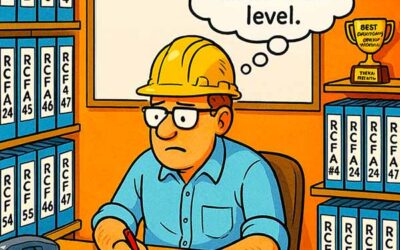
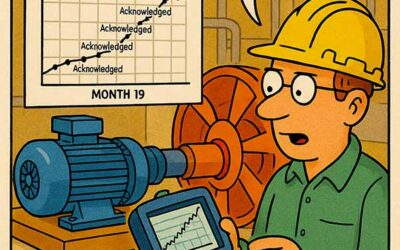
This cartoon hits that nerve perfectly. A maintenance tech, hands clasped like a sinner in confession, stares at the CMMS and admits: “Forgive me—I haven’t logged a failure since Q2.”
It’s funny, but it’s also deadly accurate.
CMMS data integrity and failure logging aren’t clerical tasks—they’re strategic foundations. If your CMMS doesn’t reflect reality, you’re not managing a plant; you’re managing a fantasy. No predictive model, digital twin, or AI optimizer can make up for missing data.
Let’s be blunt: if you’re not logging failures, you’ve already failed.
When the Data’s Not There, the Strategy Falls Apart
A CMMS is like a mirror—it only reflects what you feed into it. When teams underreport or ignore failure events, the entire reliability strategy warps around false assumptions. And the longer it goes on, the harder it is to fix.
Here’s how poor CMMS data integrity and failure logging sabotage your plant:
Deceptive reliability metrics
No failure data? Congrats—your MTBF just spiked! But it’s a mirage. Without failures logged, the average time between them becomes meaningless. You can’t improve what you don’t measure accurately.
Blind spots in failure analysis
Unlogged breakdowns rob you of pattern recognition. Failures that recur monthly look like one-offs. You can’t spot systemic issues without trendable data.
False sense of stability
No failures on record often means leadership assumes the system is working. That drives complacency and throttles funding for needed upgrades.
Broken budget justifications
Want new assets, sensors, or more techs? You’ll need failure frequency and cost data. If your CMMS says all is well, you won’t get what you need.
Inaccurate risk assessments
Unreported failures distort risk models. If assets look perfect in the system but fail in reality, your entire risk matrix collapses.
This is not minor bookkeeping. CMMS data integrity and failure logging drive everything from capital planning to daily task assignments. When the data is bad, every downstream decision is compromised.
Why People Don’t Log Failures – and How to Fix It
The issue isn’t laziness. It’s culture, clarity, and access.
In most plants, failure logging is treated like extra credit. It’s not enforced. It’s not tracked. It’s rarely rewarded. In some cases, it’s even discouraged—especially if a logged failure might make someone look bad.
Here’s what keeps failure data from getting entered:
- Fear of blame – If logging a breakdown could trigger disciplinary action or get someone “written up,” they’ll stay quiet.
- Time pressure – With dozens of jobs queued, no one wants to spend 15 minutes documenting a minor failure.
- Cumbersome systems – If the CMMS requires too many steps or only works on a desktop, logging becomes friction-heavy.
- No feedback loop – When techs log issues and never see follow-up, they stop bothering.
To fix it, leadership must reframe failure reporting from “admission of guilt” to “catalyst for improvement.”
CMMS data integrity and failure logging should be:
- Easy – Use mobile tools, QR codes, or tablets at the point of work.
- Fast – Pre-loaded templates and dropdowns reduce friction.
- Expected – Make logging a step in every job completion.
- Reviewed – Use failure data in weekly team meetings.
- Safe – Disconnect logs from disciplinary systems.
- Rewarded – Recognize teams that consistently enter complete, accurate data.
Turning the CMMS Into a Tool for Learning, Not Just Tracking
A CMMS isn’t a vault—it’s a living tool. When it contains honest, complete failure data, it becomes one of the most powerful levers in reliability engineering.
Here’s what good CMMS data integrity and failure logging unlocks:
- Actionable KPIs – You’ll know your true MTBF, MTTR, and asset-level performance.
- Prioritized investments – Assets that show frequent or high-cost failures rise to the top.
- Smarter PM intervals – Condition-based logic becomes viable when failure histories are real.
- Predictive maintenance readiness – AI needs clean data to train. You can’t fake history and expect good predictions.
- Culture of continuous improvement – Transparency feeds trust. Trust feeds learning. Learning feeds performance.
Plants that embrace failure data don’t fail more—they grow faster. Because they see the problems sooner and solve them smarter.
Data Integrity Begins With Honesty—and Ends With Results
This cartoon isn’t just a gag—it’s a warning. If you’re not logging failures, you’re not learning. You’re not improving. You’re flying blind.
Want a better maintenance culture? Start with better data. Want better data? Start with honesty.
Ask your team today:
What failure didn’t we log last week?
Then ask: Why didn’t we?
That answer might just reveal your plant’s biggest blind spot.
Because at the end of the day, CMMS data integrity and failure logging are about one thing: turning reality into results.