
CAPEX vs OPEX in Maintenance Budgeting: The Never-Ending Tug-of-War
Few debates in maintenance are as persistent—or as misunderstood—as CAPEX vs OPEX in maintenance budgeting. It’s a conversation that plays out in nearly every industrial organization: the engineering team wants to invest in upgraded assets, while finance wants to minimize upfront spending. The result? A stalemate where long-term reliability quietly loses to short-term financial optics.
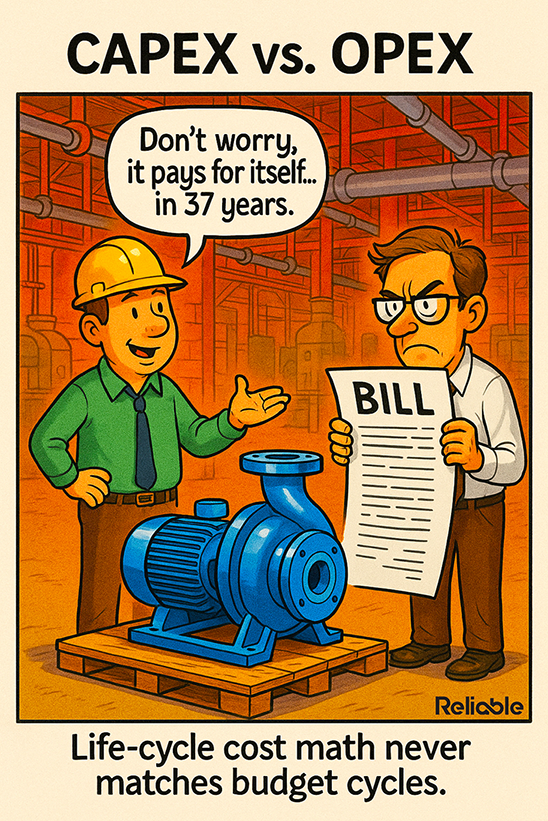
The cartoon captures the absurdity perfectly. An engineer, standing proudly next to a shiny new pump, reassures the finance manager, “Don’t worry, it pays for itself… in 37 years.” It’s a funny exaggeration of a real-world truth: life-cycle cost justifications often fail to align with annual budget cycles, even when the math is solid.
In principle, life-cycle cost analysis (LCCA) should lead to better decisions—prioritizing total cost of ownership (TCO) and operational uptime over sticker price. But in practice, companies operate on fiscal calendars and quarterly performance metrics that reward cost containment, not cost optimization. The result is predictable: underinvestment in reliability, reactive maintenance, and an endless OPEX treadmill.
Why Life-Cycle Cost Models Break Under Budget Pressure
The logic behind CAPEX vs OPEX in maintenance budgeting is straightforward: capital expenditures (CAPEX) are long-term investments, while operational expenditures (OPEX) are recurring costs for day-to-day operations. In an ideal reliability culture, these two streams would harmonize—CAPEX projects would reduce OPEX through improved efficiency, less downtime, and longer asset life.
However, corporate finance systems don’t operate that way. Budgets are typically approved annually, and leaders are rewarded for hitting short-term targets. A proposal for a $250,000 asset replacement that saves $30,000 per year in avoided maintenance and energy might be excellent engineering—but with an eight-year payback, it rarely survives the first budget meeting.
So the maintenance team continues to repair rather than replace. Spare parts are ordered repeatedly—labor hours increase. Energy waste becomes normalized. The total cost of ownership quietly balloons—but the short-term P&L still looks fine.
As Drew Troyer often writes, “We manage what we measure. And if we measure cost, not value, we’ll always chase the wrong number.” Most organizations don’t even track the compounding cost of deferred CAPEX, which leads to increased risk exposure, declining performance, and the cultural normalization of firefighting.
In essence, annual budgets kill life-cycle logic. They favor short-term optics over long-term economics.
Bridging the Divide Between Reliability and Finance
The cultural and linguistic gap between engineers and accountants is often the root cause of poor CAPEX vs OPEX in maintenance budgeting decisions. Engineers talk in failure modes, MTBFs, and vibration spectra; finance teams speak in ROI, NPV, and EBITDA. Without translation, the two worlds talk past each other.
To bridge this gap, reliability leaders must reposition maintenance spending as risk management, not cost. The question shouldn’t be “How much will this cost?” but “What risk does this spending mitigate?” When viewed through that lens, CAPEX investments that prevent catastrophic failures, environmental fines, or reputational damage become much easier to justify.
Here are four practical ways to align the two worlds:
- Translate Reliability into Business Language
Express reliability outcomes in terms of avoided losses, not technical wins. Instead of “We improved MTBF by 20%,” say, “We reduced unplanned downtime by 400 hours annually, equivalent to $1.2M in recovered production capacity.” - Quantify Deferred CAPEX Costs
Treat deferred replacement as a financial liability. Calculate the increasing OPEX burden—labor, parts, downtime—and present it as a measurable financial risk. Deferred maintenance is debt; the longer it accrues, the more expensive it becomes to service. - Leverage Predictive Maintenance Data
Use IIoT systems and analytics to predict degradation rates and forecast financial impacts of failure. When predictive maintenance models quantify the probability of failure and expected loss, they provide the financial rigor CFOs respect. - Integrate Reliability Metrics Into Financial Dashboards
Merge asset health indicators (MTBF, mean downtime, cost per hour) with financial KPIs (ROI, NPV, RONA). This unites finance and reliability teams around a single, cross-functional scorecard.
This translation effort doesn’t just help engineers win budget battles; it redefines how the organization perceives maintenance itself.
How to Optimize CAPEX vs OPEX for Sustainable Reliability
Getting CAPEX vs OPEX in maintenance budgeting right isn’t just about arithmetic; it’s about strategy. Leading companies approach asset management as a financial discipline rooted in reliability science.
- Adopt a Life-Cycle Asset Management Plan
Map every critical asset’s expected life, performance curve, and maintenance cost trajectory. Identify when replacement becomes more economical than continued repair. This transforms budgeting from reactive guesswork to proactive renewal strategy. - Implement Reliability-Centered Investment Models
Use probabilistic risk models, like Weibull or Monte Carlo simulations, to forecast failure behavior and quantify ROI for reliability-driven CAPEX. These models provide statistical confidence in investment timing. - Use Energy Efficiency and Sustainability as Financial Levers
Many capital projects can be justified not only through reduced maintenance costs but also through lower energy intensity and carbon output. As ESG frameworks evolve, linking reliability investments to sustainability metrics strengthens the business case. - Eliminate “Use It or Lose It” Budget Mentality
Annual budget cycles often punish fiscal prudence. When teams underspend on OPEX, they risk budget cuts next year, which incentivizes wasteful end-of-year spending. High-reliability organizations address this by establishing rolling, multi-year maintenance funds that reward efficiency and reinvest savings into reliability projects. - Build a Reliability Governance Framework
Create a governance model that defines asset classes, approval thresholds, and investment criteria based on life-cycle economics. Include both finance and operations in the review process to prevent CAPEX-OPEX silos from undermining decision quality.
Culture Change: From Expense Control to Value Creation
Sustainable improvement in CAPEX vs OPEX in maintenance budgeting requires cultural transformation. Maintenance must evolve from being viewed as a cost center to a value creator. That shift demands new leadership behaviors, metrics, and incentives.
Leadership Commitment
Executives must champion reliability as a profit enabler. When leaders publicly connect uptime, product quality, and safety to business value, maintenance teams gain the credibility and political capital to make long-term investments.
Metric Alignment
KPIs must evolve from “maintenance cost per unit” to “maintenance value contribution.” This reframing shifts focus from cost containment to performance optimization.
Integrated Planning
Annual budget processes must integrate maintenance planning, production scheduling, and capital forecasting. When these processes run in silos, short-term goals always cannibalize long-term reliability.
Behavioral Reinforcement
Reward teams not for saving money in the short term, but for sustaining performance in the long term. The organizations that excel at reliability have embedded it into their identity, not just their balance sheet.
Conclusion: Budget Cycles Change, Physics Doesn’t
No matter how elegant the spreadsheet, the physical reality remains: machines wear, oils oxidize, seals fail, and maintenance deferred today will be paid for tomorrow, usually with interest. The humor in the cartoon isn’t just about exaggerated ROI math; it’s a reflection of a universal truth in industrial reliability: life-cycle cost math never matches budget cycles.
But it doesn’t have to stay that way. By reframing CAPEX vs OPEX in maintenance budgeting as a strategic conversation about value, risk, and reliability, not just expense, leaders can bridge the gap between financial and operational worlds.
When organizations start viewing maintenance as an investment in risk mitigation, operational excellence, and sustainable performance, they move from firefighting to foresight. That’s when “it pays for itself” stops being a punchline and starts being a measurable outcome.