
Introduction: Why Operators Matter in Autonomous Maintenance
Autonomous maintenance best practices for operators aren’t just another initiative; they are the key to transforming equipment reliability from a maintenance department duty into a shared plantwide responsibility.
Operators spend more time with equipment than anyone else. They hear the hum of motors, notice changes in vibration, and can spot subtle signs of wear before breakdowns happen. That’s why autonomous maintenance, one of the core pillars of Total Productive Maintenance (TPM), prioritizes equipping operators with the knowledge and routines to handle basic care tasks.
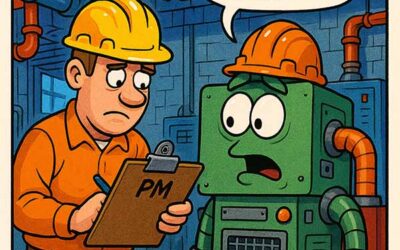
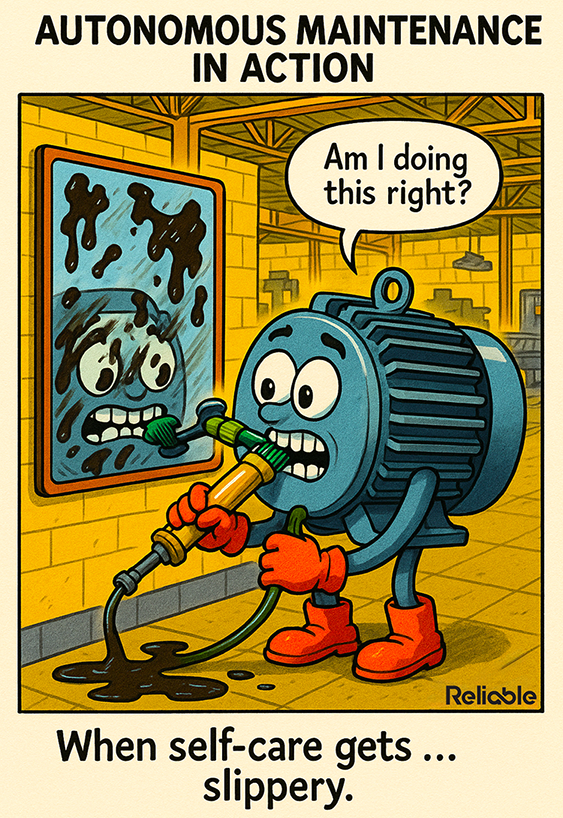
The cartoon of a motor trying, and failing, to grease itself mirrors what happens when operators aren’t trained and supported. Autonomous maintenance without structure quickly turns into slippery mistakes. However, when done right, it leads to higher uptime, safer plants, and a stronger reliability culture.
Core Principles of Autonomous Maintenance Best Practices for Operators
At its heart, autonomous maintenance best practices for operators focus on making small, repeatable actions routine. The approach is often summarized by three words: clean, inspect, lubricate.
- Cleaning to Inspect – Machines can’t hide their condition when dirt, dust, and oil build-up are removed. Operators who clean thoroughly identify and address leaks, cracks, or misalignments before they escalate.
- Lubrication Discipline – Following correct type, volume, and frequency guidelines prevents both under- and over-lubrication, both of which shorten bearing and gear life.
- Inspection Routines – Operators use checklists to check temperatures, vibrations, noises, or alignment daily. Early abnormality detection is the cheapest form of predictive maintenance.
- Tightening and Adjusting – Loose fasteners, belts, or couplings are minor issues that can cascade into failures. Operators trained to correct them keep machines in a safe state.
Without these principles, plants fall into reactive maintenance. With them, autonomous maintenance best practices for operators extend the lifespan of machines and empower frontline workers to play a direct role in reliability.
Common Pitfalls When Operators Apply Autonomous Maintenance
Even with clear intentions, autonomous maintenance best practices for operators can go wrong when training and support are absent.
Some common failure modes include:
- Over-Lubrication: Operators often think “more is better.” In reality, excess grease overheats bearings and damages seals.
- Improvised Standards: Without visual guides or standard checklists, operators create their own routines—leading to inconsistency and missed tasks.
- Training Gaps: Operators unsure of what constitutes “normal” conditions can’t identify abnormalities.
- Cultural Resistance: Workers may view maintenance as someone else’s job, resisting the mindset shift.
- Feedback Failure: When operators report issues but see no action, engagement drops.
The cartoon, an anxious motor wondering, “Am I doing this right?” captures the uncertainty operators face when there are no standards and no reinforcement.
Benefits of Autonomous Maintenance Best Practices for Operators
When executed properly, autonomous maintenance best practices for operators deliver benefits across reliability, culture, and cost control:
- Reduced Downtime: Early detection and correction of abnormalities prevent unplanned stoppages.
- Stronger Ownership: Operators feel a sense of pride and responsibility for equipment health.
- Higher Safety: Oil leaks, loose parts, or overheating get caught before they escalate into safety incidents.
- Efficient Maintenance Teams: Specialists focus on predictive and precision tasks while operators handle routine care.
- Extended Asset Life: Consistent lubrication and inspection reduce replacement costs and capital expenditures.
- Continuous Improvement: Operators provide real-world feedback that helps engineering teams design more maintainable equipment.
Studies show that plants adopting autonomous maintenance programs often reduce breakdowns by 40–60% within the first two years.
Case Example: Lubrication Done Right vs. Wrong
Consider two identical manufacturing plants running similar motors.
- Plant A implemented autonomous maintenance best practices for operators. Operators were trained on the correct grease type and volume, used calibrated grease guns with indicators, and followed posted checklists. Over the course of three years, bearing failures decreased by 70%.
- Plant B told operators simply to “keep the machines greased.” Without training or standards, some motors were over-lubricated until seals blew out, while others were neglected. Failures increased, downtime rose, and morale declined.
The lesson is clear: autonomous maintenance best practices for operators work only when training and systems support them. Otherwise, they introduce more variability, not less.
Steps to Implement Autonomous Maintenance Best Practices for Operators
Rolling out autonomous maintenance across a plant takes structure, patience, and leadership commitment. Here’s a proven implementation roadmap:
- Start with Training – Teach operators what to look for, how to clean, how to lubricate correctly, and what “good condition” looks like. Use hands-on sessions and one-point lessons, not just manuals.
- Develop Standard Work – Create laminated checklists and visual standards that operators can easily follow. Avoid ambiguity.
- Pilot on One Machine – Begin with a critical asset. Measure downtime, abnormalities caught, and lubrication compliance. Build momentum with visible wins.
- Build Feedback Loops – Ensure maintenance teams respond quickly to operator reports. Nothing kills buy-in faster than ignored input.
- Celebrate Successes – Publicly recognize operators who prevent breakdowns. Recognition builds culture faster than directives.
- Scale and Mature – Extend the program to more machines, expand into minor adjustments, and eventually empower operators to suggest design improvements.
Cultural Shifts Through Operator Involvement
Autonomous maintenance best practices for operators aren’t just about tools and checklists; they’re about reshaping culture. When operators see that leadership values their observations and that their actions prevent failures, reliability becomes a personal matter.
This cultural ownership spreads. Technicians spend less time firefighting. Supervisors see fewer production delays. Operators take pride in “their” machines. Plants that once viewed maintenance as an expense are now beginning to see it as a competitive advantage.
Conclusion: Turning Slippery Self-Care into Sustainable Reliability
The cartoon of a motor clumsily greasing itself is funny, but it’s also a warning. Without training and structure, autonomous maintenance becomes chaotic.
However, when organizations adopt autonomous maintenance best practices for operators, the benefits extend to reliability, safety, and culture. Machines last longer, downtime shrinks, and operators transform from passive users into proactive stewards.
This is what TPM has always intended: not just maintenance as a department, but maintenance as a culture. The path is clear: train, standardize, empower, and celebrate. Do that, and the plant shifts from slippery mistakes to sustainable, world-class reliability.