Factories are evolving rapidly. Artificial intelligence, IIoT connectivity, and digital twins are converging to transform maintenance from reactive firefighting to proactive foresight. Within this ecosystem, augmented reality in predictive maintenance serves as the bridge between raw data and real-world action.
Picture a technician walking through the plant with live data overlaid on assets: vibration severity evaluated against ISO 20816-3 (preferred for new assessments) or legacy ISO 10816-3 limits still widely used for machines 15–1500 kW on rigid supports, and bearing temperature rise above ambient (ΔT °C/°F) following OEM and industry norms—typically 70–80 °C absolute or 15–20 °C above baseline for rolling-element bearings (SKF/NSK guidelines) and 45–55 °C rise for sleeve bearings on turbomachinery (API 670 5th Ed. Table 7).
These contextual overlays compress the distance between awareness and decision while grounding insights in quantitative data and established thresholds.
Augmented reality turns invisible data into visible intelligence, closing the gap between knowing and doing.
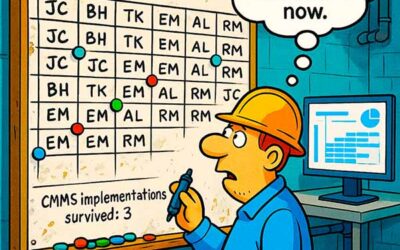
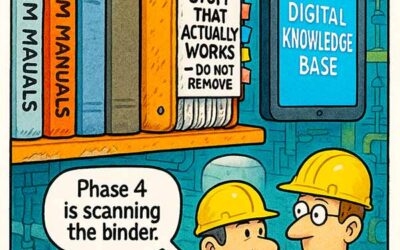
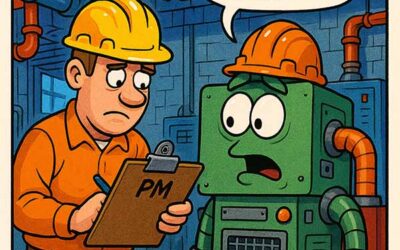
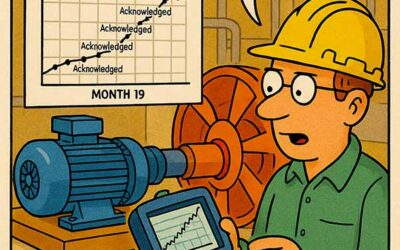
But as the cartoon reminds us, when digital overlays lie, reality bites. A technician walking into a wall because “the screen said it was clear” captures a deeper truth: predictive maintenance must remain grounded in human awareness and accurate data.
How Augmented Reality Strengthens Predictive Maintenance
Predictive maintenance works by catching failures before they escalate. AR amplifies this by placing actionable insight at the point of work.
Key Advantages
- Real-Time Visualization: Health indicators shown in the context of ISO 20816-3 or legacy ISO 10816-3, where still in use, and temperature thresholds trended over time.
- Hands-Free Guidance: Step-by-step instructions appear in view, but AR must never bypass physical LOTO verification; overlay prompts shall only supplement, not replace, OSHA 1910.147(c)(7) procedures. AR shall display a mandatory physical-verification checkpoint requiring a technician photo or NFC tap before proceeding.
- Remote Collaboration: Experts annotate live video feeds for field support.
- Reduced Downtime Potential: When paired with planning, spare-parts readiness, and skilled technicians, AR shortens the detection-to-repair interval.
Example Workflow Using AR
- Receive predictive alert from the monitoring system.
- Open the AR interface to locate tagged equipment visually.
- View vibration trend overlays (e.g., Bearing B2 – 7 mm/s RMS with BPFO sideband modulation indicating outer-race wear, +15 % over 30 days) evaluated against the correct machine class per ISO 20816-3 or 10816-3.
- Follow guided maintenance procedure.
- Confirm repair completion and automatically log results to the CMMS/EAM.
Reducing Human Error Through Contextual Intelligence
AR’s most significant benefit is spatial clarity. Instead of deciphering an abstract tag, the technician sees a color-coded overlay on the exact bearing, drive end, or coupling.
Why Context Matters
- Reduces ambiguity in component identification.
- Minimizes documentation and rework errors.
- Accelerates correlation between frequency content and physical location.
Still, AR is only as reliable as its data sources. Sensor drift, timestamp errors, or misaligned 3-D models can yield confident mistakes. Guard against that with structured verification.
Maintain Data Fidelity
- Calibrate vibration sensors per risk-based schedule (SMRP Metric 5.4.2) using ISO 16063 methods – every 3–12 months for critical continuous systems, up to 36 months for low-risk route-based assets.
- Verify infrared camera calibration annually; conduct thermographic inspections quarterly for critical thermal assets.
- Maintain time synchronization across IIoT devices to avoid phase lag.
- Target spatial registration accuracy ≤ 10 mm under controlled lighting; expect 15–30 mm in real industrial environments with magnetic interference (2023 IEEE VR Industrial AR Accuracy Benchmark + Boeing/NIST trials).
- Keep CAD/P&ID and digital-twin models current through formal change management.
- Use risk-based overlay verification after any modification; quarterly for critical assets is a sound baseline.
Even with AR alignment, technicians must validate visually and physically before acting.
Training the Workforce for Hybrid Diagnostics
Technology adoption depends on people. AR reshapes how technicians interact with data, but never replaces experiential judgment.
Modern Training Stack
- VR simulations for immersive, zero-risk procedural practice.
- AR field guidance to overlay instructions during live work.
- Recorded sessions capturing expert workflows.
- Interactive prompts (hazard cues, quizzes) embedded directly in displays.
Training Goals
- Reinforce spatial awareness under overlays.
- Build confidence interpreting velocity, acceleration, and bearing-fault frequencies (BPFO/BPFI/BSF/FTF) with modulation sidebands.
- Teach fail-safes for visibility or alignment errors.
- Balance digital trust with sensory validation – look, listen, feel, and verify.
Human-Factor Precautions
- Follow manufacturer duty-cycle guidance (e.g., Microsoft HoloLens 2 Industrial Edition Ergonomics Guide: 1.5–2 h continuous use for most users with 10-min breaks every 45 min) and ISO 9241-303:2022 (HMD display requirements).
- Adjust brightness and refresh for local lighting.
- Ensure PPE compatibility.
- Manage cognitive load; critical steps like LOTO or energized work require full attention.
Building a Reliable AR-PdM Ecosystem
AR is the visualization layer of an integrated reliability framework.
Essential Components
- IoT Sensor Network: Reliable velocity/acceleration/temperature/process data with defined alarm bands.
- Digital Twin Models: Accurate geometry and tag mapping.
- CMMS/EAM Integration: Real-time work order linkage and data feedback.
- Secure Data Pipeline: Version control, audit trails, and access governance.
Implementation Roadmap
- Map critical assets where spatial data improves decision speed.
- Integrate data streams (sensors, analytics, maintenance logs).
- Pilot in low-risk areas, gather usability and safety metrics.
- Iterate and scale, refining tolerances, latency, and user experience.
Safety & Ergonomics
- Test devices under real lighting, vibration, and heat conditions.
- Define AR-off zones for tasks needing direct sightlines.
- Align policy with SMRP Best Practices and OSHA requirements.
When managed correctly, AR enhances perception, not distraction.
The Strategic Value of Visual Intelligence
Information flow defines maintenance effectiveness. AR transforms static dashboards into live spatial intelligence, connecting people, assets, and context.
Strategic Benefits
- Higher accuracy in condition-based actions.
- Shorter detection-to-repair cycles.
- Better collaboration across disciplines.
- Preservation of institutional knowledge via visual documentation.
Emerging Capabilities
- Pre-computed FEA stress maps are being overlaid today in fewer than 20 high-criticality pilot sites (GE, Siemens Energy, Shell 2024–2025); real-time physics solving remains confined to workstation-class XR in aerospace and O&G applications.
- AI-driven anomaly detection linked to FMECA libraries is advancing (2024–2026 horizon), enabling context-aware recommendations and automated recordkeeping.
Seeing the Future Clearly
The cartoon lands because it highlights a truth: when technology outpaces process discipline, collisions – literal or figurative – follow. Augmented reality in predictive maintenance provides powerful situational awareness and decision support, but only when anchored in standards, calibration, and disciplined human oversight.
AR should amplify, not replace, human expertise. When data integrity, system integration, and training align, it becomes an extension of the technician’s senses – helping them see, decide, and act with precision and confidence.