
When Augmented Reality in Industrial Maintenance Meets Real Life
The dream of augmented reality in industrial maintenance is powerful: technicians wearing smart glasses can “see” equipment data in real time, overlay digital models on physical assets, and follow guided steps to complete complex repairs faster. In theory, it’s a maintenance revolution, hands-free precision and instant access to expert knowledge.
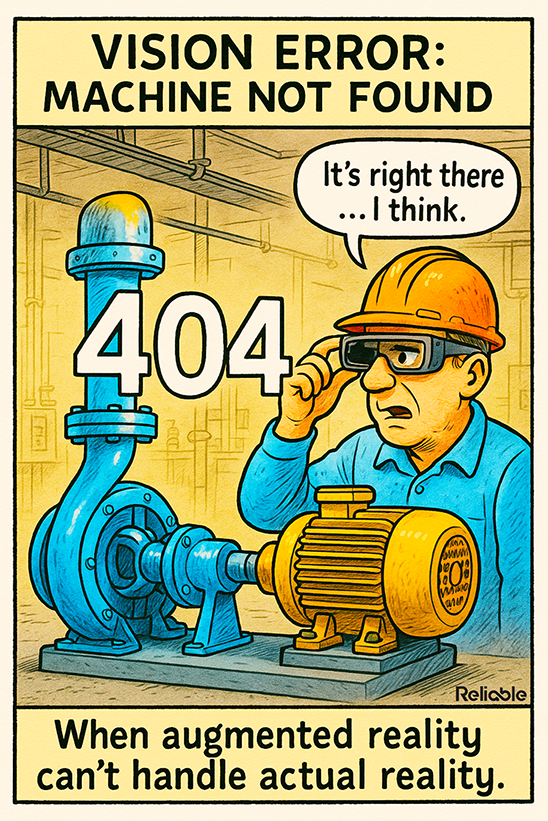
But in practice, the scene often looks more like this cartoon: a technician staring through an AR headset that declares, “404 MACHINE NOT FOUND.” The pump is right there, humming away in front of him, yet the system doesn’t recognize it. The promise of seamless digital integration meets the stubborn reality of imperfect data, inconsistent asset tagging, and unreliable connectivity.
This isn’t a failure of AR itself; it’s a failure of readiness. Augmented reality isn’t a magic overlay; it’s a mirror reflecting how well – or poorly – your foundational data and processes are aligned.
The Blind Spot in Augmented Reality in Industrial Maintenance
For AR to work, the digital world must perfectly match the physical one. That requires precise location data, clean master records, and consistent identifiers across CMMS, EAM, and IoT systems. But many plants still struggle with duplicate asset tags, outdated drawings, and incomplete records.
When AR can’t find a pump that’s physically present, it’s usually because the data model doesn’t know it exists, or knows it by another name. Technicians end up waving their hands through virtual overlays, trying to align digital ghosts with physical machines.
The result is frustration and wasted time. And ironically, the more advanced the AR system, the more fragile it becomes. High-resolution 3D mapping and object recognition are only as accurate as the underlying metadata.
If your data isn’t reliable, your reality won’t be either.
The root cause is simple: most facilities are still in the early stages of digital maturity. AR magnifies that immaturity by making every data flaw visible in 3D.
Data Integrity Defines Augmented Reality in Industrial Maintenance
A successful AR deployment depends on data integrity. Every overlay, instruction, or equipment diagnostic displayed in an AR headset pulls from databases such as CMMS, historians, MES systems, IoT dashboards, and digital twins. If any of those contain outdated or mismatched information, AR will confidently show the wrong thing in the right place.
This is where AR’s potential turns against itself. Instead of eliminating human error, it can automate it, at scale. An incorrect lubrication schedule, a mislabeled asset, or a misaligned tag can all propagate instantly into every headset on the floor.
Clean data becomes as critical as clean oil. In both cases, contamination spreads silently until the damage becomes visible. That’s why plants preparing for augmented reality in industrial maintenance must start not with the headset, but with a data audit:
- Verify asset hierarchies and tag alignment.
- Standardize naming conventions.
- Synchronize equipment records across all systems.
- Eliminate duplicates and ghost assets.
Without this discipline, your AR platform becomes a flashy interface for unreliable information.
Why Training and Trust Still Beat Technology
AR can guide a technician step-by-step through a gearbox rebuild, but it can’t teach intuition. It can highlight temperature anomalies, but it can’t sense the difference between “too hot” and “running harder than usual.”
The danger of overreliance is subtle: when technology gives the illusion of certainty, human curiosity fades. If the headset says, “everything’s fine,” who questions it?
The best reliability professionals still use their senses, the sound of cavitation, the smell of overheated grease, and the vibration felt through a tool handle. These are human diagnostics that no overlay can replace.
That’s why training for augmented reality in industrial maintenance must include judgment-based exercises. Teach technicians how to interpret, not just follow. When the system glitches or the asset “disappears,” they should know how to navigate reality without digital guidance.
AR should empower technicians, not deskill them. Used wisely, it extends their reach; used carelessly, it narrows their vision.
Grounding Digital Ambition in Physical Reality
The plants that succeed with AR share a common trait: they’ve already mastered the fundamentals. Their maintenance strategies are built on accurate asset hierarchies, disciplined data practices, and strong cross-functional collaboration.
In these environments, AR adds value by visualizing condition trends, guiding complex overhauls, and displaying safety information in real time. But in plants with poor documentation, AR quickly exposes the cracks. Missing sensors, unlinked records, or unverified digital twins turn the experience into a glitchy game of industrial “Where’s Waldo?”
The lesson is clear: before you invest in augmented reality in industrial maintenance, invest in your reality. Audit the data, verify the tags, and align every record with the actual physical asset. Otherwise, the first thing your AR headset will reveal isn’t insight, it’s chaos.
AR doesn’t replace reliability fundamentals; it audits them.
Grounding digital initiatives in physical precision ensures AR becomes an accelerator of reliability, not another technology that promises transformation but delivers confusion.
The Future of Augmented Reality in Industrial Maintenance
The next evolution of AR won’t just display data—it will interpret it. AI-driven contextual overlays will prioritize critical alerts, correlate trends, and even predict failures based on multi-sensor inputs. But the quality of those predictions will still depend on the quality of the foundational data.
In the near future, expect to see:
- AI-integrated AR headsets that learn from maintenance logs and vibration data.
- Voice-controlled overlays allowing hands-free access to asset histories.
- Real-time collaboration where remote experts annotate live views through AR glasses.
Yet even in this advanced stage, one principle will remain unchanged: the physical world is the ultimate reference point. No algorithm can override the reality of a loose coupling, a hot bearing, or an empty oil reservoir.
The key isn’t replacing human insight; it’s augmenting it. AR should make technicians faster, safer, and more confident, but never blind to what’s in front of them.
Closing Thought
When your AR headset flashes “404 MACHINE NOT FOUND,” it’s not just a software bug; it’s a cultural warning. It says your digital world has drifted too far from your physical one.
True digital transformation doesn’t start with headsets; it begins with humility. Plants that acknowledge their data gaps and fix them before adopting AR will win. Those who rush in without groundwork will keep searching for machines that were never missing, just mislabeled.