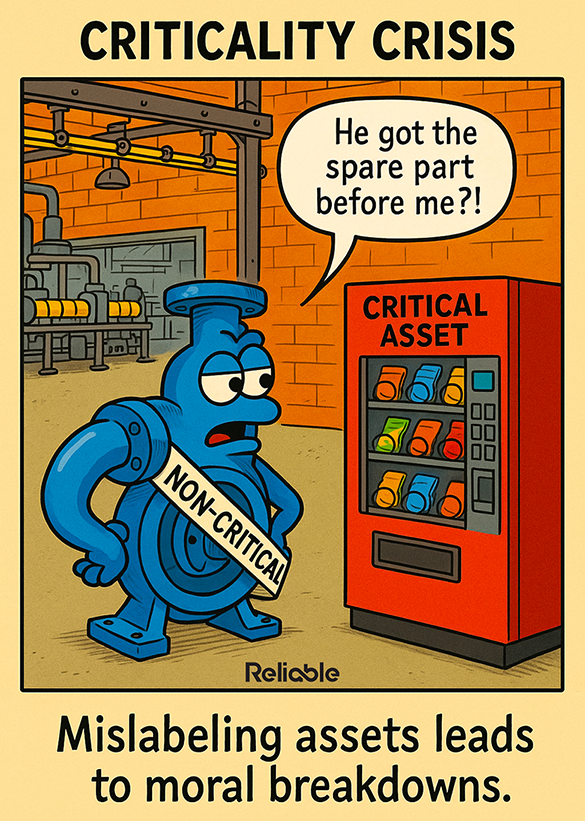

When it comes to asset management, decisions have a ripple effect that extends far beyond the machine room floor. A mislabeled pump or motor may seem like a minor clerical error, but the downstream effects can be massive. Asset criticality mislabeling isn’t just about a tag on a spreadsheet, it’s about distorted priorities, wasted capital, and the morale of the people who keep plants running.
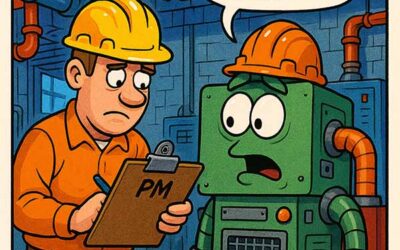
The cartoon captures it well: the “non-critical” pump seethes as it watches another machine get the part it needed, purely because of faulty labeling. This is no laughing matter in real plants. Mislabeling drives poor decisions, undermines trust, and creates what I often refer to as “hidden fragility”- systems that appear stable until the wrong failure exposes their true brittleness.
Let’s break down how asset criticality mislabeling compromises reliability, why it’s so prevalent, and what leaders must do to correct it.
The Real Cost of Asset Criticality Mislabeling
Every asset has consequences when it fails. The question isn’t whether it matters, it’s how much it matters. That is where criticality comes in. Done well, it prioritizes resources so that reliability strategies protect what matters most. Done poorly, it turns into a dangerous illusion.
Mislabeling assets as non-critical sets off three predictable chain reactions:
- Skewed priorities: Maintenance teams chase after the “officially critical” assets, while overlooked machines cause real production bottlenecks. This is triage gone wrong.
- Hidden risks: Assets dismissed as “low priority” can bring entire lines down when they fail. This creates blind spots in risk assessments and crisis response.
- Cultural breakdowns: Technicians and engineers know when something doesn’t smell right. When leadership insists an obviously vital compressor is “non-critical,” frontline trust erodes. Reliability requires buy-in, and mislabeling corrodes it.
Plants pay for asset criticality mislabeling in downtime, emergency spending, safety incidents, and loss of credibility. The price tag is bigger than the spare parts bill, it’s organizational alignment.
How Asset Criticality Mislabeling Undermines Reliability Strategies
Criticality analysis is the starting point for every reliability effort. Think of it as the “compass” guiding strategy. If the compass is wrong, every downstream activity points in the wrong direction.
- Maintenance strategy development: Preventive and predictive tasks are assigned to the wrong machines. Operators end up baby-sitting assets that don’t matter while critical machines run to failure.
- Spare parts stocking: Stores departments hold too many spares for the wrong equipment. True high-risk assets get starved of coverage, forcing expensive expedited orders.
- Risk assessment: If the asset registry undervalues key machines, hazard and operability (HAZOP) studies or failure mode analyses will miss critical vulnerabilities.
- Decision-making delays: In emergencies, labels drive response. If criticality is mislabeled, teams hesitate or act too slowly, compounding the incident.
The result is strategic drift. Leadership thinks they’re executing a reliability program, but in practice, they’re just running a misaligned machine lottery. This is the hidden danger of asset criticality mislabeling: you can’t see the flaw until the failure occurs, and by then the costs are already baked in.
Building a Reliable Asset Criticality Framework
So how do we avoid the trap? It starts with rigor and discipline. A reliable framework for assessing criticality should include:
- Cross-functional alignment: Operations, maintenance, safety, and finance must weigh in. An asset that looks low-cost to replace might be irreplaceable during peak demand.
- Quantitative scoring: Assign scores for safety, environmental, production, and financial consequences. Multiplying intuition with data keeps bias in check.
- Dynamic updating: Criticality isn’t static. Mergers, expansions, new processes, and even staffing changes can shift an asset’s importance. Reassess regularly.
- Transparency and training: Everyone should understand why assets are classified as they are. This builds trust in the system and prevents the morale breakdowns that happen when decisions feel arbitrary.
- Audit and feedback loops: Reliability engineers should periodically audit classifications against failure histories. If a supposedly non-critical asset consistently causes downtime, the framework must be recalibrated.
Criticality analysis is not about being perfect once, it’s about being directionally correct and continuously improving. Done right, it turns a static ranking into a living management tool.
From Mislabeling to Mastery: Turning Insight into Uptime
Correcting asset criticality mislabeling is not just a technical exercise—it’s an act of leadership. Admitting past misclassifications takes courage, but it’s the only way to rebuild credibility. The process typically unfolds in three stages:
- Acknowledgment: Leaders must admit that current criticality rankings may be flawed. This resets expectations and invites engagement.
- Re-ranking with evidence: Using cross-functional input and quantitative scoring, update classifications. Involve the people closest to the work—they often spot blind spots first.
- Resource realignment: Redirect spare parts, monitoring technologies, and preventive maintenance toward the newly identified critical assets.
The benefits compound quickly: fewer emergencies, better inventory control, and higher confidence in decision-making. Just as important, the cultural turnaround is palpable. Teams see that leadership values truth over convenience and performance over paperwork.
Reliability is as much about ethics as it is about engineering. Asset criticality mislabeling teaches the wrong lesson, that appearances matter more than consequences. Correcting it sends the right message: in this plant, we put resources where they matter most. That’s a foundation for resilience, trust, and sustainable uptime.