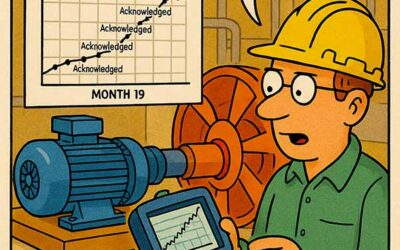
When vibration alarms go quiet because someone muted them rather than because the machine improved, you’re stepping into unsafe territory. An alarm that doesn’t influence decisions becomes background noise, and that noise obscures the warning signal while the underlying degradation continues unchecked. Teams rarely ignore alarms out of negligence; more often, they’ve lost confidence in what those alarms are telling them.
Restoring that confidence requires sharper conversations: tactical, engineering-driven questions that expose misconfigured thresholds, poor parameter selection, sensor issues, or pure alarm fatigue. Use the following conversation starters to understand why your alarms are being dismissed and what needs tightening in your condition monitoring program.
25 Conversation Starters
- “Are our alarm thresholds tied to ISO 20816 evaluation zones and OEM commissioning values – or have we tuned them to the machine’s actual statistical baseline?”
- “Are our setpoints based on ISO A–D zones, historical trending, and criticality – or are they vendor software defaults that were never validated against real operating behavior?”
- “Which specific failure mode was this alarm intended to detect, and does the current configuration still reflect that physics?”
- “Did we silence this alarm because it was inaccurate, or because it was accurate and inconvenient?”
- “What changed in load, speed, duty cycle, or process context when these alerts became chronic?”
- “Are we reviewing both RMS trends and spectral data before dismissing the alarm, or reacting only to broadband values?”
- “What’s the false-positive rate for this sensor over the last 30–90 days, and does that indicate alarm logic issues or real mechanical issues?”
- “Are we capturing the right combination of parameters – Velocity for ISO severity and Acceleration (or Envelope) for bearing faults, rather than relying on only one?”
- “Could mounting integrity, sensor adhesion, magnet strength, cable condition, or electrical continuity be contributing to junk data?”
- “Is the alarm tied to characteristic fault frequencies – bearing defect frequencies, gearmesh, blade-pass – or just a fixed overall limit?”
- “Do our thresholds separate low-frequency energy from high-frequency content, or are they blended—masking early bearing damage while over-alarming on process variability?”
- “Do operators understand what this alarm actually signifies – or are they working from outdated assumptions?”
- “Is this alarm firing because of sensor issues, or because the machine is genuinely degrading?”
- “Are alarm acknowledgments paired with waveform and spectrum review, or simply cleared to silence the dashboard?”
- “If this alarm required immediate investigation, would we have the Spectrum, Time Waveform, and Phase data needed to diagnose it?”
- “Are we correlating vibration alarms with thermal imaging, motor current analysis, or airborne ultrasound – or analyzing vibration in isolation?”
- “Is this elevated vibration tied to a mechanical fault (unbalance, misalignment, looseness), a change in operating conditions, or amplification near a resonant frequency?”
- “When was the last time we verified sensor mounting integrity (stud torque, adhesive bond, or magnet condition) and performed a response check with a portable shaker?”
- “What’s the economic consequence if this alarm is legitimate and we ignore it for another six months?”
- “When was the last time this alarm correlated with a confirmed degradation event?”
- “Are these alarm levels aligned with actual failure modes – or generic defaults that don’t reflect our machines?”
- “If vibration alarms didn’t exist on this asset, how would we detect the same failure mode manually?”
- “What evidence – harmonics, sidebands, Phase relationships, waveform shape – would confirm this alarm’s credibility?”
- “Is this alarm firing during run-up or coast-down, and do we have transient logic – trip multipliers or suppression windows – configured correctly?”
- “Which alarms do we respond to immediately, and why does this one fall outside that category?”
- “Are we trending RMS, Peak, and Crest Factor – and do we understand which metric exposes which failure mode?”
- “Are we running Acceleration Enveloping for early-stage bearing damage before the RMS energy rises?”
When vibration alarms get ignored, the problem isn’t the people; it’s the system. Overly sensitive thresholds, generic defaults, the wrong parameters, poor mounting, or absent cross-technology validation erode trust. When credibility drops, the diagnostic loop collapses, and early degradation hides behind a wall of meaningless alerts.
These conversation starters give teams a structured way to restore alarm integrity, sharpen the logic behind thresholds, align parameters with actual failure modes, and rebuild confidence in the monitoring system. The sooner these discussions happen, the sooner your alarms become actionable again, and the sooner you prevent degradation from turning into unplanned downtime.