Unlocking Vibration Analysis Methods for Effective Diagnostics: Techniques, Tools, and Benefits

Unlocking Vibration Analysis Methods for Effective Diagnostics: Techniques, Tools, and Benefits
Vibration analysis monitors mechanical motion to detect faults early, helping teams prevent failures and reduce unplanned downtime. This article explains the principal vibration analysis methods - time domain, frequency domain (FFT), joint/time-frequency, and modal analysis - showing how each method uncovers different diagnostic signals and when to apply them for machinery health decisions.
What Is Vibration Analysis in Predictive Maintenance?
Vibration analysis is a condition-monitoring technique that measures machine vibration to detect mechanical faults such as imbalance, misalignment, bearing defects, looseness, and gear wear before failure occurs. It converts vibration signals into diagnostic features that enable early fault detection, root cause identification, and planned corrective action.
What Are the Main Vibration Analysis Methods?
The primary vibration analysis methods used in industrial diagnostics include:
Time-domain analysis
Frequency-domain analysis (FFT)
Time-frequency analysis (STFT, wavelets)
Envelope (demodulation) analysis
Order tracking (for variable speed)
Modal analysis (structural dynamics)
Each method reveals different fault characteristics and is often used in combination.
When Should Each Vibration Analysis Method Be Used?
Use time-domain analysis to detect impacts, looseness, and transient events
Use FFT to identify periodic faults (imbalance, misalignment, gear mesh, bearing frequencies)
Use envelope analysis for early-stage bearing defects
Use order tracking for variable-speed equipment
Use modal analysis to locate resonance and structural problems
What Are the Key Vibration Analysis Techniques for Machinery Diagnostics?
Vibration analysis techniques each reveal distinct aspects of machine behavior: time-domain analysis exposes transient events, frequency-domain analysis (FFT) isolates periodic faults, joint/time-frequency methods reveal non-stationary signals, and modal analysis locates structural resonances. Together, these methods form a layered diagnostic approach where one technique confirms or refines findings from another, improving fault isolation and reducing false positives.
In practice, technicians start with simple overall vibration and time-domain waveform checks, move to FFT and envelope analysis for bearing and gear faults, and apply modal or order analysis when structural or variable-speed issues require deeper insight.
The following subsections explain when to use time-domain and frequency-domain analyses and how each contributes to an effective diagnostic workflow.
How Does Time Domain Analysis Detect Transient Vibration Events?
Time-domain analysis examines the raw time waveform to identify transient events, impact spikes, and amplitude metrics, such as RMS and crest factor, that indicate sudden or intermittent faults. This method is effective for detecting looseness, impacts from broken components, and rub events because it preserves temporal relationships and reveals when high-amplitude bursts occur relative to operating conditions.
Key metrics include peak acceleration for impact severity, RMS for overall energy, and crest factor for impulsive behavior; technicians commonly flag crest factors above typical baselines (e.g., >3-4 for rotating machinery) as a sign of developing impact-type faults. It's crucial to note that crest factor trends matter more than absolute values; both increases and decreases from a stable baseline can be diagnostic, indicating different stages of fault progression. Time-domain findings typically lead directly into frequency-based tests; if impulses are present, envelope or spectral analysis can identify repetitive frequencies associated with bearings or gear teeth.
The analysis of signals with transient components is crucial for understanding complex vibration patterns.
Time-Frequency Distribution for Transient Vibration Analysis
A Time-Frequency Distribution for Analysis of Signals with Transient Components and Its Application to Vibration Analysis A time-frequency distribution for analysis of signals with transient components and its application to vibration analysis.
What Is Frequency Domain Analysis and How Does FFT Reveal Fault Frequencies?
Frequency-domain analysis converts time waveforms into a spectrum using the FFT algorithm to show how vibration energy distributes across frequencies, revealing periodic fault signatures such as 1x-RPM peaks, harmonics, and bearing defect frequencies. Converting machine speed from RPM to Hz and mapping spectral peaks to orders helps attribute peaks to imbalance, misalignment, gear mesh, or bearing elements; for example, a dominant 1x peak usually indicates imbalance while sidebands around a mesh frequency suggest gear issues.
FFT also reveals harmonics and modulation patterns; sidebands spaced at the running speed are diagnostic of modulation effects such as looseness or gear wear. Interpreting spectra requires attention to sampling rate, windowing, and resolution to avoid misleading peaks. Different window functions serve specific purposes: Hanning windows are standard for continuous signals, providing good frequency resolution with reduced spectral leakage; rectangular windows suit transient capture, offering the best frequency resolution but higher leakage; and Flat-top windows are used for precise amplitude accuracy.
The choice of window affects both amplitude accuracy and frequency resolution. It's also important to remember that frequency resolution is determined by the sampling rate divided by the number of FFT points (or inversely proportional to the time record length), meaning longer time records provide better resolution for distinguishing closely-spaced spectral peaks. This often complements envelope detection for low-amplitude, high-frequency bearing faults.
Various frequency domain techniques can be employed to analyze transient vibration phenomena.
Frequency Domain Analysis Methods for Transient Vibration
The signal is analyzed in frequency domain by using fast Fourier transform, short time Fourier transform and wavelet analysis. The merits and demerits of each method are illustrated in the NVH analysis of powertrain start/stop transient phenomenon by using wavelet analysis and time domain transfer path analysis, SN Moorthy, 2015
Which Types of Vibration Sensors Are Essential for Accurate Monitoring?
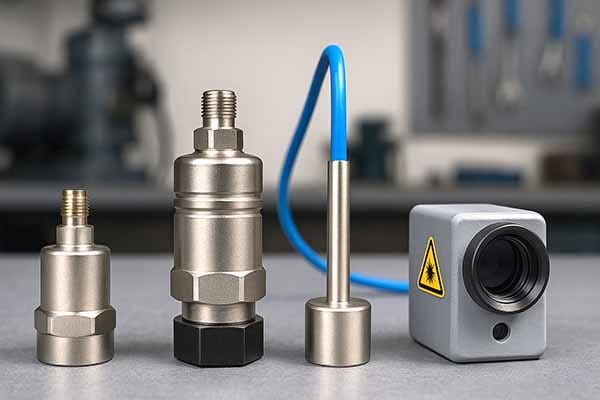
Choosing the right sensor is critical because sensor type determines the measurable parameter, frequency bandwidth, and sensitivity needed to detect specific faults. Accelerometers measure acceleration and are ideal for high-frequency bearing and impact detection; velocity sensors capture midband energy for overall machine health; displacement probes resolve slow shaft motions and rubs.
Mounting method, environmental protection, and connector/cable quality also affect signal fidelity, so selection balances frequency needs, cost, and installation constraints. The table below compares common sensor types by their primary characteristics to help you match sensor choice to diagnostic objectives.
Different sensor types suit distinct monitoring needs and environments:
| Sensor Type | Measured Parameter | Typical Frequency Range | Mounting Method | Ideal Applications |
|---|---|---|---|---|
| Accelerometer (PZT) | Acceleration (g) | 2-5 Hz – 20 kHz (typical industrial PZT); DC response available with special low-frequency models | Stud mount or adhesive | Bearing fault detection, transient events |
| Velocity Sensor | Velocity (mm/s or in/s) | 10 Hz – 1 kHz (moving-coil type) or 1 Hz – 2 kHz+ (piezo-based) | Magnetic or stud | Overall vibration, balance trending |
| Displacement Probe (Eddy Current) | Displacement (µm) | DC – 1 kHz (typical for 8mm probes on ferrous targets; higher frequencies possible with specialized designs) | Fixed probe gap | Rubs, slow shaft movement, looseness |
| Laser Vibrometer | Velocity/Displacement (non-contact) | DC – 100 kHz | Line-of-sight, remote | Hard-to-reach targets, thin structures |
This comparison highlights tradeoffs: accelerometers provide broad bandwidth for high-frequency faults, velocity sensors simplify long-term trending, displacement probes best capture slow movements, and laser vibrometers enable non-contact measurement for challenging access or cleanliness requirements. Choose sensors based on the highest frequency of interest and the mechanical parameter most diagnostic of the target fault.
What Are the Differences Between Accelerometers, Velocity, and Displacement Sensors?
Accelerometers output acceleration and excel at capturing high-frequency content from bearings, impacts, and structural resonances; their units are typically g or m/s² and require appropriate sensitivity selection. Velocity and displacement can be derived from acceleration via single or double integration, respectively, though accurate low-frequency integration requires careful consideration of high-pass filtering to remove drift.
Typical high-pass filter cutoffs of 0.5-2 Hz are often used for velocity integration to remove low-frequency drift while preserving machine fundamental frequencies. Velocity sensors report velocity and are useful for mid-frequency overall machine health trending, where ISO 20816 (formerly ISO 10816) vibration standards often apply, defining severity criteria for machine condition evaluation, offering more straightforward integration for continuous monitoring.
Displacement probes measure relative shaft position or clearance changes and are indispensable for detecting slow oscillations, rubs, or shaft movement that acceleration-based sensors might not resolve. Understanding these differences allows teams to mix sensor classes for a complete picture: accelerometers for bearing diagnostics, velocity sensors for trend alarms, and displacement probes for shaft-critical machinery.
How Do Advanced Sensors Like PZT, MEMS, and Laser Vibrometers Improve Diagnostics?
PZT-based accelerometers offer high sensitivity and a wide bandwidth, making them the default choice for detecting subtle bearing faults and transient impulses in industrial settings. It's important to note that PZT accelerometers measure dynamic vibration only and cannot measure true DC (static) acceleration. MEMS accelerometers offer small size, low cost, and suitability for wireless nodes and large-scale deployments.
However, they typically have lower sensitivity, higher noise floors, and bandwidth limitations (often <5-10 kHz) compared to PZT devices, making them suitable for overall vibration monitoring and low-frequency applications but less effective for high-frequency bearing diagnostics requiring envelope analysis. It's worth noting that some newer high-performance MEMS, particularly those designed for aerospace or specialized R&D, can achieve bandwidths exceeding 20 kHz, though these are significantly more expensive than typical industrial MEMS devices.
Laser Doppler vibrometers deliver non-contact, high-resolution measurements that enable diagnostics on rotating targets and thin structures without mounting constraints; they are instrumental in R&D or troubleshooting where contact mounting distorts the measurement. However, they require a clear line of sight to the target, are sensitive to surface finish and contamination, and may struggle with highly reflective or highly absorptive surfaces. Selecting between these options requires balancing sensitivity, frequency range, installation feasibility, and budget constraints.
How Can Vibration Analysis Detect Common Machinery Faults Effectively?
Vibration signatures map directly to fault physics: imbalance and misalignment produce strong order-related peaks, bearings create high-frequency defect patterns, and looseness generates broadband energy and harmonics. A structured diagnostic workflow begins with overall vibration and time-waveform checks, proceeds to FFT and envelope analysis for periodic and high-frequency faults, and uses order analysis or modal testing when variable speed and structural resonance are involved. The table below maps common faults to diagnostic indicators and the recommended analysis method to speed accurate root-cause identification.
| Fault Type | Vibration Signature / Feature | Recommended Diagnostic Method |
|---|---|---|
| Bearing fault | Repetitive impulses at defect frequencies (BPFO, BPFI) with high-frequency content | Envelope detection + high-resolution FFT |
| Imbalance | Dominant 1x RPM peak with consistent phase | FFT order analysis and balance correction |
| Misalignment | 1x and 2x RPM peaks with axial component and specific phase differences | Multi-axis FFT and coupling inspection |
| Looseness | Increased broadband energy, variable peaks, subharmonics | Time-domain transients + spectral analysis |
| Gear mesh wear | Mesh frequency and sidebands, amplitude increase over time | Narrowband FFT and sideband analysis |
This mapping streamlines troubleshooting: envelope analysis highlights bearing defects that are missed on raw FFTs, while order analysis separates speed-related components on variable-speed equipment. For gearbox diagnostics, the gear mesh frequency is calculated as the number of teeth multiplied by the shaft speed, with modulation sidebands at shaft speeds indicating wear, eccentricity, or loading issues. Following a prioritized diagnostic flow reduces unnecessary disassembly and accelerates corrective action.
What Are the Vibration Signatures of Bearing Failures and How Are They Diagnosed?
Bearing faults generate repeating impacts as rolling elements pass a defect, producing spectral peaks at characteristic frequencies computed from bearing geometry: ball pass frequency outer race (BPFO), ball pass frequency inner race (BPFI), ball spin frequency (BSF), and fundamental train frequency (FTF).
These characteristic frequencies are computed from bearing geometry factors (pitch diameter, ball diameter, contact angle, and number of rolling elements), which are often provided by manufacturers or can be calculated. Some online calculators and databases (e.g., from SKF, NSK, Timken) also provide these frequencies directly when bearing part numbers are known.
It's important to note that these are theoretical frequencies; measured frequencies may deviate by ±1-2% due to factors such as slip, so analysts should search within a band around the calculated values. Envelope detection isolates the high-frequency modulation caused by these impacts, making low-amplitude faults visible even when masked by structural resonances. This method works by bandpass-filtering the raw signal around a high-frequency band (typically 5-40 kHz) where bearing impacts excite structural response, rectifying the filtered signal, and then performing an FFT on the resulting envelope to reveal the lower-frequency bearing defect frequencies.
Typical diagnostic steps include measuring running speed to convert RPM to Hz, identifying characteristic peaks and their harmonics, and confirming with phase or trend analysis to rule out electrical or structural noise. Proper diagnosis avoids false positives by cross-checking with load, speed variation, and adjacent component behavior.
The effectiveness of envelope analysis for bearing fault diagnosis is particularly notable in condition monitoring systems.
Wireless Envelope Analysis for Bearing Fault Diagnosis in Condition Monitoring Systems
Envelope analysis is an effective method for characterizing impulsive vibrations in wired condition monitoring (CM) systems. This paper describes the implementation of envelope analysis on a wireless sensor node to achieve a more convenient and reliable CM system. To maintain CM performances under the constraints of resources available in the cost effective Zigbee based wireless sensor network (WSN), a low cost cortex-M4F microcontroller is employed as the core processor to implement the envelope analysis algorithm on the sensor node.
The on-chip 12 bit analog-to-digital converter (ADC) working at 10 kHz sampling rate is adopted to acquire vibration signals measured by a wide frequency band piezoelectric accelerometer. The data processing flow inside the processor is optimized to satisfy the extensive memory usage in implementing fast Fourier transform (FFT) and Hilbert transform (HT). Thus, the envelope spectrum can be computed from a data frame of 2048 points to achieve a frequency resolution acceptable for identifying the characteristic frequencies of different bearing faults.
Experimental evaluation results show that the embedded envelope analysis algorithm can successfully diagnose the simulated bearing faults and the data transmission throughput can be reduced by at least 95% per frame compared with that of the raw data, allowing a large number of sensor nodes to be deployed in the network for real time monitoring. Implementation of envelope analysis on a wireless condition monitoring system for bearing fault diagnosis, GJ Feng, 2015
How Does Vibration Analysis Identify Misalignment, Imbalance, and Looseness?
Imbalance appears as a strong 1x RPM peak with stable phase across measurement points and typically responds directly to balancing corrections, often guided by standards like ISO 21940-11 (formerly ISO 2954) for balance quality grades. Misalignment often produces both 1x and 2x RPM content, with notable axial vibration and phase shifts between bearing locations. Specifically, angular misalignment typically shows high axial vibration with a 180° phase difference across the coupling, while parallel (offset) misalignment often shows higher radial 2x-RPM content with less axial component.
For trending purposes, phase measurements require consistent sensor locations and reference points across measurements. Looseness yields broadband energy, non-repeatable peaks, and amplitude changes under load; it often produces subharmonics (e.g., ½x, ⅓x RPM), particularly with structural looseness such as pedestal rocking or foundation issues, rather than simple bearing clearance problems.
A checklist-style workflow - measure at multiple axes, compare phase relationships (e.g., a 180° phase difference across a coupling often confirms misalignment, while in-phase high vibration suggests imbalance), vary speed/load, and inspect mechanical couplings - helps confirm root cause before corrective actions such as balancing, realignment, or tightening.
What Are the Benefits of Vibration Monitoring in Predictive Maintenance Programs?
Vibration monitoring delivers measurable business benefits by identifying faults early, optimizing maintenance intervals, and reducing emergency repairs, which together improve asset availability and lower lifecycle costs. Metrics tied to these benefits include reductions in unplanned downtime, improvements in MTBF (mean time between failures), and reductions in MTTR (mean time to repair) through focused interventions.
Integrating vibration trends into work-order systems automates prioritization and spare-part planning, enabling maintenance teams to act on verified condition data rather than fixed schedules. The table below links specific benefits to measurable indicators and typical operational impact to help justify investments.
| Benefit | Metric / Indicator | Typical Impact |
|---|---|---|
| Early fault detection | Increased lead time to failure detection (days/weeks) | Reduced emergency repairs and avoided catastrophic failures |
| Reduced unplanned downtime | Percent decrease in unplanned stops | Improved overall equipment availability |
| Optimized spares & labor | Fewer emergency part orders; lower MTTR | Lower maintenance cost-per-repair |
| Extended asset life | Slower degradation rates on critical components | Deferred capital replacement costs |
These outcomes translate to measurable ROI when vibration alerts trigger targeted inspections and repairs that prevent failures. Reliable and similar content providers synthesize case-based guidance and workflows to help maintenance organizations convert monitoring data into prioritized actions and KPI improvements.
How Does Vibration Analysis Reduce Maintenance Costs and Prevent Downtime?
Vibration analysis enables condition-based interventions that target faulty components before catastrophic failure, reducing the frequency of emergency repairs and enabling planned outages for efficient resource use. By increasing lead time for detectable faults, teams can order parts and schedule crews, cutting MTTR and lowering overtime and expedited shipping costs.
Example ROI drivers include prevented bearing replacements during in-operation failures and avoided collateral damage to shafts or gearboxes when faults are corrected early. Translating these savings into KPIs - reduced unplanned downtime percentage and improved MTBF - supports the business case for monitoring investments and justifies scaling from route-based to continuous systems.
How Is Vibration Data Integrated with CMMS and EAM Systems for Proactive Maintenance?
Integration typically follows an event flow: sensors and edge analytics generate alerts, cloud or on-premise platforms normalize data and map it to asset IDs, and the CMMS/EAM receives structured events that create prioritized work orders. Essential data fields to map include timestamp, asset identifier, severity level, vibration metric (e.g., RMS, 1x magnitude, envelope amplitude), recommended action, and supporting spectral snapshot.
Threshold tuning and trend-based logic reduce false positives by using rate-of-change and multi-parameter confirmation rules before creating automated work orders. ISO 20816 severity zones (A/B/C/D) can provide useful starting points for alarm thresholds, which should then be fine-tuned to specific machine baselines and operational criticality. Practical considerations include ensuring data model compatibility, implementing asset hierarchy mapping, and running pilot rule sets to refine alerts before enterprise rollout.
What Are the Emerging Trends and Innovations in Vibration Analysis for Diagnostics?
Recent advances through 2023–2024 accelerate diagnostics by combining AI/ML, wireless sensors, cloud analytics, and digital twin modeling to improve anomaly detection and prognostics. Edge inferencing reduces bandwidth by performing initial feature extraction near sensors, while cloud platforms enable cross-asset learning and remote expert collaboration.
Digital twins simulate resonant behavior and what-if scenarios to confirm root causes before mechanical intervention. These innovations lower barriers to broad deployment, enabling more assets to be monitored continuously with actionable diagnostics rather than raw alarms.
How Are AI and Machine Learning Enhancing Vibration Data Interpretation?
AI and ML automate anomaly detection and classification by learning normal-condition patterns and flagging deviations with scored confidence, enabling earlier and more consistent detection than manual thresholding. Supervised models classify known fault types when labeled data exist, while unsupervised methods detect novel anomalies by modeling baseline behavior; both approaches depend critically on data quality and representative training sets.
Practical ML deployment faces challenges such as severe class imbalance (far more normal than faulty data), the need for robust sensor drift compensation, and data spanning variable operating conditions and fault progression stages. Edge ML models perform lightweight inference to surface likely faults in real time, whereas cloud models can retrain with larger, aggregated datasets for improved diagnostic accuracy. Practical deployment pairs ML outputs with human review and domain rules to minimize false alarms and build trust in automated diagnostics.
What Role Do Wireless Sensors, IoT, and Digital Twins Play in Modern Vibration Monitoring?
Wireless sensors and IoT gateways scale monitoring by simplifying installation and enabling broad coverage where wiring is costly. However, battery-powered wireless systems often operate in duty-cycle mode (periodic snapshots, e.g., once per hour to once per day) rather than continuous sampling, which, along with battery life and reduced high-frequency bandwidth for some devices, can limit their use for rapid transient capture and synchronous multi-point measurements.
IoT architectures place edge analytics close to sensors for feature extraction and event filtering, sending summaries or flagged waveforms to central analytics to conserve bandwidth. Digital twins in vibration programs typically provide physics-based models of structural dynamics and natural frequencies, helping engineers predict resonance conditions and validate measurement data against expected system behavior.
While they can aid in understanding system behavior, detailed fault signature simulation (e.g., specific bearing defects) is largely research-level and not yet standard in operational maintenance programs. When combined, these technologies enable predictive programs that balance installation speed, data fidelity, and analytic depth.
How Do You Choose and Install Vibration Analysis Equipment for Optimal Results?
Selecting equipment requires matching diagnostic needs to tool capability: basic handheld meters (often called vibration pens) provide quick overall levels (typically velocity RMS) for walk-around routes and initial screening, while portable FFT analyzers enable deeper spectral and time-domain troubleshooting, and permanent systems provide continuous trend and alarm capabilities.
Key DAQ considerations include sampling rate (≥2× highest frequency of interest), anti-aliasing filters, channel synchronization for phase analysis, and software that supports envelope, order, and modal analyses. Sensor placement, mounting method, and cable routing determine signal quality; correct installation and verification checks are as important as sensor selection for reliable diagnostics. The following subsections cover practical installation best practices and tool selection guidance.
What Are the Best Practices for Sensor Installation and Data Collection?
Good sensor installation begins with solid mechanical coupling: use stud mounting with correct torque where possible, prepare mounting surfaces to be flat and clean, and avoid soft-mounting unless the application demands it. Ensure cables are shielded and grounded properly, route them away from power sources to reduce electrical noise, and verify signal quality with a reference measurement prior to baselining.
Set sampling rates at 2.56× to 3× (not just 2×) the highest frequency you intend to analyze to provide sufficient margin for anti-aliasing filter roll-off and ensure adequate spectral resolution, and use anti-aliasing filters to prevent spectral contamination; Anti-aliasing filters typically have corner frequencies at 0.4× the sampling rate to ensure adequate roll-off before the Nyquist frequency.
Confirm by capturing a short time waveform and inspecting for expected machine orders. Regular calibration checks and a simple verification routine - compare sensor readings to known references or a secondary measurement device - maintain long-term data integrity.
Installation checklist context: Surface preparation: Clean and flatten mounting surfaces to ensure rigid sensor coupling. Mounting torque: Apply manufacturer-recommended torque for stud-mounted accelerometers. Cable routing: Shield and route cables away from high-voltage lines to minimize noise.
Follow-up verification ensures that initial installation leads to reliable trending and accurate diagnostics rather than misleading data.
Which Vibration Analysis Tools and Meters Are Most Effective for Different Machinery?
Tool selection depends on diagnostic depth, budget, and deployment scale: basic handheld meters (vibration pens) provide quick overall levels (typically velocity RMS) for walk-around routes and initial screening, while portable FFT analyzers enable deeper spectral and time-domain troubleshooting, and permanent systems give continuous trending with alarm capabilities for critical assets.
For bearing diagnostics, tools with envelope detection and high-frequency sampling are essential; for variable-speed machinery, order tracking (which, using a tachometer or keyphasor signal, resamples data in the angular domain to maintain constant orders-per-revolution resolution regardless of speed variation) and synchronous sampling are required.
Software is equally important—choose platforms that offer trending, alarm tuning, and CMMS export capabilities to turn measurement into maintainable actions. Pilot deployments help determine whether a route-based program or continuous monitoring yields the best ROI for your asset mix.
Tool-selection summary: Handheld meters: Best for routine route checks and quick overall vibration screening. Portable FFT analyzers: Best for in-depth troubleshooting, spectral analysis, and envelope detection. Permanent monitoring systems: Best for critical assets requiring continuous alarms and trending.
These choices balance cost, diagnostic capability, and the maintenance strategy you intend to support, ensuring that measurement fidelity aligns with actionable outcomes.
Key Takeaways
Vibration analysis enables early detection of mechanical faults
No single method is sufficient for all problems
Time-domain and FFT form the foundation
Envelope analysis is essential for bearing diagnostics
Sensor selection directly affects diagnostic accuracy
Combining methods reduces false positives
Frequently Asked Questions
What faults can vibration analysis detect?
Vibration analysis can detect imbalance, misalignment, bearing defects, looseness, gear wear, resonance, and shaft-related problems.
Which vibration analysis method is best for bearings?
Envelope (demodulation) analysis combined with high-resolution FFT is best for detecting early-stage bearing faults.
Do wireless vibration sensors work for bearing diagnostics?
Some high-performance wireless sensors can support bearing diagnostics, but many are better suited for overall vibration and low-frequency monitoring.
How often should vibration data be collected?
Critical assets benefit from continuous monitoring, while less critical assets typically use weekly or monthly route-based data collection.