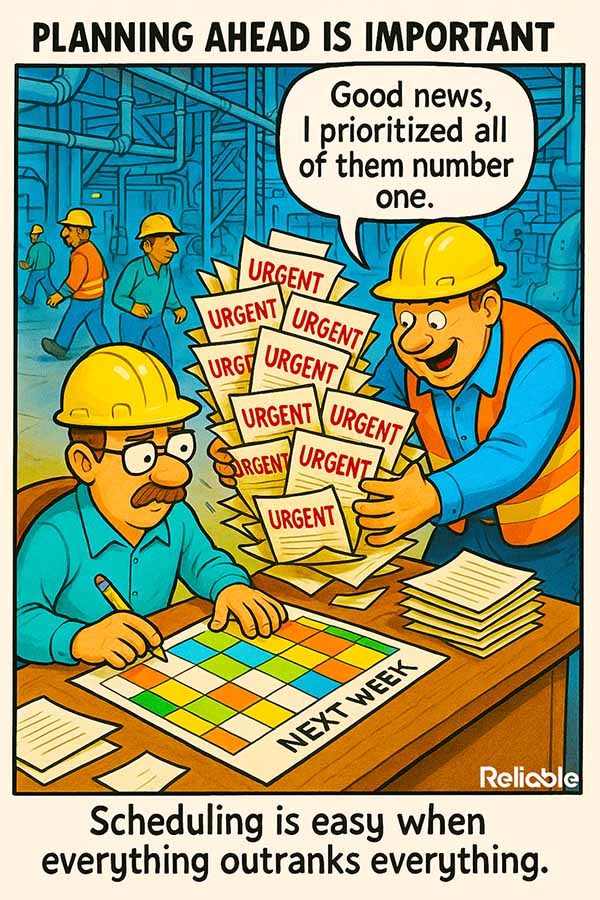

There is a special kind of chaos that arrives when every job claims to be urgent. The planner faces a queue where each request insists it is the top priority, the schedule becomes a coin toss, and the loudest voice in the hallway wins the day. Maintenance criticality analysis helps replace gut feel with an agreed view of asset consequence or risk, but it should be one input to work-order priority rather than the only one.
Criticality analysis starts with a practical question: what happens to safety, the environment, production, quality, or cost if this asset or required function is lost? Once those consequences are defined consistently, the plant has a defensible way to distinguish assets whose failure matters greatly from those that can be restored with less urgency.
How to Perform Maintenance Criticality Analysis Step by Step
The method is disciplined rather than complicated. Define the asset or function being assessed, agree on consequence categories and scoring scales, and apply them consistently. Some organizations rank criticality primarily by consequence; others combine consequence with likelihood, exposure, or detectability to produce a broader risk score. The important point is to define the method before scoring and use it consistently.
Consequence is where the real thinking happens, and common dimensions include safety, environmental impact, production or quality loss, and repair or business cost. A structured method like How to Perform FMEA can sharpen the failure-mode side of the picture. A simple one-to-five scale can work, but each score needs explicit definitions and the weighting or aggregation rules should be agreed before the workshop starts.
Criticality starts with consequence. A low-cost valve on a bottleneck or safety function can outrank a far more expensive asset whose loss has little operational effect.
If the site uses a risk-based method, likelihood or exposure adds another dimension. Do not assume that multiplying two numbers is always the right model: risk matrices, weighted scores, maximum-consequence rules, and other methods can all be valid when their assumptions are clear. High-consequence safety or environmental risks may also remain top-tier even when estimated likelihood is low, depending on the organization’s risk criteria.
Reliability-centered maintenance starts with functions and performance standards, then examines functional failures, failure modes, effects, and consequences. How to Perform RCM can therefore use criticality to help scope where analysis effort is most valuable, but an asset criticality score is not a substitute for the RCM process itself.
Keep the scoring system simple enough that people can apply it consistently, but do not let speed replace validation. A quick pilot can expose problems in the scale or weighting; high-consequence decisions should be reviewed by the functions that own the relevant safety, environmental, operational, and engineering risks.
Turning the Ranking Into Real Priorities
A ranking on a spreadsheet changes little until it reaches the work process. Criticality can influence resource allocation, but work-order priority should also consider the current failure state, safety or regulatory urgency, operating consequence, due date, opportunity window, and whether the asset is already degraded or unavailable.
- Scheduling: use asset criticality as one input to the priority rules rather than automatically scheduling every job on a high-criticality asset ahead of all other work.
- Stocking: give high-criticality assets stronger spare-parts analysis, while also considering lead time, failure rate, repairability, alternate sources, shelf life, and inventory cost before deciding what must be held on site.
- Attention: concentrate condition monitoring and inspection where the consequence and likelihood of missed degradation justify the effort and where the task can meaningfully change the outcome.
That is where criticality supports better allocation. Point maintenance planning and inspection effort toward assets and failure modes where the risk justifies it rather than spreading effort evenly across everything. The goal is a better use of limited resources, not a guaranteed reliability gain. Common failure modes in the analysis include:
- Scoring nearly everything high, which can mean the criteria are too broad or the scale is not discriminating enough.
- Rating assets mainly by purchase price or physical size instead of the consequence of losing the required function.
- Building the list once and never revisiting it as bottlenecks, production requirements, safeguards, operating context, or asset configuration change.
If a large share of the plant lands in the top tier, review the scoring definitions before forcing the distribution downward. The result may reflect a weak scale, but some facilities genuinely carry a large concentration of high-consequence assets. The ranking should reflect the risk, not a preferred bell curve.
Agree on the scoring scale before anyone starts so the numbers carry the same meaning across departments. Record the assumptions behind unusual scores, and involve operations, maintenance, engineering, and safety or environmental specialists where their consequences are part of the model.
Making Criticality Analysis Stick
The hardest part of criticality analysis is rarely the first pass through the asset list. It is keeping the ranking alive after the initial enthusiasm fades and the next dramatic emergency starts demanding everyone’s attention.
A ranking earns its keep when people use it consistently and understand what it does and does not mean. When a supervisor points to criticality together with job urgency and current condition to explain why one job moved ahead of another, priority becomes more defensible.
Expensive software is not required for a first pass. A shared spreadsheet and an agreed scale can support a pilot on a limited system or asset group. Validate the method, correct the definitions, then expand it rather than attempting to score an entire plant in one rushed session.
The moment everything is urgent, nothing is. Criticality helps separate long-term asset importance from immediate work urgency so scarce resources can be directed by consequence and risk instead of volume alone.
The practical path is to score assets using a defined method, use that result in the work, spares, and inspection rules, and then review it on a planned cadence plus event triggers such as a moved bottleneck, changed operating duty, modified safeguard, or new production line.
Done well, criticality analysis gives the planner and reliability team a defensible input instead of another loud opinion. It does not make every priority decision automatically, but it makes the underlying consequence and risk visible enough to support better ones.