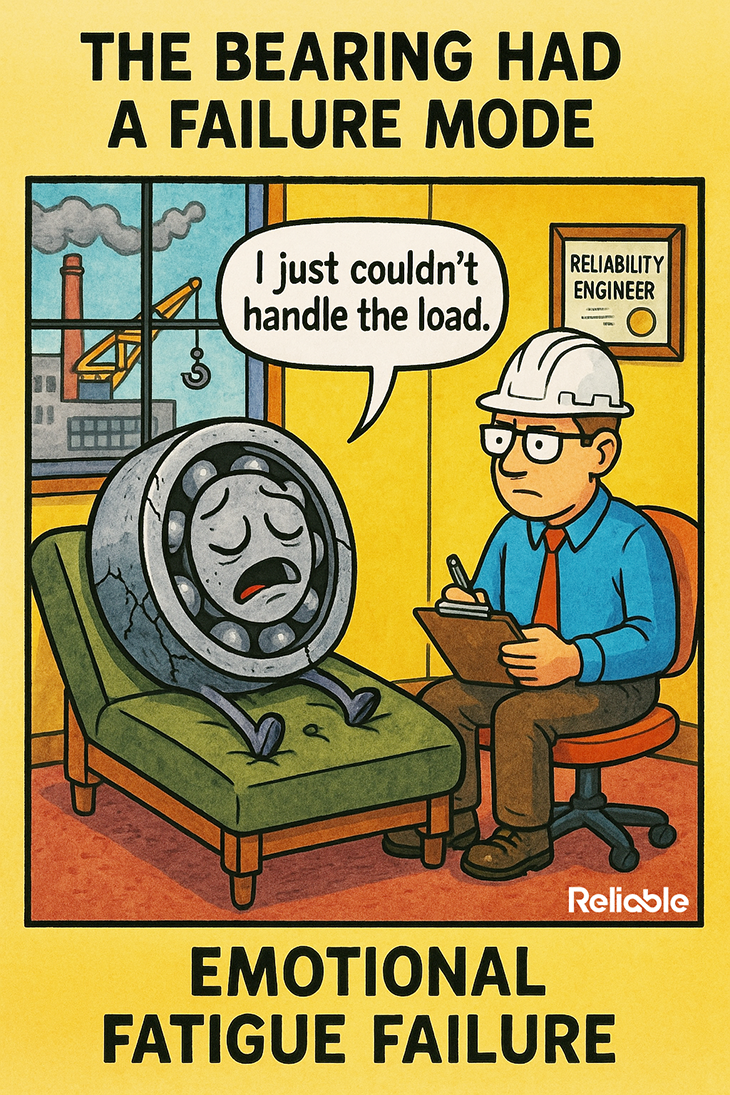

Rolling-bearing fatigue develops over repeated rolling contacts, but it does not always begin the same way or end in seizure. ISO 15243 distinguishes subsurface-initiated and surface-initiated rolling contact fatigue. In either case, cracks can develop and propagate until material breaks away as spalling. The damage seen when a bearing is removed may be the late-stage result of operating conditions that acted over many load cycles.
What Causes Bearing Fatigue Failure at the Metal Level
Rolling contact fatigue is one recognized bearing failure mode. Repeated contact loading creates cyclic stresses in and near the raceway. In subsurface-initiated fatigue, microcracks form below the surface and propagate to spalling; surface-initiated fatigue can begin at the raceway when lubrication or cleanliness is poor. Bearing rating life is statistical, not a predicted retirement date for one bearing: ISO 281 basic rating life is associated with 90% reliability under defined assumptions.
Operating conditions can shorten fatigue life or cause other damage modes before nominal fatigue life is reached. Inadequate lubrication, contamination, excessive or unexpected load, misalignment or tilt, incorrect internal clearance, and poor mounting can change stress distribution or damage raceways. Modern rating-life methods explicitly account for several of these influences, but service failures still require diagnosis rather than comparison with a catalog life alone.
When a bearing fails prematurely, do not assume it simply wore out. Operating, lubrication, sealing, mounting, alignment, and load conditions are common contributors and should be checked before the replacement goes in.
The Factors That Bring Fatigue Forward
Load matters strongly. In ISO 281 basic rating-life calculations, bearing life varies with an inverse power of equivalent dynamic load, so a relatively small increase in load can materially reduce calculated life. The exact effect depends on bearing type and the load case. Overload can also cause plastic deformation or other damage, so not every overloaded bearing fails by classic rolling contact fatigue.
Lubrication affects whether rolling surfaces remain separated by an adequate film. When film thickness is insufficient, asperity interaction and sliding can promote surface distress and surface-initiated fatigue. Wrong viscosity, inadequate lubricant supply, contamination, water ingress, or degraded lubricant can change film formation or introduce wear or corrosion mechanisms. These conditions can reduce bearing life, but they should not all be labeled fatigue without examining the damage.
Hard particles can be overrolled into raceways and create indentations with local stress concentrations. Misalignment or shaft and housing distortion can produce uneven or edge loading, depending on bearing design and internal geometry. Either condition can accelerate fatigue or contribute to other damage modes. The location and pattern of damage matter when separating cause from effect.
Mounting errors can create damage before normal operation begins. Applying mounting force through the rolling elements when fitting a tight ring can indent raceways, and forcing a bearing into a misaligned seat can create abnormal loading. Correct tools, fits, cleanliness, alignment, and mounting procedures are therefore part of bearing-life control, not just installation workmanship.
Overload, poor lubrication, contamination, misalignment, and mounting damage are better treated as operating conditions or causes that can lead to several bearing damage modes. The failed surface tells you what happened; the operating history helps tell you why.
Catching Bearing Fatigue Failure Early
Localized bearing defects often produce repetitive impacts that vibration analysis can detect, especially with techniques such as high-frequency or enveloped acceleration. Characteristic bearing defect frequencies are useful diagnostic guides, but slip, speed variation, load, sensor location, and other faults can shift or mask the signature. A rising defect-related trend is a reason to investigate and plan, not a precise countdown clock.
After removal, bearing failure analysis should classify visible damage and compare it with operating evidence. Spalling, discoloration, indentations, smearing, corrosion, fracture, and wear patterns can narrow the possibilities, but appearance alone does not always establish root cause. ISO 15243 specifically recognizes that additional investigation may be needed. Load history, lubrication condition, fits, alignment, temperature, sealing, and mounting evidence all belong in the diagnosis.
Vibration is only one useful signal. Wear-debris or oil analysis can add evidence where the bearing shares a circulating lubricant, while temperature, ultrasound, acoustic emission, and motor-current methods may provide additional clues in suitable applications. There is no universal order in which these indicators appear, and temperature is often nonspecific. The strongest diagnosis comes from trending appropriate signals and checking whether independent evidence supports the same fault hypothesis.
So the practical answer to what causes bearing fatigue failure is not to assume the bearing was simply defective or that it merely reached an expected age. Material or manufacturing defects are possible, but premature failure should also trigger a review of load, lubrication, contamination, sealing, fits, mounting, alignment, clearance, and operating conditions. Replace the part, then correct any contributing condition the evidence identifies.